Track progress, take quizzes and save notes on this lesson.

Free forever · no card needed

Start free
Intermediate

Party Systems and Party Success

Paper 1, 2.4 UK political parties in context

Aligned to the Pearson Edexcel 9PL0 specification

Level
Intermediate
Reading time
18 min
Published
9 September 2026
On this page
  1. 1.How Party Systems Are Classified
  2. 2.Is Westminster Still a Two-Party System?
  3. 3.Four Party Systems Inside One Country
  4. 4.What Multi-Party Politics Does to Government
  5. 5.Leadership as a Factor in Party Success
  6. 6.Unity, the Media and Governing Competence
  7. 7.Consensus and Adversary Politics
  8. 8.Exam Focus: Common Mistakes

Key takeaways

  • A party system is classified by how many parties have a realistic chance of entering government: one-party dominant, two-party, two-and-a-half party or multi-party.
  • Westminster looked two-party in seats and multi-party in votes in 2024: the two largest parties took about 82% of seats on just over 57% of the vote.
  • The UK contains several party systems at once — multi-party under AMS in Scotland, multi-party under the closed proportional list in Wales since May 2026, and power-sharing in Northern Ireland.
  • Issue 4 of the specification names leadership explicitly as a factor in party success, alongside the media, party unity and governing competence.
  • Andy Burnham became Prime Minister on 20 July 2026 without a general election, barely a month after entering the Commons — a live test of how far leadership alone can change a party's position.

How Party Systems Are Classified

A party system describes how the parties in a country are grouped and structured. The decisive test is not how many parties exist but how many have a realistic prospect of forming a government, or part of one.

SystemDefinitionExample
Dominant-partyCompetitive elections, but one party wins repeatedly over decadesThe Conservatives held office for 18 unbroken years from 1979 to 1997
Two-partyTwo parties alternate in office and between them take almost all votes and seatsThe UK from 1945 to 1970: the Conservatives and Labour took about 97% of the vote in 1951
Two-and-a-half partyTwo large parties plus a third that occasionally holds the balanceThe UK from 2010 to 2015, when 57 Liberal Democrat MPs made a coalition possible
Multi-partySeveral parties win significant representation and government usually requires more than oneThe Scottish Parliament and the Senedd since May 2026

Two cautions before you classify anything:

  • Votes and seats can give different answers. A country can be multi-party in support and two-party in outcome. Under first-past-the-post that is the normal result.
  • Classification depends on the arena. Westminster, Holyrood, the Senedd and Northern Ireland produce different answers at the same moment.

Do not describe a party system as though it were a permanent feature of a country. It is an outcome of the electoral system, the social structure and the choices voters make, and all three change.

Is Westminster Still a Two-Party System?

The 2024 general election gives evidence for both answers at once.
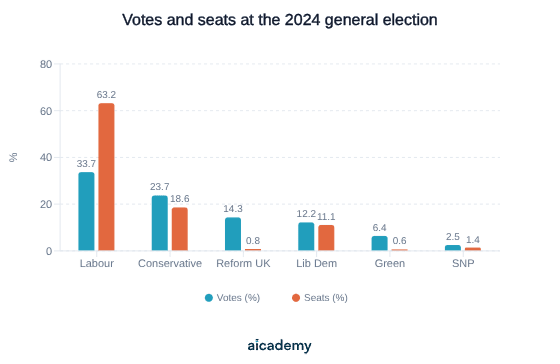
Grouped bar chart comparing vote share with seat share in 2024: Labour 33.7 per cent of votes against 63.2 per cent of seats, Reform UK 14.3 per cent of votes against 0.8 per cent of seats, and the Liberal Democrats 12.2 against 11.1.

The case that it remains two-party. The Conservatives and Labour took almost 82% of the seats, one of them formed a single-party government with a majority of 174, and the other became the Official Opposition. No third party came close to office. Professor Sir John Curtice described the 2024 outcome as the most disproportional in British electoral history — but disproportionality is the machinery by which two-party outcomes are manufactured.

The case that it has become multi-party. That 82% of seats rested on just over 57% of the votes, a record low combined share for the two parties. Five parties took more than 6% of the vote each. Reform UK finished second in 98 constituencies and the Greens in 40. In 2019 the same two parties had taken 75% of the vote and 87% of the seats, so the shift in five years is substantial.

Worked example — the price of a seat in 2024. Turnout was 59.7% of an electorate of 48,224,212, so roughly 28.8 million votes were cast. Dividing each party's votes by its seats shows what first-past-the-post actually charged:

PartyApproximate votesSeatsApproximate votes per seat
Labour9.70 million41123,600
Liberal Democrat3.51 million7248,800
Conservative6.82 million12156,400
SNP0.72 million980,000
Green1.84 million4460,000
Reform UK4.12 million5824,000

A Reform UK seat cost roughly 35 times as many votes as a Labour one. The two parties with dispersed support paid the most; the party with the most concentrated support, the Liberal Democrats, paid less than the Conservatives did.

The most defensible judgement, as of September 2026, is that the UK has a multi-party electorate inside a two-party parliament, and that the electoral system is the reason the two do not match.

Four Party Systems Inside One Country

Devolution created legislatures with different electoral systems, and different systems produce different party systems. The May 2026 elections make the contrast unusually clear.

LegislatureElectoral systemResult, May 2026System type
Senedd CymruClosed proportional list (D'Hondt), 96 members from 16 six-member constituencies, new for 2026Plaid Cymru 43 (35.4%), Reform UK 34 (29.3%), Labour 9 (11.1%), Conservative 7 (10.7%), Green 2 (6.7%), Liberal Democrat 1 (4.5%)Multi-party
Scottish ParliamentAdditional Member SystemSNP 57, Labour 17, Reform UK 17, Green 15, Conservative 12, Liberal Democrat 10Multi-party
Northern Ireland AssemblySingle Transferable Vote, with mandatory power-sharingMichelle O'Neill (Sinn Féin) First Minister and Emma Little-Pengelly (DUP) deputy First Minister since 3 February 2024Multi-party, power-sharing
House of CommonsFirst-past-the-postLabour 411, Conservative 121, Liberal Democrat 72, SNP 9, Reform UK 5, Green 4Two-party in outcome

Two developments deserve special attention.

  • Wales changed its electoral system, and its party system changed with it. The Senedd expanded from 60 members to 96 and replaced the Additional Member System with a closed proportional list, on a single ballot cast for a party. Turnout reached 51.6%, the highest at any Senedd election and the first above 50%, and Labour left government in Wales for the first time since 1999.
  • Scotland's multi-party pattern deepened. The SNP fell from 64 seats in 2021 to 57 in May 2026, Labour from 22 to 17, and Reform UK entered with 17.

When a question asks about "the UK party system", say which arena you mean in your first sentence. Answers that treat Westminster as the whole of the UK cannot use the strongest available evidence.

What Multi-Party Politics Does to Government

If more parties win seats, single-party majority government becomes harder. The consequences run in both directions.

The problems.

  • Coalitions require compromise that voters did not vote for. The 2010–15 Conservative–Liberal Democrat coalition produced a programme neither party had put to the electorate, and the Liberal Democrats fell from 57 seats to 8 in 2015, with their reversal on tuition fees among the most-cited reasons.
  • Minority governments are weak. The 2017–19 parliament produced a Conservative minority government relying on a confidence-and-supply agreement with the DUP, and it repeatedly failed to pass its central legislation.
  • Coalitions can break. Devolved government in Northern Ireland broke down in 2022 and was not restored until February 2024; the 2021–24 co-operation agreement between Labour and Plaid Cymru in Wales collapsed before its term ended.
  • Accountability blurs. If two parties share office, voters cannot straightforwardly remove the one responsible for a policy.

The defences.

  • Coalitions are normal in most of Europe and are not obviously less stable than single-party government; the 2010–15 coalition ran a full five-year term.
  • Compromise can improve legislation by forcing the government to command a genuine majority rather than a manufactured one.
  • Broader representation. A government formed by parties with 55% of the vote has a stronger claim than one formed by a party with 33.7%.

The counter-argument from the electoral system. The June 2026 Financial Times case study set out the sceptical case: first-past-the-post is not built to sustain multi-party politics and will squeeze it out again. The system rewards the least unpopular party, punishes wasted votes and pushes parties to build broad internal coalitions before the contest rather than governing coalitions after it. On that reading the current fragmentation is a phase, not a settlement — and since every governing party has won under the existing rules, none has much incentive to change them.

Want more lessons like this one?

Generate lessons on anything you study. Free account, no card needed.

Start generating

Leadership as a Factor in Party Success

Issue 4 of the specification names leadership explicitly among the factors that explain why parties succeed or fail. Three mechanisms are worth separating.

  • Leaders shape the campaign. They front the broadcasts, take the debates and carry the blame for errors.
  • Leaders hold the party together, or fail to. A divided party looks unfit to govern regardless of its policies.
  • Leaders carry a valence judgement. Voters use them as a shortcut for whether a party is competent and trustworthy.

Case study: the change of Prime Minister, June–July 2026. This is the strongest recent example available, because it isolates leadership from every other variable — no general election intervened.

  1. The trigger was electoral. At the May 2026 local elections Labour lost around 35 councils and nearly 1,500 councillors, on a projected national vote share of about 17%. Around 103 Labour MPs called for Sir Keir Starmer to go and several Cabinet ministers resigned.
  2. The resignation. Starmer announced he would stand down on 22 June 2026.
  3. The route into Parliament, secured in advance. Andy Burnham, then Mayor of Greater Manchester and not an MP, had already entered the Commons at the Makerfield by-election on 18 June 2026 — four days before Starmer's announcement — after the sitting MP stood down to create the vacancy. It was the first by-election deliberately engineered to bring a party leader into the Commons since Leyton in 1965.
  4. The succession. Burnham was elected leader unopposed on 17 July 2026 with 379 MP nominations, over 94% of the parliamentary party, and became Prime Minister on 20 July 2026.
  5. The result so far. Polling in early September 2026 put Labour roughly level with Reform UK: YouGov on 6–7 September had Labour 23%, Reform UK 23%, Conservative 20%, Green 12% and Liberal Democrat 11–12%, while Opinium on 2 September had Labour 28% and Reform 24%. That is a recovery on 17%, but not a transformation.

The case cuts both ways, which is what makes it useful. A party changed its leader and improved its position without changing its programme, which supports the leadership thesis. Yet it remained level with a party that has five MPs, which suggests leadership can arrest a decline more easily than it can reverse one.

Three shorter leadership examples.

ExampleWhat it shows
Nigel Farage returns to lead Reform UK, 3 June 2024Reform's poll rating rose from about 11% to 15% within weeks; a leader can be a party's principal electoral asset
Rishi Sunak's 2024 campaignCalling the election in the rain without an umbrella, and leaving the D-Day 80th anniversary commemoration early, damaged a party already behind; leadership errors compound existing weakness
The SNP's three leaders in fourteen monthsThe party lost all but nine of its 48 Westminster seats in 2024; instability at the top reads to voters as a party that cannot govern

Unity, the Media and Governing Competence

Leadership is one factor among several, and a strong answer weighs them against each other.

1. Party unity

The 2019–24 parliament had three Prime Ministers and five Chancellors. Liz Truss lasted 49 days as Prime Minister, resigning after a tax-cutting mini-budget triggered a crisis on the financial markets. Boris Johnson resigned in July 2022 after the partygate scandal. Visible division is among the most reliable predictors of defeat, because it damages the party's claim to competence directly.

2. Governing competence and valence

Sunak made five pledges early in his premiership — halve inflation, grow the economy, reduce debt, cut NHS waiting lists and stop small-boat crossings. By the summer of 2024 only the first had been delivered. Inflation had fallen to 2.3% by the spring of 2024, close to the Bank of England's target, and the government gained little credit for it. Voters were judging a record, not a manifesto.

3. The media

The media's influence is contested, and the evidence is genuinely mixed.

  • The case for influence. The Sun backed Labour on the eve of polling day in 2024 after supporting the Conservatives since 2010, repeating a pattern from 1997 and 2010. Digital advertising is now central: Labour reported spending £2.9 million on it during the 2024 campaign against the Conservatives' £1.7 million, and social media allows targeting by age, gender and locality.
  • The case against. Newspaper circulation has fallen by an estimated three-quarters since 1997. Televised debates have lost audience: 9.4 million watched the first in 2010, 6.7 million in 2019 and 4.8 million the first ITV debate of 2024. The Sun has a record of endorsing the party already heading for victory, which suggests it reflects opinion more than it forms it.

4. The context a party cannot control

Some causes sit outside any leader's reach. The Covid-19 spending package and the war in Ukraine from February 2022 pushed up debt and inflation, and the resulting cost-of-living pressure was widely read as a "feel bad" factor comparable to 1979, 1997 and 2010. Prices were still visibly higher than four years earlier, and no amount of campaigning changed that.

Ranking the factors is what earns AO3. A defensible line: unity and competence set the ceiling on a party's support, leadership determines whether it reaches that ceiling, and the media mostly amplifies what voters have already concluded.

Consensus and Adversary Politics

The two terms describe how far apart the main parties stand.

Consensus politics means broad agreement on the fundamentals, with competition over competence and detail. The post-war years are the standard example: both parties accepted the mixed economy, the NHS, the welfare state and full employment. Commentators of the time captured it by merging the names of the Conservative Chancellor R. A. Butler and his Labour opposite number Hugh Gaitskell into "Butskellism".

Adversary politics means the parties define themselves against each other and offer sharply opposed programmes. The clearest period runs from 1979: Thatcher's governments broke with the post-war settlement, and Labour under Michael Foot responded with a far-left programme in 1983.

The pattern since is a swing back towards consensus, then away from it:

PeriodPatternEvidence
1945–79ConsensusMixed economy, NHS and full employment accepted by both parties
1979–92AdversaryPrivatisation and union reform against nationalisation and unilateral disarmament
1997–2010New consensus on Thatcherite groundNew Labour left most privatisations intact and made the Bank of England independent
2015–19AdversaryCorbyn's renationalisation programme against a Conservative party fighting over Brexit
2024Narrower gap between the two largest partiesPearson's own analysis records the Conservative and Labour manifestos as less sharply contrasting than in 2019; both ruled out rises in the main taxes and both backed the triple lock, more police and support for Ukraine

The complication in 2026. Consensus between the two largest parties can coincide with a widening gap across the system as a whole. Reform UK's programme — leaving the European Convention on Human Rights, scrapping net zero, freezing non-essential immigration — is a long way from the Green Party's wealth tax and nuclear disarmament. The centre may have converged while the range has widened, and saying so precisely is a strong evaluative move.

Exam Focus: Common Mistakes

1. Giving a one-word answer to the party system question

"The UK has a two-party system" cannot survive Reform UK on 14.3% of the vote, or a Senedd in which Labour holds 9 of 96 seats. Distinguish votes from seats, and Westminster from the devolved legislatures, in your opening paragraph.

2. Forgetting that Wales changed its electoral system

The May 2026 Senedd election was the first under a closed proportional list system for 96 members, replacing the Additional Member System. Writing about Welsh elections as though AMS were still in use is a factual error on the most recent evidence available.

3. Treating leadership as a decorative extra

Issue 4 names it explicitly. A question on party success that mentions leadership in one sentence has under-weighted the factor the specification chose to add.

4. Attributing every outcome to the leader

Leadership interacts with the economy, unity, competence and the electoral system. The 2026 change of Prime Minister lifted Labour from roughly 17% at the May 2026 local elections to the low-to-high twenties by September 2026 — real movement, but the party stayed level with Reform UK. Say what leadership did and what it did not do.

5. Overstating media influence

Circulation is down about three-quarters since 1997 and debate audiences have roughly halved since 2010. The evidence supports a claim of reinforcement more comfortably than a claim of persuasion, so hedge accordingly.

6. Confusing consensus with agreement on everything

Consensus is agreement on fundamentals, not identical manifestos. The 2024 Conservative and Labour offers converged on tax, pensions and Ukraine while differing on Great British Energy, rail ownership and a £12 billion benefits cut.

7. Using undated polling

Polls move. Attribute and date every one: YouGov on 6–7 September 2026 had Labour and Reform UK level on 23%. A sentence such as "Reform leads the polls" is unmarkable, because it is not a claim about anything in particular.

Key terms

Party system
How a country's parties are organised in relation to one another, judged mainly by how many of them have a realistic prospect of forming a government or part of one.
Two-and-a-half party system
A system with two large parties competing for power and one smaller party that sometimes holds the balance and can be brought into government.
Dominant-party system
A system with genuine competition and free elections in which one party nevertheless wins repeatedly over a long period.
Adversary politics
A pattern of competition in which the main parties define themselves against each other and offer sharply opposed programmes.
Consensus politics
A pattern in which the main parties broadly agree on the fundamentals of policy and compete over competence and detail rather than direction.
Valence
Judgements about how competently a party would govern, as opposed to whether voters agree with its policies.
Confidence and supply
An arrangement in which a smaller party supports a minority government on confidence votes and budgets without joining it or accepting collective responsibility.

Frequently asked questions

It depends on whether you count votes or seats. In 2024 the Conservatives and Labour took about 82% of Commons seats on just over 57% of the vote, so Westminster remains two-party in outcome while being multi-party in support. Scotland, Wales and Northern Ireland are multi-party.

Issue 4 of the specification names it explicitly. Leadership shapes campaigns, unity and public trust, and Nigel Farage's return on 3 June 2024 lifted Reform UK from about 11% to 15%. But it works alongside the economy, competence and the electoral system rather than replacing them.

Consensus politics means the main parties broadly agree on the fundamentals, as in the post-war years. Adversary politics means they offer sharply opposed programmes, as between 1979 and 1997. Pearson's own analysis records the 2024 manifestos as less sharply contrasting than those of 2019.

Generate revision on any topic you study

Type any topic you're studying and Aicademy generates a complete lesson, quiz, and flashcard set, personalised to your level.

Lessons on anything

Structured, level-matched lessons on any topic you study

Practice quizzes

Find out what you actually know before the exam does

Flashcard sets

Lock in key concepts with instant revision cards

Ask Aica

Stuck on something? Get a clear explanation, any time

Prev

Emerging and Minor Parties

Next

Electoral Systems: FPTP, AMS, STV and CPLS

Related lessons

14 min

Lesson

Emerging and Minor Parties

A-Level Politics · Pearson Edexcel 9PL0

2 hours ago

17 min

Lesson

The Established Parties

A-Level Politics · Pearson Edexcel 9PL0

2 hours ago

14 min

Lesson

The Democratic and Republican Parties

A-Level Politics · Pearson Edexcel 9PL0

2 hours ago

16 min

Lesson

Three Key General Elections

A-Level Politics · Pearson Edexcel 9PL0

2 hours ago

Top students don’t revise more. They revise what counts.

Start revising free

Free to start. No card needed.