Track progress, take quizzes and save notes on this lesson.

Free forever · no card needed

Start free
Advanced

The Established Parties

Paper 1, 2.2 Established political parties

Aligned to the Pearson Edexcel 9PL0 specification

Level
Advanced
Reading time
17 min
Published
9 September 2026
On this page
  1. 1.Where the Three Parties Came From
  2. 2.Conservative Ideas: One Nation and the New Right
  3. 3.Conservative Policy Across the Four Assessed Areas
  4. 4.Labour Ideas: Old Labour, New Labour and What Came After
  5. 5.Labour Policy Across the Four Assessed Areas
  6. 6.Liberal Democrat Ideas: Classical Liberals, Modern Liberals and the Orange Book
  7. 7.Liberal Democrat Policy and the Party's Position in 2026
  8. 8.Exam Focus: Common Mistakes

Key takeaways

  • The Conservative Party dates from Peel's Tamworth Manifesto of 1834; Labour began as the Labour Representation Committee in 1900; the Liberal Democrats were formed by the 1988 merger of the Liberal Party and the SDP.
  • One nation conservatism is paternalistic and accepts state action to bind society together; the New Right combines neo-liberal free-market economics with neo-conservative authority on morality and law and order.
  • Old Labour meant public ownership under Clause IV, redistribution and a close union link; New Labour rewrote Clause IV in 1995 and accepted the market while using its proceeds for public services.
  • Liberal Democrat thinking runs between classical liberalism, which wants a minimal state, and modern liberalism, which holds that freedom requires the state to remove obstacles such as poverty and ill health.
  • The 2024 manifestos placed the three parties closer together than in 2019: all three backed Ukraine, a two-state solution and the pension triple lock.

Where the Three Parties Came From

Each of the three established parties carries its origins into its present arguments. The Conservative Party grew out of Parliament; Labour grew out of the trade unions; the Liberal Democrats grew out of a split and a merger.
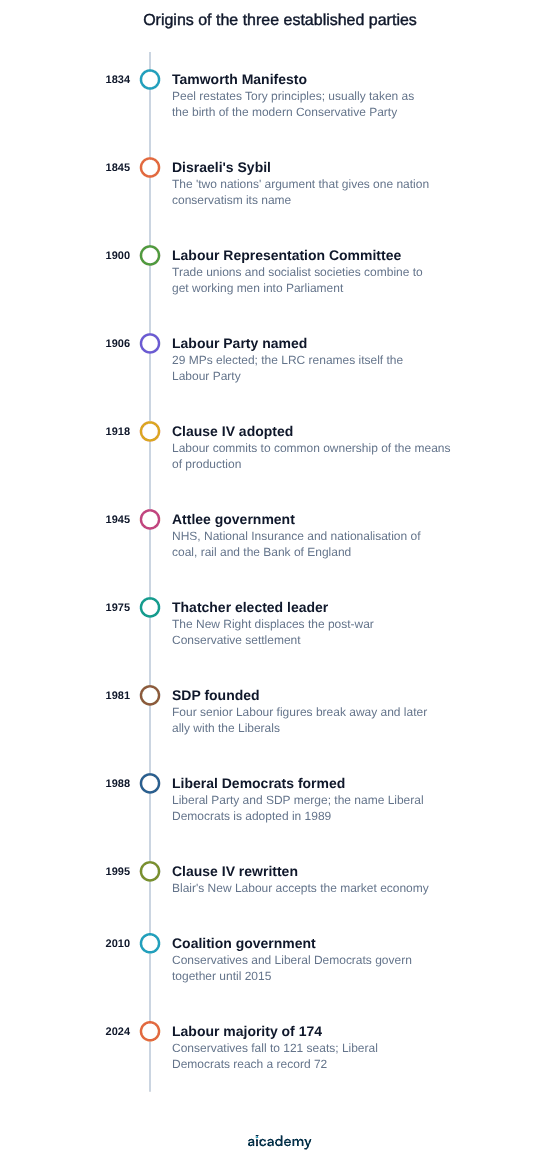
Timeline from 1834 to 2024 marking the Tamworth Manifesto, Disraeli's Sybil, the founding of the Labour Representation Committee in 1900, Clause IV in 1918, the Attlee government, the Thatcher and Blair leaderships, the 1988 Liberal Democrat merger, the 2010 coalition and the 2024 general election.

Three points to carry forward:

  • The Conservatives are the oldest of the three and have historically prized adaptability over doctrine — which is why the party has held both one nation and New Right positions within living memory.
  • Labour was created to represent an interest — organised labour — before it had a worked-out ideology, which is why the union link has been so persistently contested.
  • The Liberal Democrats are the youngest and the only one formed by merger, which left two intellectual traditions inside one party.

Conservative Ideas: One Nation and the New Right

Conservatism in the UK has been shaped by two strands that pull in different directions.

One nation conservatism comes from Benjamin Disraeli, whose 1845 novel Sybil described Britain as two nations, the rich and the poor, "between whom there is no intercourse and no sympathy". His conclusion was practical rather than sentimental: if the gap is allowed to widen, the nation itself is at risk, so the wealthy have an obligation to improve conditions for the poor. Disraeli's governments passed public health and housing legislation in the 1870s. The tradition ran through the post-war Conservative acceptance of the NHS and full employment, and Pearson's own terminology identifies David Cameron and Theresa May as later exponents.

The New Right displaced it after Margaret Thatcher won the leadership in 1975. It has two components, and losing the distinction between them costs marks:

Neo-liberal strandNeo-conservative strand
Core claimFree markets allocate resources better than the stateSocial order depends on authority, discipline and shared morality
On the economyPrivatise, deregulate, cut direct taxationBroadly follows the neo-liberals
On the stateRoll it backStrengthen it where order is concerned
Policy examplesRight to Buy under the Housing Act 1980; privatisation of British Telecom in 1984 and British Gas in 1986Tougher sentencing; restrictions on trade unions; a stress on the traditional family

The two strands are not obviously compatible — one wants less government, the other wants more of it in a different area — and that tension is a ready-made evaluative point in any essay on Conservative ideology.

A one nation Conservative and a New Right Conservative can support the same tax cut for different reasons: the first because it aids growth that funds public services, the second because taxation itself is an intrusion. Look at the justification, not just the policy.

Where the party stands. Kemi Badenoch has led the Conservative Party since 2 November 2024 and was Leader of the Opposition as of September 2026, after the party fell to 121 seats and 23.7% of the vote in 2024 — its worst general election result in seat terms.

Conservative Policy Across the Four Assessed Areas

The specification names four policy areas. The 2024 general election manifesto is the party's most recent full programme put to voters, so it is the safest evidence base; date every claim you make from it.

AreaConservative position at the 2024 general election
The economyNo increase in income tax, VAT or corporation tax; the main National Insurance rate scrapped for the self-employed; planning laws simplified to speed up infrastructure and housebuilding
Law and order8,000 more police officers; longer sentences for serious crimes; four new prisons
WelfareThe benefits bill cut by £12 billion; the state pension triple lock protected; a lifetime cap on the cost of social care
Foreign affairsDefence spending raised to 2.5% of GDP by 2030; support for Ukraine against the Russian invasion; recognition of Israel's right to self-defence alongside a push for a two-state solution

Reading the ideology out of the policy. The tax pledges and the deregulation of planning are neo-liberal; the sentencing and prisons package is neo-conservative; the triple lock and the social care cap are one nation, protecting a group the market would leave exposed. A single manifesto contains all three strands, which is why "the Conservatives are a Thatcherite party" is too blunt a claim to defend at A-Level.

The four-year record before 2024 pulls the same way. The Johnson government's "levelling up" agenda and its large Covid-19 spending package were interventionist in a way Thatcher would have rejected; Liz Truss's tax-cutting mini-budget of September 2022, which triggered a crisis on the financial markets and left her the shortest-serving Prime Minister in UK history at 49 days, was neo-liberalism applied without restraint.

Labour Ideas: Old Labour, New Labour and What Came After

Old Labour is the party's traditional programme: public ownership, a tax and benefit system that redistributes towards the less well off, welfare and public services that expand year on year, and a close alliance with the trade unions. Its constitutional expression was Clause IV of the 1918 party constitution, committing Labour to common ownership of the means of production, distribution and exchange. The Attlee government of 1945–51 delivered the fullest version of it: the National Health Service in 1948, National Insurance, and public ownership of the Bank of England, coal and the railways.

New Labour, or the Third Way, was a deliberate revision of that inheritance. Drawing on the sociologist Anthony Giddens, it broadened the party's appeal well beyond its industrial working-class base and loosened the alliance with the unions.

Case study: the rewriting of Clause IV, 1995. Tony Blair became Labour leader in July 1994 and immediately targeted the party's most symbolic text. A special conference in April 1995 replaced the commitment to common ownership with a statement of values that accepted market enterprise and competition alongside high-quality public services. Three things followed.

  1. Signal. The change was aimed at voters and the press, not at policy detail. Its purpose was to demonstrate that Labour had stopped being the party of nationalisation.
  2. Substance. In office from 1997, Labour left the great majority of the privatised industries in private hands, gave the Bank of England operational independence over interest rates in 1997, and introduced the National Minimum Wage in 1998, which took effect in 1999.
  3. Cost. Nothing about the shift satisfied the party's left, and the argument returned when Jeremy Corbyn won the leadership in 2015 on an explicitly Old Labour programme of renationalisation and higher taxation.

Sir Keir Starmer, leader from April 2020, moved the party back towards the centre, dropped much of the 2019 programme and emphasised economic stability. The 2024 manifesto shows the compromise: some public ownership, but far less than in 2019, which had also promised to renationalise Royal Mail and the energy companies.

Where the party stands. Andy Burnham was elected Labour leader unopposed on 17 July 2026 and became Prime Minister on 20 July 2026. Because he took office without a general election, the party has not yet put a manifesto of his own to voters — so when writing about "current Labour policy" in September 2026, the 2024 manifesto and the government's record remain the evidence, and you should say so explicitly.

Worth saving these ideas?

Turn what you've read into instant revision cards. Free to get started.

Make flashcards

Labour Policy Across the Four Assessed Areas

AreaLabour position at the 2024 general election
The economyNo increase in income tax, VAT or National Insurance; a state-owned generator, Great British Energy; gradual renationalisation of the railways; planning reform for housing and infrastructure
Law and order13,000 more police and community support officers; new prisons to tackle overcrowding; Respect Orders to ban antisocial individuals from town centres; a knife-crime package built around youth hubs
WelfareAge bands removed from the national minimum wage; the pension triple lock protected; 3,000 new nurseries and breakfast clubs in primary schools; a ban on exploitative zero-hours contracts and stronger employment rights
Foreign affairsAn aim to raise defence spending to 2.5% of GDP; better trade relations with the EU while remaining outside the single market and the customs union; support for Ukraine; a push for an Israel–Hamas ceasefire and a two-state solution

Two observations that convert this table into analysis:

  • The tax pledges are the New Labour inheritance. Ruling out rises in the three largest taxes is a commitment Blair and Gordon Brown would recognise. Labour limited its planned rises to a small number of measures, such as adding VAT to private school fees.
  • The employment and ownership pledges lean the other way. Great British Energy, rail renationalisation and a substantial extension of employment rights sit closer to Old Labour than anything the party offered between 1997 and 2010, even though they fall well short of the 2019 programme.

That combination is the answer to the standard exam question "how far has Labour abandoned its socialist roots?" The honest response is: on ownership, partially and selectively; on taxation, almost entirely; on workers' rights, considerably less than is often claimed.

Liberal Democrat Ideas: Classical Liberals, Modern Liberals and the Orange Book

The Liberal Democrats hold two liberal traditions inside one party, and the specification names both.

Classical liberalism developed among early liberals who held that individual freedom is best achieved when the state's role is kept small. Freedom, on this view, means being left alone: the absence of interference. Modern liberalism arose in opposition to unrestrained free-market capitalism, on the argument that this had left many individuals unfree in any meaningful sense. Being left alone is little use to someone who is destitute, ill or uneducated, so the state must remove those obstacles.

The modern liberal tradition has an unusually strong claim on the British welfare state:

  • The Liberal government elected in 1906 introduced old age pensions in 1908 and the National Insurance Act in 1911.
  • William Beveridge, whose 1942 report identified want, disease, ignorance, squalor and idleness as the five giants to be defeated, was a Liberal.
  • John Maynard Keynes, whose case for government management of demand shaped post-war economic policy, was also a Liberal.

Case study: the coalition, tuition fees and the price of governing. The tension between the two traditions became a public crisis between 2010 and 2015.

  1. The Orange Book, 2004. The Orange Book: Reclaiming Liberalism, edited by David Laws and Paul Marshall, argued that the party had drifted too far from its classical roots and should be readier to use market mechanisms in public services. Contributors included Nick Clegg and Vince Cable. Social liberals inside the party read it as a move to the right.
  2. Government, 2010. After the general election produced a hung parliament, Clegg took the party into coalition with the Conservatives. Liberal Democrats secured a rise in the income tax personal allowance and the pupil premium — both defensible in either tradition.
  3. Tuition fees. Every Liberal Democrat MP had signed a pledge to oppose any rise in tuition fees. In government the party supported raising the cap to £9,000 from 2012. The reversal was read as a straightforward broken promise and dominated coverage of the party for years.
  4. The bill. In 2015 the party fell from 57 seats to 8 and Clegg resigned. It took until 2024 to recover.

The coalition is the sharpest available example of a party's factions colliding with the demands of office. Use it, but be precise about the mechanism: the damage came from a specific broken pledge, not from coalition as such.

Liberal Democrat Policy and the Party's Position in 2026

AreaLiberal Democrat position at the 2024 general election
The economyInvestment in green infrastructure and housebuilding; tax cuts for banks reversed and capital gains tax reformed, funding the NHS and social care — around £27 billion, the largest tax-raising plan of the three main parties
Law and orderBetter community policing and supervision of offenders in the community; more resources to prosecute hate crimes
WelfareThe state pension triple lock protected; the two-child limit on child benefit removed; free personal care at home for adults and more support for carers
Foreign affairsDefence cuts reversed; closer trade relations with the EU and eventually rejoining the single market; support for Ukraine; a push for an Israel–Hamas ceasefire and a two-state solution

The balance of that programme is modern liberal: it raises taxes to fund care, extends benefits and treats poor health and unpaid caring as barriers to freedom. The Orange Book strand is much less visible than it was in 2010.

Electoral position. Sir Ed Davey has led the party since 27 August 2020. In 2024 it won 72 seats on 12.2% of the vote — its best result ever, and the strongest performance by a party of this tradition since the Liberals won 158 seats in 1923. The party achieved this by concentrating resources on winnable seats in southern and rural England, so its seat share was unusually close to its vote share. That is worth remembering when you write about first-past-the-post: the system punished Reform UK in 2024 and rewarded the Liberal Democrats in the same election, and geography is the reason.

Exam Focus: Common Mistakes

1. Describing origins without connecting them to current policy

Section 2.2 asks how origins and development "shaped their ideas and current policies". A paragraph of history followed by a list of policies, with nothing linking them, answers half the question. Say why the union origin explains Labour's employment rights package, or why the merger explains the two Liberal Democrat traditions.

2. Missing a policy area

Four areas are named: the economy, law and order, welfare and foreign affairs. Foreign affairs is the one candidates most often omit, and it is the easiest to prepare because the three parties' 2024 positions on Ukraine, defence spending and a two-state solution are close enough to memorise together.

3. Collapsing the New Right into one thing

Neo-liberal and neo-conservative are distinct. Free markets and firmer state authority are pulling in opposite directions, and the ability to say so precisely is what turns a description of Conservative policy into the analysis AO2 rewards.

4. Treating parties as monolithic

The Conservatives contain one nation and New Right positions; Labour contains Old Labour and New Labour; the Liberal Democrats contain social liberals and Orange Book liberals. An answer that describes a party as a single fixed thing cannot explain why its policy shifts between leaders.

5. Using pre-2024 policy as current policy

The party positions in this lesson come from the 2024 general election manifestos, which is the most recent full programme each party has put to voters. Say that explicitly rather than presenting a 2019 pledge as though it still stands.

6. Writing about Labour as though the leadership had not changed

Andy Burnham became Labour leader on 17 July 2026 and Prime Minister on 20 July 2026. An essay that discusses "Starmer's Labour" in the present tense in September 2026 is factually out of date, and examiners reward current, dated evidence.

7. Overstating convergence — or understating it

The three 2024 manifestos agreed on the triple lock, Ukraine and a two-state solution, and Pearson's own analysis records the Conservative and Labour offers as less sharply contrasting than in 2019. That is a genuine convergence, but Great British Energy, rail renationalisation and a £12 billion benefits cut are real differences. Argue the balance rather than asserting one side of it.

Key terms

One nation
The paternalistic strand of conservatism, associated with Disraeli, which holds that the wealthy owe obligations to the poor and that social division threatens the nation itself.
New right
A combination of two strands: neo-liberals, who want free markets and a smaller state, and neo-conservatives, who want firmer state authority over crime, order and morality.
Old Labour
Labour's traditional programme of public ownership, redistribution from rich to poor, expanding welfare and a close alliance with the trade unions.
New Labour (Third Way)
The revision of Labour's aims under Tony Blair, drawing on Anthony Giddens, which accepted the market economy, widened the party's appeal beyond the working class and loosened the union link.
Classical liberals
Early liberals who argued that individual freedom is best secured by keeping the role of the state to a minimum.
Modern liberals
Liberals who responded to industrial capitalism by arguing that being left alone is not enough for freedom, and that the state must remove obstacles such as poverty, disease and ignorance.
Faction
An organised grouping within a party that shares a distinct interpretation of the party's principles and campaigns for it internally.

Frequently asked questions

One nation conservatism, from Disraeli, holds that the better-off have a duty to the poor and accepts state action to hold society together. The New Right rejects that: it wants free markets and a smaller state, combined with firm authority on crime and morality.

Clause IV, adopted in 1918, committed Labour to common ownership of the means of production. Blair had it rewritten in 1995 to signal that Labour accepted the market economy and was seeking support well beyond the working class — the core move that created New Labour.

Social liberals emphasise modern liberalism: an active state that tackles poverty, ill health and poor education because these limit real freedom. Orange Book liberals, after the 2004 book of that name, lean towards classical liberalism and market solutions in public services.

Generate revision on any topic you study

Type any topic you're studying and Aicademy generates a complete lesson, quiz, and flashcard set, personalised to your level.

Lessons on anything

Structured, level-matched lessons on any topic you study

Practice quizzes

Find out what you actually know before the exam does

Flashcard sets

Lock in key concepts with instant revision cards

Ask Aica

Stuck on something? Get a clear explanation, any time

Prev

Political Parties: Functions and Funding

Next

Emerging and Minor Parties

Related lessons

17 min

Lesson

Political Parties: Functions and Funding

A-Level Politics · Pearson Edexcel 9PL0

2 hours ago

13 min

Lesson

Tensions within Conservatism

A-Level Politics · Pearson Edexcel 9PL0

2 hours ago

15 min

Lesson

Tensions within Socialism

A-Level Politics · Pearson Edexcel 9PL0

2 hours ago

18 min

Lesson

Party Systems and Party Success

A-Level Politics · Pearson Edexcel 9PL0

2 hours ago

Top students don’t revise more. They revise what counts.

Start revising free

Free to start. No card needed.