Track progress, take quizzes and save notes on this lesson.

Free forever · no card needed

Start free
Intermediate

Emerging and Minor Parties

Paper 1, 2.3 Emerging and minor UK political parties

Aligned to the Pearson Edexcel 9PL0 specification

Level
Intermediate
Reading time
14 min
Published
9 September 2026
On this page
  1. 1.A System Built for Two, and What Is Happening to It
  2. 2.The Long Rise of the Others
  3. 3.Reform UK: Origins, Development and Position
  4. 4.The Green Party of England and Wales: Origins, Development and Position
  5. 5.How Minor Parties Change What the Big Parties Do
  6. 6.What Holds Minor Parties Back
  7. 7.Exam Focus: Common Mistakes

Key takeaways

  • In 2024 the two largest parties took about 82% of Commons seats on just 57% of the vote, the lowest combined share the Conservatives and Labour have recorded.
  • Reform UK began as the Brexit Party in 2018, won the 2019 European election with 30.5% of the vote, and in 2024 took 14.3% of the vote but only five seats.
  • The Green Party of England and Wales began as PEOPLE in 1972, elected its first MP in 2010 and won four seats in 2024 on 6.4% of the vote.
  • Minor parties change outcomes without winning: Reform UK came second in 98 seats in 2024 and may have cost the Conservatives up to 80 constituencies by splitting the right-wing vote.
  • At the May 2026 devolved elections Reform UK won 34 of 96 Senedd seats and 17 Scottish seats, and the Greens won 15 Scottish seats and 2 in the Senedd.

A System Built for Two, and What Is Happening to It

Minor parties in the UK have historically won votes without winning power. That gap is widening, and the 2024 general election is the clearest evidence.

PartyVotes (%)SeatsSeats (%)
Labour33.741163.2
Conservative23.712118.6
Reform UK14.350.8
Liberal Democrat12.27211.1
Green Party6.440.6
SNP2.591.4
Plaid Cymru0.740.6

Three things stand out.

  • The two largest parties took almost 82% of the seats on just over 57% of the votes — a record low combined vote share for the Conservatives and Labour.
  • Reform UK polled more votes than the Liberal Democrats and won 67 fewer seats. The difference is geography, not popularity: Liberal Democrat support is concentrated in identifiable seats, Reform UK's was spread across the country.
  • Six independents were elected, and the number of MPs sitting outside the three largest parties was the highest in modern times.

"Minor" is a statement about seats, not about influence. A party that comes second in 98 constituencies is shaping the strategy of every party that has to beat it.

The Long Rise of the Others

The fragmentation of 2024 was not sudden. It has been building for four decades, in a pattern of surges that produce votes but not seats.
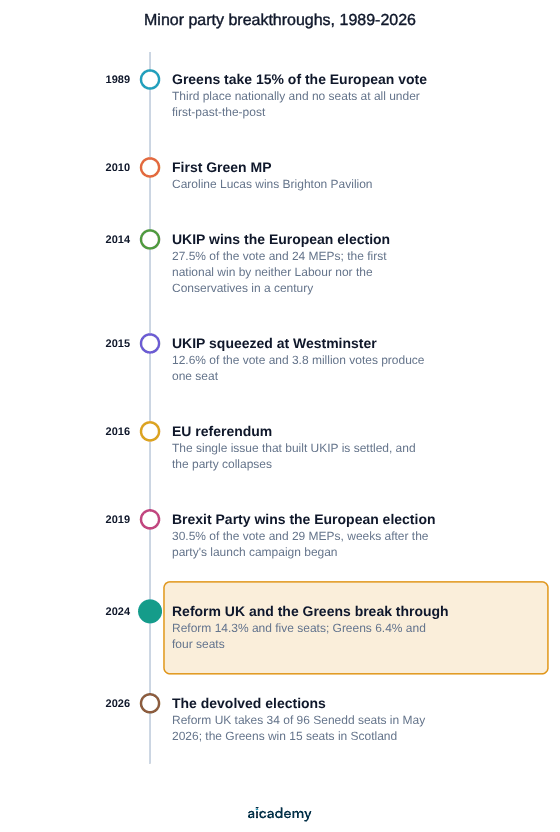
Timeline of minor party breakthroughs: the Greens take 15 per cent in 1989 and win no seats, UKIP tops the 2014 European election, the Brexit Party wins in 2019, Reform UK takes 14.3 per cent for five seats in 2024, then 34 Senedd seats in 2026.

The pattern repeats: a minor party performs strongly where the electoral system is proportional or the stakes are low, then is squeezed at a Westminster general election. What changed in 2024 is that the squeeze no longer removed the party from the picture.

Reform UK: Origins, Development and Position

Origins. Reform UK was founded as the Brexit Party in 2018 and launched under Nigel Farage in the spring of 2019, after the UK's withdrawal from the EU was delayed. It won the May 2019 European Parliament election with 30.5% of the vote and 29 seats within months of being created. At the December 2019 general election it stood down in Conservative-held seats and won nothing. It was renamed Reform UK in 2021, broadening from a single issue to a general programme.

Development. Farage returned as leader on 3 June 2024, mid-campaign, and stood in Clacton. Unlike 2019 the party contested seats across the country. Its poll rating rose from about 11% to 15% during the campaign, and it finished with 14.3% of the vote and five seats.

Position as of September 2026. Reform UK has moved from a party of protest to a party that wins legislatures:

  • At the May 2026 Senedd election it won 34 of the 96 seats on 29.3% of the vote, second only to Plaid Cymru.
  • At the May 2026 Scottish Parliament election it won 17 seats, level with Labour.
  • YouGov polling on 6–7 September 2026 put Reform UK on 23%, level with Labour, with the Conservatives on 20%.

Ideas and policies. Its 2024 manifesto, Our Contract with You, published on 17 June 2024, is the fullest statement of its programme.

AreaReform UK's 2024 position
ImmigrationFreeze non-essential immigration; a new Department of Immigration; a five-year residency and employment requirement before benefits; employers' National Insurance raised to 20% for foreign workers
The economyIncome tax personal allowance raised to £20,000 and the higher-rate threshold to £70,000; corporation tax cut from 25% to 20% and then to 15%; inheritance tax abolished below £2 million
Law and order40,000 more police officers over five years; zero-tolerance policing
Rights and the constitutionRepeal the Human Rights Act 1998, replace it with a British Bill of Rights, and withdraw from the European Convention on Human Rights
EnergyScrap net zero and its subsidies; expand oil, gas and shale licensing
DefenceDefence spending raised to 2.5% of GDP within three years and later to 3%, with 30,000 more army recruits

Independent analysts disputed the arithmetic of the tax package at the time — a reminder to describe manifesto pledges as promises rather than as costed plans.

The Green Party of England and Wales: Origins, Development and Position

Origins. The party began in Coventry in 1972 as PEOPLE, was renamed the Ecology Party in 1975 and the Green Party in 1985. In 1990 the UK-wide party divided into three: the Green Party of England and Wales, the Scottish Greens and the Green Party Northern Ireland.

Development. Its early breakthrough was also its clearest lesson about the electoral system. At the 1989 European Parliament election the Greens took about 15% of the vote, finishing third nationally — and won no seats, because those elections were then run under first-past-the-post. The party's first MP arrived twenty-one years later, when Caroline Lucas won Brighton Pavilion in 2010.

Position as of September 2026. In 2024 the party won four seats on 6.4% of the vote — Brighton Pavilion, Bristol Central, Waveney Valley and North Herefordshire — and came second in 40 constituencies. Since then:

  • Zack Polanski has led the party since 2 September 2025.
  • At the May 2026 Scottish Parliament election the Greens won 15 seats; at the Senedd election they won 2 seats on 6.7%.
  • YouGov polling on 6–7 September 2026 put the Greens on 12%, level with or slightly ahead of the Liberal Democrats on 11–12%.

Ideas and policies. The party's programme is environmentalist and economically redistributive, and its 2024 manifesto Real Hope, Real Change set out the fullest version.

AreaGreen Party's 2024 position
The economyA wealth tax of 1% a year on assets above £10 million and 2% above £1 billion; a £15 an hour minimum wage
Health and welfareA large multi-year increase in NHS and social care funding; free personal care on the Scottish model; more money for children's social care
HousingRent controls; 150,000 genuinely affordable social homes a year; an end to Right to Buy
Environment30% of UK land given protected status, with a land-use framework balancing climate, nature, food and housing
Foreign affairs and defenceContinued NATO membership, while pressing the alliance to adopt a no-first-use nuclear policy; the UK to join the Treaty on the Prohibition of Nuclear Weapons and dismantle its nuclear weapons; continued support for Ukraine and a Gaza ceasefire

Comparing the two. Reform UK and the Greens are useful together precisely because they are opposites. Both are minor parties squeezed by the same electoral system, but one is right-wing and pulls voters from the Conservatives, the other is left-wing and pulls voters from Labour. In 2024 Reform came second in 98 seats, the Greens in 40 — one threat from each flank.

Something not quite clicking?

Ask Aica to explain any part of this differently. Free, takes 30 seconds.

Ask Aica

How Minor Parties Change What the Big Parties Do

Winning seats is one route to influence. Threatening to take votes is another, and in a first-past-the-post system it can be more effective.

Case study: UKIP and the EU referendum. This is the standard worked example, and it holds up.

  1. The threat builds. Through the early 2010s UKIP's support grew at local and European elections, drawn largely from voters who would otherwise have backed the Conservatives, while the party held no Westminster seats at all.
  2. The response. In January 2013, with UKIP still holding no Commons seats, David Cameron promised a referendum on EU membership to stop further losses of Conservative votes to it.
  3. The threat grows anyway. UKIP won the 2014 European Parliament election with 27.5% of the vote and 24 MEPs — the first time in about a century that a national election in Britain was won by a party other than the Conservatives or Labour. Two Conservative MPs defected to it.
  4. The squeeze. At the 2015 general election UKIP took 12.6% of the vote and more than 3.8 million votes — and one seat, Clacton.
  5. The outcome. The referendum was held in 2016 and produced a Leave majority. UKIP had achieved its founding aim without ever holding more than two seats, and then collapsed, because the issue that sustained it was gone.

The mechanism matters more than the story: a minor party influences policy by making a major party fear the loss of its own voters.

Case study: Reform UK and the split right, 2024. Pearson's own analysis of the 2024 election concludes that Reform UK enhanced the Labour victory and may have cost the Conservatives up to 80 constituencies by splitting the right-wing vote. Portsmouth North shows the arithmetic:

Amanda Martin (Labour)          14,495   34.8%
Penny Mordaunt (Conservative)   13,715   33.0%
Melvyn Todd (Reform UK)          8,501   20.4%

Labour won the seat on 34.8%. Conservative and Reform votes together came to 53.4% — comfortably more than the winner — but split between two candidates they elected neither. Multiply that pattern across the country and a party with five MPs has reshaped the composition of the House of Commons.

Other routes to influence are worth a sentence each: minor parties raise issues the large parties would rather avoid; they hold the balance of power in devolved legislatures, as the SNP and Plaid Cymru have done; and they provide a home for protest, which is why their support tends to peak at local, devolved and second-order elections.

What Holds Minor Parties Back

Four barriers, in descending order of importance.

1. The electoral system

First-past-the-post rewards concentrated support and wastes dispersed support. The Electoral Reform Society modelled the 2024 result under the Additional Member System used in Scotland: Labour would have won 236 seats rather than 411, the Conservatives 157, the Green Party 42 and Reform UK as many as 94. The parties would be the same; the system would produce an entirely different Commons.

2. Money

Party funding in the UK is overwhelmingly private, and public funding is allocated by past performance. An established party draws on decades of accumulated members, donors and affiliated organisations, so it enters a campaign able to spend several times what a newer party can raise. Short Money is calculated from seats and votes already won, which helps parties that have already broken through and does nothing for those that have not.

3. Media coverage and credibility

Broadcasters' impartiality rules distribute coverage partly by past electoral performance, so a new party starts with less airtime. Reform UK's rise in 2024 was helped by an unusual asset — a leader who was already one of the most recognisable politicians in the country.

4. The wasted-vote argument

Voters who prefer a minor party may still back a larger one to influence the result. The 2024 campaign saw organised tactical voting, with the group Best for Britain advising centre-left voters which candidate was best placed to defeat the Conservatives in each seat. Tactical voting suppresses minor party votes even where sympathy for them is high.

The barriers reinforce one another. Few seats produce little money and little coverage, which makes a vote for the party look wasted, which produces few seats. Breaking the loop usually needs an external shock — a referendum, a realignment, or a change of electoral system.

Exam Focus: Common Mistakes

1. Answering with only one minor party

Section 2.3 asks for the ideas and policies of two other minor parties. Reform UK and the Green Party are the strongest pairing because they sit on opposite flanks and both had major results in May 2026. Prepare both to the same depth.

2. Describing a party without its policies

"Reform UK is a right-wing populist party" is a label. Naming the £20,000 personal allowance, the 40,000 police officers and the pledge to leave the ECHR is evidence. The specification asks for ideas and policies.

3. Measuring importance by seats alone

Five MPs understates Reform UK's effect on the 2024 result, and it says nothing about 34 Senedd seats in May 2026. Importance is measured in seats, in second places, in the policies the large parties adopt in response, and in devolved legislatures.

4. Treating the SNP and Plaid Cymru as ordinary minor parties

Nationalist parties are minor at Westminster and major within their nations. In May 2026 Plaid Cymru became the largest party in the Senedd with 43 of 96 seats. If you use them, be explicit about which arena you are describing.

5. Ignoring the devolved evidence

The May 2026 results are the strongest recent evidence available on minor parties, and different electoral systems make them more revealing still. Wales used a closed proportional list system for the first time; Scotland used the Additional Member System.

6. Confusing votes with seats

Reform UK won 14.3% of votes and 0.8% of seats in 2024. Write both figures. An answer that gives only one of them cannot make the argument about disproportionality that the topic is really about.

7. Reaching no judgement on importance

The likely 30-mark question is a version of "evaluate the view that minor parties have little importance in the UK". Decide early whether influence without office counts as importance, argue it consistently, and support it with dated evidence.

Key terms

Minor party
A party that contests elections nationally or regionally but has little realistic prospect of forming a government on its own.
Emerging party
A party whose support is growing quickly enough to change the calculations of the established parties, whether or not it has yet won many seats.
Single-issue party
A party built around one dominant aim, such as leaving the European Union or protecting the environment, rather than a full programme for government.
Nationalist party
A party organised around the interests and constitutional future of one nation within the UK, such as the SNP in Scotland or Plaid Cymru in Wales.
Wasted vote
A vote that contributes nothing to the outcome under first-past-the-post: either cast for a losing candidate, or surplus to the winner's requirement.
Vote splitting
The effect of two parties with similar supporters dividing that support between them, allowing a third party to win the seat on fewer votes than the two would have taken together.

Frequently asked questions

First-past-the-post rewards support that is concentrated in particular seats and wastes support that is spread thinly. In 2024 Reform UK took 14.3% of the vote and won five seats, while the Liberal Democrats took 12.2% and won 72, because their vote was concentrated.

They pull the large parties towards their positions: UKIP's rise preceded David Cameron's 2013 pledge of an EU referendum. They also change outcomes without winning — Reform UK came second in 98 seats in 2024 and, on Pearson's analysis, may have cost the Conservatives up to 80 seats by splitting the right-wing vote.

At the 2024 general election Reform UK proposed freezing non-essential immigration, raising the income tax personal allowance to £20,000, cutting corporation tax to 15%, scrapping net zero, leaving the European Convention on Human Rights and recruiting 40,000 police officers.

Generate revision on any topic you study

Type any topic you're studying and Aicademy generates a complete lesson, quiz, and flashcard set, personalised to your level.

Lessons on anything

Structured, level-matched lessons on any topic you study

Practice quizzes

Find out what you actually know before the exam does

Flashcard sets

Lock in key concepts with instant revision cards

Ask Aica

Stuck on something? Get a clear explanation, any time

Prev

The Established Parties

Next

Party Systems and Party Success

Related lessons

17 min

Lesson

The Established Parties

A-Level Politics · Pearson Edexcel 9PL0

2 hours ago

18 min

Lesson

Party Systems and Party Success

A-Level Politics · Pearson Edexcel 9PL0

2 hours ago

14 min

Lesson

Electoral Systems: FPTP, AMS, STV and CPLS

A-Level Politics · Pearson Edexcel 9PL0

2 hours ago

Top students don’t revise more. They revise what counts.

Start revising free

Free to start. No card needed.