Track progress, take quizzes and save notes on this lesson.

Free forever · no card needed

Start free
Advanced

Three Key General Elections

Paper 1, 4.1 Case studies of three key general elections

Aligned to the Pearson Edexcel 9PL0 specification

Level
Advanced
Reading time
16 min
Published
9 September 2026
On this page
  1. 1.The Three Elections the Specification Requires
  2. 2.1979: The Winter of Discontent Election
  3. 3.Explaining 1979: Competence, Leadership and Policy
  4. 4.1997: The Landslide That Redrew the Political Map
  5. 5.Explaining 1997: Sleaze, Division and New Labour
  6. 6.2024: A Landslide Built on One Third of the Vote
  7. 7.Explaining 2024: A Verdict on Fourteen Years
  8. 8.What the Three Elections Have in Common
  9. 9.Exam Focus: Using Election Case Studies

Key takeaways

  • Three election case studies are required: one from 1945–92, the compulsory 1997 election, and one since 1997. Each needs results, impact on parties and government, and the factors behind the outcome.
  • In 1979 the Conservatives won 339 seats on 43.9% of the vote, a majority of 43, after the Winter of Discontent and a lost confidence vote by 311 to 310. It began 18 years of Conservative government.
  • In 1997 Labour won 418 seats on 43.2% of the vote, a majority of 179, on a 10.2-point swing. The Conservatives were left with 165 seats and none at all in Scotland or Wales.
  • In 2024 Labour won 411 seats and a majority of 174 on 33.7% of the vote and 59.7% turnout — 63.2% of seats from a third of the votes, which Sir John Curtice called the most disproportional ever.
  • All three were turning-point elections in which a governing party lost its reputation for competence; leadership, manifesto, campaign and wider context then decided the scale of the defeat.

The Three Elections the Specification Requires

Content area 4.1 names three general elections, and the choice is only partly yours:

  • one election from the period 1945–92
  • the 1997 election — compulsory, no substitute permitted
  • one election since 1997

This lesson uses 1979, 1997 and 2024. Each is a turning-point election: a long-serving government was thrown out, the winner took office with a large majority, and the losing party spent years rebuilding.

For each election the specification requires three things, and an answer that supplies only the first is incomplete:

RequirementWhat you must be able to do
The resultsQuote seats, vote share, majority and turnout accurately
Impact on parties and governmentExplain what the result did to the winners, the losers and the direction of policy
The factors behind the outcomeWeigh party policies and manifestos, campaign techniques, leadership and the wider political context

Issue 4 of the specification (May 2026) added leadership to the list of factors in 4.1. Treat it as a factor you are expected to assess in its own right, not as background colour.

1979: The Winter of Discontent Election

James Callaghan had been Prime Minister since April 1976, leading a Labour government that had lost its Commons majority and was propped up from March 1977 by the Lib–Lab pact. Its incomes policy — a 5% limit on pay rises — collapsed over the winter of 1978–79 into the strikes remembered as the Winter of Discontent: lorry drivers, gravediggers, refuse collectors and hospital ancillary staff, with rubbish uncollected in the streets.

Two constitutional events followed in quick succession:

  • On 1 March 1979 the devolution referendums failed. Scotland voted Yes by 51.6%, but that was only about a third of the registered electorate, short of the 40% threshold imposed by Parliament; Wales rejected devolution heavily. The SNP withdrew its support from the government.
  • On 28 March 1979 the government lost a motion of no confidence by 311 votes to 310 — the first government defeated on confidence since 1924. Callaghan had to call an election.

The result, 3 May 1979:

PartySeatsChangeVote shareVotes
Conservative339+6243.9%13.7m
Labour269−5036.9%11.5m
Liberal11−213.8%4.3m
SNP2−91.6%0.5m

Conservative majority 43, on a turnout of 76.0% and a swing of 5.2% from Labour — the largest at any election since 1945 up to that point. Margaret Thatcher became the UK's first woman Prime Minister.

Explaining 1979: Competence, Leadership and Policy

Governing competency. The strikes did not merely inconvenience voters; they destroyed Labour's core claim that its union links let it manage industrial relations where the Conservatives could not. Inflation had reached over 24% in 1975 and the government had been forced to seek an IMF loan in 1976. By 1979 the argument that Labour was the safe pair of hands had no evidence behind it.

Leadership. Callaghan's judgement was central twice over. He had been widely expected to call an election in autumn 1978, while Labour was level in the polls, and announced in September that he would not — a decision that left him fighting after the strikes rather than before them. Returning from a summit in Guadeloupe in January 1979, at the height of the strikes, he gave an airport interview that The Sun rendered as the headline "Crisis? What Crisis?" — words he did not use, but which stuck because they matched the public mood. Thatcher, by contrast, offered an unusually clear programme and was presented as a decisive break from consensus politics.

Manifesto and policy. The 1979 Conservative manifesto was short and specific: control inflation, cut income tax, restore secret ballots and limit picketing in trade union law, and give council tenants the right to buy their homes. That last policy was aimed squarely at skilled working-class voters and was delivered early in the new Parliament by the Housing Act 1980.

Campaign. The Conservatives had retained the advertising agency Saatchi & Saatchi, whose 1978 poster showing a lengthening dole queue under the line "Labour Isn't Working" is one of the few pieces of British political advertising to have entered general memory. It set the campaign's terms nearly a year before polling day.

Impact on parties and government. The election opened 18 years of Conservative government, and with it monetarism, privatisation and the reshaping of trade union law. Labour moved sharply left under Michael Foot from 1980, split in 1981 when four senior figures left to found the SDP, and lost again heavily in 1983. Callaghan reportedly told an aide during the campaign that there had been a sea change in politics and that it did not matter what either leader said — an unusually candid reading of a realigning election.

1997: The Landslide That Redrew the Political Map

By 1997 the Conservatives had governed for 18 years and John Major had been Prime Minister for six. The party's reputation had been damaged by three separate problems that reinforced each other: economic failure, internal division over Europe, and a run of scandals.

The result, 1 May 1997:

PartySeatsChangeVote shareVotes
Labour418+14543.2%13.5m
Conservative165−17830.7%9.6m
Liberal Democrat46+2816.8%5.2m
Referendum Party02.6%0.8m

Seat changes are measured against notional 1992 results on the redrawn 1997 boundaries. Labour's majority was 179, on a swing of 10.2% — the largest since 1945. Turnout fell to 71.4%, then the lowest since 1935.

Three features of the result are worth committing to memory:

  • The Conservatives won no seats at all in Scotland or Wales, reducing them to an English party in parliamentary terms.
  • Seven serving Cabinet ministers lost their seats, most famously Michael Portillo in Enfield Southgate.
  • The Liberal Democrats won 46 seats on 16.8% of the vote, having won only 20 seats on 17.8% in 1992. A smaller share of the vote produced more than twice as many seats, which is the strongest single indication that anti-Conservative tactical voting was widespread.

Want more lessons like this one?

Generate lessons on anything you study. Free account, no card needed.

Start generating

Explaining 1997: Sleaze, Division and New Labour

The wider context: Black Wednesday. On 16 September 1992 sustained speculative pressure forced the pound out of the European Exchange Rate Mechanism. Interest rates were raised to 12% and a rise to 15% was announced within a single day before the policy was abandoned. The Conservatives had won the 1992 election on economic competence; polling on which party was better trusted with the economy moved decisively to Labour after 1992 and did not move back before the election, even though growth returned and unemployment fell.

Division. The Maastricht Treaty split the parliamentary party. In November 1994 the whip was withdrawn from eight Eurosceptic MPs, leaving the government temporarily without a majority. Voters were watching a governing party argue with itself.

Sleaze. The Guardian's cash-for-questions allegations in October 1994 led Major to establish the Committee on Standards in Public Life under Lord Nolan, whose 1995 report produced the Seven Principles of Public Life. The damage was compounded by the collapse of the "back to basics" theme launched in 1993, after a succession of ministerial scandals. In Tatton, the sitting Conservative MP Neil Hamilton was defeated by the independent anti-sleaze candidate Martin Bell, whom Labour and the Liberal Democrats stood aside for.

Leadership and manifesto. Tony Blair became Labour leader in July 1994 and rewrote Clause IV of the party constitution at a special conference in April 1995, abandoning the historic commitment to common ownership. The 1997 manifesto ruled out increases in income tax rates and accepted Conservative spending plans for two years — designed to remove the "tax and spend" attack line rather than to inspire. Its retail offer was reduced to five promises printed on a pledge card, including cutting infant class sizes to 30 and cutting NHS waiting lists by 100,000.

Campaign. Labour's Millbank operation was the most disciplined the party had run: message control, a rapid rebuttal unit, and resources concentrated on marginal seats. The Sun, which had backed the Conservatives at every election since 1979, switched to Labour on 18 March 1997, the day after the election was called.

Impact on parties and government. Labour held office for 13 years. The government made the Bank of England operationally independent within five days of taking office, held successful devolution referendums in Scotland and Wales in September 1997, and passed the Human Rights Act 1998. The Conservatives went through three leaders before the 2005 election and did not win a Commons majority again until 2015.

2024: A Landslide Built on One Third of the Vote

Rishi Sunak called the election on 22 May 2024, earlier than most of his party expected, with inflation newly back down to 2.3%. Polling day was 4 July 2024.

PartySeatsChange% of seats% of votes
Labour411+21163.233.7
Conservative121−25118.623.7
Liberal Democrat72+6411.112.2
SNP9−391.42.5
Reform UK5+50.814.3
Green4+30.66.4
Plaid Cymru4+20.60.7
Independents6+60.92.0

Seat changes are measured against notional 2019 results on the boundaries used in 2024; against the actual 2019 result the Conservatives fell from 365 seats to 121. Labour's majority was 174 on 59.7% turnout, the lowest since 2001. Professor Sir John Curtice described the outcome as the most disproportional in British electoral history.

The comparison with 1997 is the single most useful thing in this lesson:
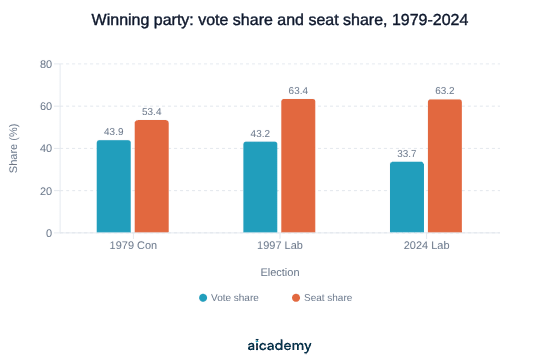
Grouped bars comparing the winning party's vote share with its Commons seat share. Conservatives 1979: 43.9 per cent of votes, 53.4 per cent of seats. Labour 1997: 43.2 and 63.4 per cent. Labour 2024: 33.7 per cent of votes but 63.2 per cent of seats.

Labour's seat share in 2024 was almost identical to 1997, but it was won on nine and a half percentage points less of the vote. That gap is the argument for electoral reform in a single figure — and the reason a 2024 comparison is more analytically useful than a straight retelling of either election.

Explaining 2024: A Verdict on Fourteen Years

Governing competency. The 2019–24 Parliament produced three Prime Ministers and five Chancellors. Boris Johnson resigned in July 2022 over the partygate scandal and the handling of the Chris Pincher affair; Liz Truss lasted 49 days, the shortest tenure of any UK Prime Minister, after a tax-cutting mini-budget triggered a crisis in the financial markets. Sunak and Jeremy Hunt restored stability, but Labour used the episode as evidence of incompetence for the remaining two years.

Delivery. Sunak made five pledges early in his premiership: halve inflation, grow the economy, reduce debt, cut NHS waiting lists and stop small-boat crossings. By the summer of 2024 only the first had been met. No government-sponsored flight to Rwanda ever departed, despite the legislation. The cancellation of the northern leg of HS2 in October 2023 read as the abandonment of "levelling up".

Context. The tax burden as a share of GDP reached its highest level since the late 1940s and debt approached 100% of GDP. Inflation had fallen to 2.3% by spring 2024, but voters compared prices to four years earlier rather than to last year, and the government received no credit.

Leadership. Sir Keir Starmer had moved Labour to the centre since 2020, dropping the 2019 programme, distancing the party from Jeremy Corbyn and committing publicly to the nuclear deterrent. The strategy was reassurance rather than enthusiasm: the result was, as much as anything, a rejection of the Conservative record rather than an embrace of Labour's offer.

Campaign. The Conservative campaign is widely regarded as one of the worst-run in modern times — the rain-soaked announcement outside 10 Downing Street on 22 May, a national service proposal that failed to land, Sunak's early departure from the D-Day 80th anniversary commemoration in Normandy on 6 June, and a betting scandal involving his parliamentary private secretary. Labour's campaign was tightly controlled and targeted at marginal seats.

The split on the right. Nigel Farage returned as leader of Reform UK on 3 June 2024 and, unlike the Brexit Party in 2019, ran candidates everywhere. Reform took 14.3% of the vote for five seats, came second in 98 constituencies, and may have cost the Conservatives up to 80 seats by splitting the right-wing vote. Portsmouth North shows the mechanism at constituency level:

CandidatePartyVotesShare
Amanda MartinLabour14,49534.8%
Penny MordauntConservative13,71533.0%
Melvyn ToddReform UK8,50120.4%
Simon DoddLiberal Democrat3,0317.3%
Duncan RobinsonGreen1,8514.5%

Labour won the seat with barely a third of the vote while Conservative and Reform votes together came to 53.4%.

Impact on parties and government. Labour took office with a mandate for green energy investment, rail renationalisation, housebuilding and stronger employment rights, but immediately moderated expectations by pointing to a claimed £22 billion shortfall in the public finances. The Conservatives were left with 11 MPs in south-west England, three in the north-west, one in the north-east and none in Wales, and divided over whether to accommodate Reform. The SNP recorded its worst performance since 2010, and Scottish independence receded as an immediate question.

The Parliament that followed was itself turbulent. Labour lost around 35 councils at the May 2026 local elections on a projected national vote share of about 17%; Starmer announced his resignation on 22 June 2026; and Andy Burnham became Prime Minister on 20 July 2026, having entered the Commons at the Makerfield by-election only a month earlier. A 174-seat majority did not, in the event, guarantee a stable premiership.

What the Three Elections Have in Common

Examiners reward candidates who can compare case studies rather than narrate them one after another.

197919972024
IncumbentLabour (5 years)Conservative (18 years)Conservative (14 years)
Trigger for collapseWinter of DiscontentBlack Wednesday and sleazeTruss mini-budget and undelivered pledges
Winner's majority43179174
Winner's vote share43.9%43.2%33.7%
Turnout76.0%71.4%59.7%
Third-party roleLiberals 11 seatsTactical voting lifted Lib Dems to 46Reform UK split the right

Three patterns run through all three:

  1. Governments lose elections more clearly than oppositions win them. In each case the incumbent had already forfeited its reputation for competence before the campaign began. The counter-argument is that an opposition must still be credible enough to receive the protest vote — Labour was not in 1983 or 2019, and lost.
  2. Leadership matters most when it symbolises the wider argument. Thatcher stood for a break with consensus, Blair for a modernised Labour Party, Starmer for reassurance. None of the three won on personal popularity alone.
  3. Turnout has fallen as majorities have grown. The 2024 landslide rested on the smallest winning vote share of the three and the lowest turnout, which is why its mandate was contested from the first week.

Exam Focus: Using Election Case Studies

1. Answering with only one election

Section A essays such as "Evaluate the view that general elections are lost by governments rather than won by oppositions" are marked on the range of evidence. An answer built on 2024 alone cannot show a pattern. Plan to use at least two of your three case studies in every election essay.

2. Narrating instead of evaluating

The 30-mark command word is Evaluate, carrying 10 marks for AO3. A chronological retelling of 1997 earns AO1 and stalls there. Use each case study as evidence for a claim — "leadership mattered more than manifesto in 1979 because…" — and reach a judgement.

3. Quoting results loosely

"Labour won a landslide in 2024" is worth little; "Labour won 411 seats and a majority of 174 on 33.7% of the vote and 59.7% turnout" is precise AO1. Learn seats, vote share, majority and turnout for all three elections.

4. Forgetting that leadership is now a named factor

Issue 4 added leadership to 4.1. If your plan has headings for policies, campaigns and context but not for leaders, you have left out a factor the specification names.

5. Treating campaigns as decisive without evidence

Campaigns clearly mattered in 2024, but Labour led by roughly 20 points in the polls long before Parliament was dissolved and won by about 10 — which can be read as the campaign narrowing the gap rather than creating the result. Say what a campaign changed, and how you know.

6. Ignoring the impact half of the requirement

4.1 asks for "the results and their impact on parties and government". Every case study needs a paragraph on what happened next: 18 years of Conservative rule after 1979, 13 years of Labour after 1997, and a 2024 majority that had already changed Prime Minister by July 2026.

Key terms

Swing
The average movement of support from one party to another between two elections, measured in percentage points and used to compare results across constituencies.
Landslide
An election victory producing a very large parliamentary majority, well beyond what the winning party needs to govern securely.
Governing competency
Voters' judgement of how capably a party runs the country, or would run it from opposition — assessed on delivery and results rather than on ideology.
Manifesto
The document a party publishes before an election setting out the policies it undertakes to carry out if it wins.
Mandate
The authority a winning party claims to enact the programme it stood on, together with permission to decide issues that arise afterwards.
Tactical voting
Backing whichever candidate is best placed to defeat a party you oppose, rather than the candidate you would most like to win.
Turning-point election
An election that ends one period of party dominance and sets the direction of government for years afterwards, rather than simply returning the incumbent.

Frequently asked questions

One from 1945–92, the 1997 election, which is compulsory, and one since 1997. A common and well-evidenced choice is 1979, 1997 and 2024, because each ended a long period of one-party government and each is richly documented.

Labour's vote was spread efficiently across constituencies while the anti-Labour vote split between the Conservatives and Reform UK. Under first past the post, Labour took 63.2% of seats on 33.7% of the vote, with turnout at 59.7%.

The Winter of Discontent strikes destroyed Labour's claim to manage the economy and the unions; the Callaghan government then lost a confidence vote by 311 to 310. Conservative policy on tax, union law and council house sales attracted skilled working-class voters.

Generate revision on any topic you study

Type any topic you're studying and Aicademy generates a complete lesson, quiz, and flashcard set, personalised to your level.

Lessons on anything

Structured, level-matched lessons on any topic you study

Practice quizzes

Find out what you actually know before the exam does

Flashcard sets

Lock in key concepts with instant revision cards

Ask Aica

Stuck on something? Get a clear explanation, any time

Prev

Comparing Electoral Systems and Their Effects

Next

Factors Influencing Voting Behaviour

Related lessons

22 min

Lesson

Factors Influencing Voting Behaviour

A-Level Politics · Pearson Edexcel 9PL0

2 hours ago

15 min

Lesson

The Media and Opinion Polls

A-Level Politics · Pearson Edexcel 9PL0

2 hours ago

14 min

Lesson

Comparing Electoral Systems and Their Effects

A-Level Politics · Pearson Edexcel 9PL0

2 hours ago

Top students don’t revise more. They revise what counts.

Start revising free

Free to start. No card needed.