Electoral Systems: FPTP, AMS, STV and CPLS

Aligned to the Pearson Edexcel 9PL0 specification
- Topic
- Electoral Systems
- Level
- Intermediate
- Reading time
- 14 min
- Published
- 9 September 2026
On this page
- 1.First-Past-the-Post: One Seat, One Winner, No Majority Required
- 2.What FPTP Did to the 2024 General Election
- 3.The Additional Member System: Two Votes, One Correction
- 4.The Single Transferable Vote: Ranking, Quotas and Transfers
- 5.The Closed Proportional List System and the New Senedd
- 6.Comparing FPTP at Westminster with CPLS in the Senedd
- 7.Weighing the Four Systems Against Each Other
- 8.Exam Focus: Common Mistakes
Key takeaways
- FPTP elects one MP per constituency on a simple plurality: the candidate with more votes than any other wins, often on well under half the vote. Westminster and English local elections use it.
- AMS is a hybrid. Voters cast a constituency vote decided by plurality and a second party-list vote, and regional top-up seats are allocated by D'Hondt to narrow the votes-to-seats gap. Scotland uses it.
- STV elects several members per constituency from ranked ballots. Candidates need a Droop quota; surpluses and eliminated candidates' votes transfer. Northern Ireland uses it for the Assembly and councils.
- CPLS replaced AMS in Wales. On 7 May 2026 the Senedd elected 96 members from 16 six-member constituencies by D'Hondt, on one vote cast for a party, with candidate order fixed by each party.
- The 2026 Senedd result was far more proportional than Westminster's: Plaid Cymru took 44.8% of seats on 35.4% of the vote, against Labour's 63.2% of Commons seats on 33.7% of the vote in 2024.
Want more lessons like this one?
Generate lessons on anything you study. Free account, no card needed.
Comparing FPTP at Westminster with CPLS in the Senedd
This is the comparison the specification names explicitly: FPTP against a different system used in a devolved legislature. As of September 2026, the sharpest available version of it is Westminster 2024 against the Senedd 2026.
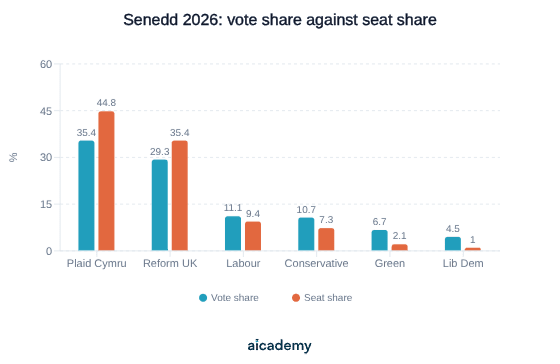
Plaid Cymru won 43 of the 96 seats on 35.4% of the vote; Reform UK took 34 on 29.3%; Labour 9 on 11.1%; the Conservatives 7 on 10.7%; the Greens 2 on 6.7%; the Liberal Democrats 1 on 4.5%. Turnout was 51.6%, the highest at any Senedd election and the first above half. Labour left government in Wales for the first time since 1999.
| Measure | Westminster 2024 (FPTP) | Senedd 2026 (CPLS) |
|---|---|---|
| Largest party's votes → seats | 33.7% → 63.2% | 35.4% → 44.8% |
| Biggest over-reward | Labour, +29.5 points | Plaid Cymru, +9.4 points |
| Biggest under-reward | Reform UK, −13.5 points | Green, −4.6 points |
| Outcome | Single-party majority of 174 | No overall majority; Plaid Cymru six seats short of the 49 needed |
| Constituency link | One named MP per seat | Six members per constituency, no personal vote |
The chart makes the headline point: under CPLS the two bars track each other for every party, while under FPTP they diverge violently. But CPLS in Wales is proportional rather than perfectly proportional, because six-member districts still leave small parties short — the Greens polled 6.7% and took 2.1% of the seats.
Key terms
- First-past-the-post (FPTP)
- An electoral system in which each constituency returns one representative and the candidate with more votes than any rival wins, whether or not that total is a majority.
- Plurality
- More votes than any other candidate, but not necessarily more than half of the votes cast; the winning condition under FPTP.
- Additional Member System (AMS)
- A mixed system pairing single-member constituency contests decided by plurality with a second tier of list seats allocated so that a party's overall seat total moves closer to its vote share.
- Single Transferable Vote (STV)
- A preferential system for multi-member constituencies in which voters rank candidates, seats are filled by a quota, and surplus or eliminated votes pass on according to those rankings.
- Closed Proportional List System (CPLS)
- A system in which each voter casts one vote for a party, seats in a multi-member constituency are shared in proportion to party vote shares, and the party itself fixes the order in which its candidates take them.
- Droop quota
- The threshold for election under STV, calculated by dividing the valid votes by one more than the number of seats, discarding the remainder, and adding one.
- D'Hondt method
- A highest-average allocation rule: each party's vote total is divided by a divisor that rises as it wins seats, and every seat goes to whichever party currently holds the largest quotient.
Frequently asked questions
Four. First-past-the-post elects MPs and councillors in England and Wales. The Scottish Parliament uses the Additional Member System, the Northern Ireland Assembly uses the Single Transferable Vote, and the Senedd has used a closed proportional list since May 2026.
No. Issue 4 of the 9PL0 specification, published in May 2026, removed Supplementary Vote from Paper 1, 3.1 and put the Closed Proportional List System in its place. Older textbooks and past papers still test SV, but it is no longer assessable content.
Under AMS you cast two votes, one for a constituency candidate and one for a regional party list, so some members represent constituencies. Under the Senedd's closed list you cast a single vote for a party and every member is elected from a party list.
Generate revision on any topic you study
Type any topic you're studying and Aicademy generates a complete lesson, quiz, and flashcard set, personalised to your level.
Lessons on anything
Structured, level-matched lessons on any topic you study
Practice quizzes
Find out what you actually know before the exam does
Flashcard sets
Lock in key concepts with instant revision cards
Ask Aica
Stuck on something? Get a clear explanation, any time
Party Systems and Party Success
Referendums in the UK
Related lessons
14 min
Comparing Electoral Systems and Their Effects
A-Level Politics · Pearson Edexcel 9PL0
2 months ago
15 min
20 min