Track progress, take quizzes and save notes on this lesson.

Free forever · no card needed

Start free
Intermediate

Genetic Engineering

4.6.2.4 Genetic engineering

Aligned to the AQA 8461 specification

Level
Intermediate
Reading time
11 min
Published
16 June 2026
Updated
1 July 2026
On this page
  1. 1.What Genetic Engineering Means
  2. 2.Genetically Modified (GM) Crops
  3. 3.Bacteria Engineered to Make Human Insulin
  4. 4.The Process of Genetic Engineering
  5. 5.Worked Example: Engineering Bacteria to Make Insulin
  6. 6.Genetic Engineering in Medicine: Gene Therapy
  7. 7.Weighing Up GM: Issues and Judgements
  8. 8.Common Exam Mistakes

Key takeaways

  • Genetic engineering is modifying the genome of an organism by introducing a gene from another organism to give a desired characteristic.
  • GM crops can be made resistant to diseases, insect attack and herbicides, or to produce bigger, better fruits, and generally show increased yields.
  • Bacteria are genetically engineered to make human insulin to treat diabetes by inserting the human insulin gene and growing the bacteria in large numbers.
  • In the Higher Tier process, enzymes isolate the required gene, it is inserted into a vector (a bacterial plasmid or virus), and the vector carries it into cells at an early stage of development.
  • Gene therapy, introducing a working copy of a gene to overcome an inherited disorder, is a future possibility being researched rather than a routine treatment.

What Genetic Engineering Means

Genetic engineering is the process of modifying the genome of an organism by introducing a gene from another organism to give a desired characteristic.

The genome is the complete set of genetic material (DNA) in an organism. In genetic engineering, a single gene that codes for a useful feature is taken from one organism and added to a different organism. That organism then has the new feature because the gene tells its cells to make a new protein.

Genetic engineering: modifying the genome of an organism by introducing a gene from another organism to give a desired characteristic.

Three things must be true for the spec definition:

  • A gene comes from one organism (the donor).
  • It is introduced into a different organism (the recipient).
  • The aim is a desired characteristic — something useful to humans.

A worked classification — decide whether each is genetic engineering:

ScenarioGenetic engineering?Why
A gene for insulin moved from a human into a bacteriumYesGene from another organism added to give a new characteristic
A gene for cold tolerance moved from a fish into a tomato plantYesCross-organism gene transfer for a desired feature
Breeding the two cows that produce the most milk togetherNoThis is selective breeding — no gene is transferred between species

Genetic engineering is not the same as selective breeding. Selective breeding chooses which existing organisms reproduce; genetic engineering directly moves a gene from one species into another. (Selective breeding is covered in its own spec section, 4.6.2.3.)

Genetically Modified (GM) Crops

A crop that has had a gene added by genetic engineering is called a genetically modified (GM) crop.

Plant crops have been genetically engineered to:

  • be resistant to diseases
  • be resistant to insect attack (an inserted gene makes the plant produce a substance toxic to the insect pests that eat it)
  • be resistant to herbicides (so weedkiller can be sprayed to kill weeds without harming the crop)
  • produce bigger, better fruits

GM crops generally show increased yields — more food is harvested from the same area of land.

Worked example — insect-resistant maize. A gene from a soil bacterium that codes for an insect-killing protein is inserted into maize plants. The maize cells now make this protein themselves. When pest insects eat the leaves, the protein damages their gut and they die. The farmer loses less of the crop to pests, so the yield rises and less chemical insecticide needs to be sprayed.

GM crop featureGene gives the plant...Benefit to the farmer
Insect resistanceAbility to make an insect-killing proteinLess crop lost to pests; higher yield
Herbicide resistanceTolerance to a specific weedkillerWeeds killed without harming the crop
Disease resistanceProtection against a plant pathogenFewer plants lost to infection

Bacteria Engineered to Make Human Insulin

Bacterial cells have been genetically engineered to produce useful substances such as human insulin to treat diabetes.

People with type 1 diabetes cannot make enough insulin, the hormone that controls blood glucose. They need a reliable supply. Genetic engineering provides one: the human insulin gene is inserted into bacteria, and the bacteria are then grown in huge numbers in industrial vats called fermenters. Because each bacterium carries the human gene, it makes genuine human insulin, which is collected and purified.

Bacteria reproduce very quickly, so a small number of engineered bacteria can be multiplied into billions, each one a tiny factory producing the desired protein.

Why this matters: before this technique, insulin was extracted from the pancreases of slaughtered pigs and cattle. Animal insulin works but is not identical to human insulin and supply was limited. Bacterially-produced human insulin is identical to the body's own, can be made in large amounts cheaply, and avoids using animals.

This is the same logic as GM crops, just with a microorganism as the recipient: a useful gene is moved into an organism so that the organism makes something we want.

The Process of Genetic Engineering

(Higher Tier only — the detailed steps below are required for Higher Tier students. Foundation students need the examples and issues, not the step-by-step mechanism.)

The main steps in genetic engineering are:

(Higher Tier only)

  1. Enzymes are used to isolate (cut out) the required gene.
  2. The gene is inserted into a vector — usually a bacterial plasmid or a virus.
  3. The vector is used to insert the gene into the required cells.
  4. Genes are transferred to the cells at an early stage of development so the organism develops with the desired characteristic.

Definitions to memorise:

(Higher Tier only) Enzyme: a biological molecule used here to cut DNA to isolate a gene. Vector: something that carries the gene into the recipient cell — usually a bacterial plasmid (a small ring of DNA found in bacteria) or a virus.

The ordered process flow:
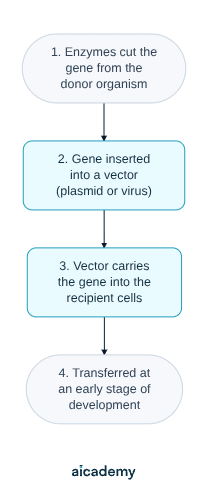
Transferring the gene at an early stage of development matters: a fertilised egg or a very young embryo grows into a whole organism. If the gene is added early, every cell that develops from those first cells carries the gene, so the entire organism shows the desired characteristic.

How much of this have you taken in?

Quiz yourself on this section, free, no card needed.

Test myself

Worked Example: Engineering Bacteria to Make Insulin

(Higher Tier only — this walk-through uses the Higher Tier process steps above.)

A common exam task gives the steps of making insulin in jumbled order and asks you to put them in sequence. Here are four steps out of order:

  • A — The bacteria reproduce, and each new bacterium makes human insulin.
  • B — Enzymes are used to cut the human insulin gene out of human DNA.
  • C — The plasmid (vector) is put back into a bacterium.
  • D — The insulin gene is inserted into a bacterial plasmid.

Correct order: B → D → C → A.

OrderStepWhat is happeningSpec idea
1BEnzymes cut out the insulin gene from human DNAEnzymes isolate the required gene
2DThe gene is inserted into a bacterial plasmidGene inserted into a vector
3CThe plasmid is put back into a bacteriumThe vector inserts the gene into the required cell
4AThe bacteria reproduce and make human insulinEngineered cells express the desired characteristic

The reasoning: you must isolate the gene before you can put it in a vector, you must load the vector before it can carry the gene into the cell, and the cell must have the gene before it can make the product.

Genetic Engineering in Medicine: Gene Therapy

Modern medical research is exploring genetic modification to overcome some inherited disorders. This idea is called gene therapy.

An inherited disorder is caused by a faulty gene passed from parents to children, such as cystic fibrosis. The aim of gene therapy is to introduce a working copy of the gene into the affected person's cells so their cells can function normally.

Gene therapy to cure inherited disorders is described as a future possibility that medical research is exploring — the spec asks you to recognise it as a potential use, not a routine treatment.

Why it is still difficult:

  • Getting the new gene into enough of the right cells is hard.
  • The effect may not last, so treatment may need repeating.
  • There are ethical concerns about changing human genes, especially if the changes could be passed to future generations.

(Extra context — not required by AQA 8461.) A small number of gene therapies have now been approved for specific conditions, but for GCSE you only need to know that genetic modification of human cells to treat inherited disorders is being researched as a possible future treatment.

Weighing Up GM: Issues and Judgements

The spec requires you to make informed judgements about the economic, social and ethical issues of genetic engineering. A good exam answer gives a benefit, a concern, and a clear judgement.

Benefits of GMConcerns about GM
GM crops give increased yields, helping feed growing populationsEffects on populations of wild flowers may fall as herbicide-resistant crops allow heavier weedkiller use
Insect-resistant crops need less insecticide sprayingInsect populations may fall, including helpful insects, harming food chains
Bacteria make cheap, pure human insulin for diabeticsSome people feel the effects of eating GM crops on human health have not been fully explored
Gene therapy may one day cure inherited disordersEthical objections to altering the genomes of organisms or humans

Worked example — evaluate growing a GM herbicide-resistant crop. A balanced answer has three parts:

  1. Benefit: the farmer can spray weedkiller that kills weeds without harming the crop, so yields increase and more food is produced.
  2. Concern: heavier weedkiller use reduces wild flowers in and around the field, which reduces food and habitat for insects, and insect populations may fall.
  3. Judgement: the higher yield helps feed more people, but the loss of wild flowers and insects could damage ecosystems; whether it is worthwhile depends on how the crop is managed and on the local environment.

When a question says "evaluate", give points on both sides and finish with a reasoned conclusion. An answer with only benefits, or only concerns, is one-sided and tends to lose the evaluation marks.

Common Exam Mistakes

1. Confusing genetic engineering with selective breeding

Genetic engineering transfers a gene from one organism into another. Selective breeding only chooses which existing organisms reproduce together — no gene is moved between species. They are different processes in different spec sections.

2. Forgetting the gene comes from a different organism

The spec definition is specific: a gene from another organism is introduced. Saying you "change the organism's own genes" misses the point that a new gene is brought in from a donor.

3. Leaving out the vector (Higher Tier)

In the process, the isolated gene is inserted into a vector — a bacterial plasmid or a virus — before going into the recipient cell. The vector is what carries the gene in. Skipping it loses a key step.

4. Saying genes are transferred at any stage

Genes are transferred at an early stage of development so that the organism develops with the characteristic in all its cells. Adding a gene to a fully grown organism would not give every cell the new gene.

5. Giving a one-sided answer to an "evaluate" question

"Evaluate" and "discuss" questions need a benefit, a concern, and a judgement. Listing only the good points (or only the risks) is incomplete and tends to lose marks for the conclusion.

6. Vague concerns about GM crops

Name the specific spec concerns: effects on wild flowers, effects on insect populations, and the view that effects of eating GM crops on human health are not fully explored. "It's unnatural" on its own is too vague.

Key terms

Genetic engineering
Modifying the genome of an organism by introducing a gene from another organism to give a desired characteristic.
Genome
The complete set of genetic material (DNA) in an organism.
Genetically modified (GM) crop
A crop that has had a gene added by genetic engineering, for example to give resistance or higher yields.
Vector
Something that carries the gene into the recipient cell, usually a bacterial plasmid or a virus.
Plasmid
A small ring of DNA found in bacteria, used as a vector in genetic engineering.
Gene therapy
Introducing a working copy of a gene into a person's cells to overcome an inherited disorder, currently a future possibility being researched.
Inherited disorder
A condition caused by a faulty gene passed from parents to children, such as cystic fibrosis.

Frequently asked questions

Genetic engineering transfers a gene from one organism into another to give a desired characteristic. Selective breeding only chooses which existing organisms reproduce together, with no gene moved between species. They are different processes in different specification sections.

The human insulin gene is inserted into bacteria, which are then grown in huge numbers in fermenters. Because each bacterium carries the human gene, it makes genuine human insulin, which is collected and purified. This replaced insulin extracted from slaughtered pigs and cattle.

Enzymes are used to isolate (cut out) the required gene, the gene is inserted into a vector such as a bacterial plasmid or virus, the vector inserts the gene into the required cells, and the gene is transferred at an early stage of development so the whole organism shows the characteristic.

Generate revision on any topic you study

Type any topic you're studying and Aicademy generates a complete lesson, quiz, and flashcard set, personalised to your level.

Lessons on anything

Structured, level-matched lessons on any topic you study

Practice quizzes

Find out what you actually know before the exam does

Flashcard sets

Lock in key concepts with instant revision cards

Ask Aica

Stuck on something? Get a clear explanation, any time

Prev

Selective Breeding

Next

Evidence for Evolution: Fossils and Extinction

Related lessons

9 min

Lesson

Selective Breeding

AQA GCSE Biology · AQA 8461

1 month ago

9 min

Lesson

Cloning: Plants and Animals

AQA GCSE Biology · AQA 8461

1 month ago

Top students don’t revise more. They revise what counts.

Start revising free

Free to start. No card needed.