Selective Breeding

Aligned to the AQA 8461 specification
- Level
- Foundational
- Reading time
- 9 min
- Published
- 16 June 2026
- Updated
- 16 August 2026
On this page
Key takeaways
- Selective breeding (artificial selection) is when humans choose which organisms reproduce based on a desired inherited characteristic, so that characteristic becomes more common in later generations.
- Selective breeding must be repeated over many generations; describing only one round of breeding is incomplete and is the most common reason students lose a mark.
- Humans selectively breed for disease resistance in crops, more meat or milk in farm animals, a gentle nature in dogs, and large or unusual flowers in ornamental plants.
- Selective breeding does not create new genes; it acts on variation that already exists, making useful existing alleles more common.
- Inbreeding reduces the gene pool and genetic variation, which causes inherited defects and leaves the population vulnerable to new diseases and environmental change.
The Process Step by Step
Selective breeding follows the same repeating cycle whether the organism is a crop, a cow, or a dog. The crucial point is that it happens over many generations — a single round of breeding is rarely enough.
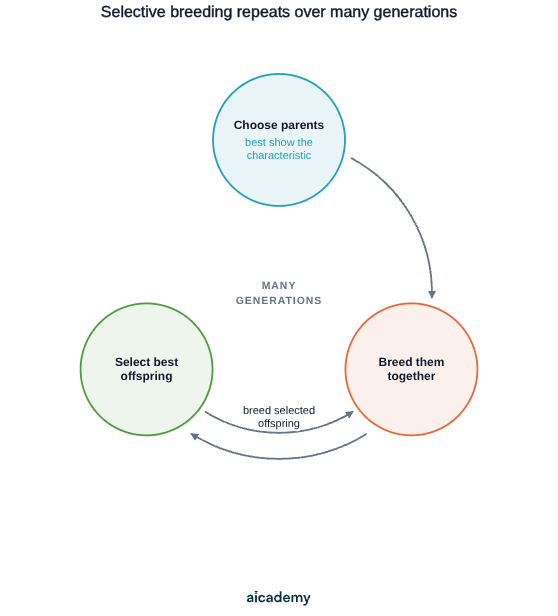
The steps in full:
- From a mixed population, choose the parents that best show the desired characteristic.
- Breed these chosen parents together.
- From their offspring, select those that best show the desired characteristic.
- Breed those selected offspring together.
- Repeat steps 3 and 4 over many generations, until eventually (nearly) all offspring show the desired characteristic.
At each generation, only the individuals closest to the target are allowed to reproduce. The ones that do not show the characteristic strongly are not bred from. Because the characteristic is inherited, each generation tends to show it a little more strongly than the last.
Exam tip: if a question asks you to describe selective breeding, you must mention selecting parents, breeding them, selecting the best offspring, and repeating over many generations. Leaving out "over many generations" is the single most common reason students lose a mark here.
Worth saving these ideas?
Turn what you've read into instant revision cards. Free to get started.
Key terms
- Selective breeding (artificial selection)
- The process by which humans choose which organisms reproduce, based on a desired inherited characteristic, so it becomes more common in later generations.
- Genetic characteristic
- A feature controlled by genes, such as coat colour, milk yield or fruit size, so that it can be inherited from parents by offspring.
- Inbreeding
- Breeding closely related organisms together, which reduces the size of the gene pool because the same few alleles are passed on repeatedly.
- Gene pool
- All the different alleles (gene versions) present in a population.
- Genetic variation
- The differences in alleles between individuals in a population, lost as the gene pool shrinks through inbreeding.
Frequently asked questions
In selective breeding (artificial selection) humans decide which organisms reproduce, whereas in natural selection the environment decides which organisms survive and reproduce. If a question says humans chose the parents, it is artificial selection.
Breeders keep choosing from the same small group of best individuals, which are often closely related. This inbreeding reduces the gene pool and variation, making inherited defects more likely and leaving the population vulnerable to new diseases or environmental change.
No. Selective breeding works only on variation that already exists in a population. Humans do not create new genes or alleles; they simply decide which existing ones get passed on, making useful ones more common over many generations.
Generate revision on any topic you study
Type any topic you're studying and Aicademy generates a complete lesson, quiz, and flashcard set, personalised to your level.
Lessons on anything
Structured, level-matched lessons on any topic you study
Practice quizzes
Find out what you actually know before the exam does
Flashcard sets
Lock in key concepts with instant revision cards
Ask Aica
Stuck on something? Get a clear explanation, any time
Variation and Evolution by Natural Selection
Genetic Engineering
Related lessons
11 min
11 min
9 min