DNA, the Genome and Protein Synthesis

Aligned to the AQA 8461 specification
- Level
- Advanced
- Reading time
- 12 min
- Published
- 16 June 2026
- Updated
- 16 August 2026
On this page
- 1.DNA: The Molecule That Stores Genetic Information
- 2.Genes, Chromosomes and the Genome
- 3.The Human Genome and Why It Matters for Medicine
- 4.DNA Structure: Nucleotides and the Four Bases
- 5.The Triplet Code and Complementary Base Pairing
- 6.Protein Synthesis: From Gene to Protein
- 7.Mutations and Non-Coding DNA
- 8.Common Exam Mistakes
Key takeaways
- DNA is a polymer made of two strands twisted into a double helix, found in chromosomes inside the nucleus, and it stores the genetic instructions for making proteins.
- A gene is a small section of DNA on a chromosome that codes for a particular sequence of amino acids to make a specific protein; the genome is all of an organism's genetic material.
- AQA limits understanding of the human genome to three uses: searching for genes linked to disease, understanding and treating inherited disorders, and tracing human migration.
- A sequence of three bases (a triplet code) codes for one amino acid, so the number of amino acids equals the number of bases divided by three.
- In complementary base pairing C always links to G and T always pairs with A, so knowing one strand lets you work out the other.
DNA Structure: Nucleotides and the Four Bases
(Biology only — this nucleotide detail appears only on the AQA GCSE Biology paper, not Combined Science. It is assessed at both Foundation and Higher tier.)
The DNA polymer is built from repeating units called nucleotides. DNA is made from four different nucleotides.
Each nucleotide is made of three parts:
- a common sugar,
- a phosphate group, and
- one of four different bases attached to the sugar.
The four bases are A, C, G and T (adenine, cytosine, guanine, thymine).
The two long strands of DNA each consist of alternating sugar and phosphate sections, forming the "backbone." Attached to each sugar is one of the four bases. A sketch of one strand looks like this:
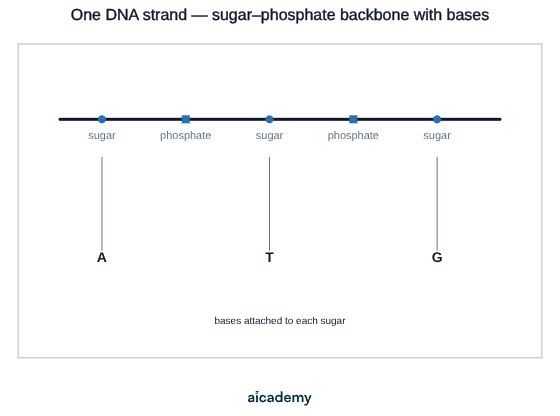
Because the backbone is the same alternating sugar–phosphate pattern all the way along, it is the order of the bases that carries the genetic information.
A nucleotide = one sugar + one phosphate group + one base. DNA is a polymer of repeating nucleotide units. You must be able to interpret a diagram of DNA structure, but you will not be asked to draw it from memory.
Studying this for an exam?
Generate a personalised learning path for this subject. Free to get started.
The Triplet Code and Complementary Base Pairing
(Biology only — the triplet code is assessed at both Foundation and Higher tier on the Biology paper. The complementary base-pairing detail later in this section is Higher Tier only.)
A sequence of three bases is the code for a particular amino acid. Because the code is read in groups of three, it is called a triplet code. The order of bases controls the order in which amino acids are assembled to produce a particular protein.
Worked example 1 — counting amino acids from bases. If a section of a gene is 30 bases long, how many amino acids does it code for?
Each amino acid needs 3 bases, so:
So 30 bases code for 10 amino acids.
Worked example 2 — working backwards. A short protein is made of 8 amino acids. How many bases of code are needed?
In the two strands of the double helix, the bases pair up in a fixed way:
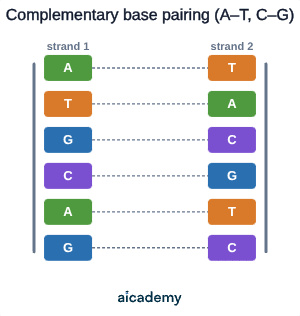
(Higher Tier only) In the complementary strands, a C is always linked to a G on the opposite strand, and a T always pairs with an A. So A–T and C–G are the only allowed pairings.
This complementary pairing means that if you know the bases on one strand, you can work out the other: opposite an A write T, opposite a T write A, opposite a C write G, and opposite a G write C.
Protein Synthesis: From Gene to Protein
(Higher Tier only — Biology only. AQA requires only a simple outline; you do not need the detailed structure of mRNA, tRNA, amino acids or proteins.)
The order of bases in a gene controls the order of amino acids in a protein. Building that protein happens in two outline stages:
1. Transcription — copying the gene. The base sequence of the gene is copied into a messenger molecule (mRNA). This copy carries the instructions out of the nucleus to a ribosome.
2. Translation — building the protein. Proteins are synthesised on ribosomes, according to the template. Carrier molecules bring specific amino acids to add to the growing protein chain in the correct order set by the triplet code.
A simple outline of the whole process:
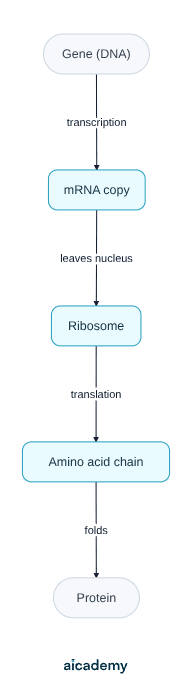
When the amino acid chain is complete, it folds up into a unique 3D shape. This shape is what lets the protein do its job — as an enzyme, a hormone, or a structural protein such as collagen.
Remember the order: a gene's base sequence → a sequence of amino acids → a folded protein. The shape of the finished protein decides its function.
Key terms
- DNA
- Deoxyribonucleic acid, the double-stranded polymer found in chromosomes in the nucleus that stores an organism's genetic instructions.
- Polymer
- A long molecule built from many small repeating units joined together.
- Double helix
- The twisted-ladder shape formed by the two strands of DNA winding around each other.
- Chromosome
- A long, coiled molecule of DNA found in the nucleus that carries many genes.
- Gene
- A small section of DNA on a chromosome that codes for a particular sequence of amino acids to make a specific protein.
- Genome
- The entire genetic material of an organism: every gene on every chromosome.
- Nucleotide
- A repeating unit of DNA made of one sugar, one phosphate group and one of four bases.
- Triplet code
- A sequence of three bases that codes for one amino acid.
- Transcription
- The stage of protein synthesis where the base sequence of a gene is copied into a messenger molecule (mRNA).
- Translation
- The stage of protein synthesis where a protein is built on a ribosome as carrier molecules bring amino acids in the correct order.
- Mutation
- A change to the base sequence of DNA, which occurs continuously.
- Phenotype
- An organism's observable characteristics.
Frequently asked questions
A gene is a small section of DNA that codes for one protein, a chromosome is a long coiled DNA molecule carrying many genes, and the genome is all of an organism's genetic material. The genome means every gene on every chromosome, not just one chromosome.
Divide the number of bases by three, because a triplet code of three bases codes for one amino acid. For example, 30 bases code for 10 amino acids, and to find the bases needed for a protein you multiply the number of amino acids by three.
A always pairs with T, and C always pairs with G. These are the only allowed pairings, so opposite an A you write T, opposite a T you write A, opposite a C you write G and opposite a G you write C.
Generate revision on any topic you study
Type any topic you're studying and Aicademy generates a complete lesson, quiz, and flashcard set, personalised to your level.
Lessons on anything
Structured, level-matched lessons on any topic you study
Practice quizzes
Find out what you actually know before the exam does
Flashcard sets
Lock in key concepts with instant revision cards
Ask Aica
Stuck on something? Get a clear explanation, any time
Sexual and Asexual Reproduction and Meiosis
Genetic Inheritance and Punnett Squares
Related lessons
8 min
11 min
11 min