Track progress, take quizzes and save notes on this lesson.

Free forever · no card needed

Start free
Intermediate

Cloning: Plants and Animals

4.6.2.5 Cloning (Biology only)

Aligned to the AQA 8461 specification

Level
Intermediate
Reading time
9 min
Published
16 June 2026
Updated
1 July 2026
On this page
  1. 1.What Cloning Means
  2. 2.Cuttings: The Gardener's Method
  3. 3.Tissue Culture: Cloning From a Few Cells
  4. 4.Embryo Transplants: Cloning Animals
  5. 5.Adult Cell Cloning: The Steps
  6. 6.Comparing All Four Methods
  7. 7.Common Exam Mistakes

Key takeaways

  • A clone is an organism that is genetically identical to another, produced asexually from a single parent with no fusion of gametes; any differences between clones come from the environment, not their genes.
  • GCSE Biology requires four cloning methods: cuttings and tissue culture clone plants, while embryo transplants and adult cell cloning clone animals.
  • Cuttings are the oldest, simplest method, where part of a parent plant grows into a new identical plant, while tissue culture grows small groups of cells into many identical plants, useful for preserving rare species and in nurseries.
  • In embryo transplants the cells of a developing embryo are split apart before they specialise, and each identical embryo is transplanted into a host mother.
  • In adult cell cloning the nucleus is removed from an egg cell and replaced with an adult body-cell nucleus, then an electric shock makes it divide into an embryo, which is implanted into a womb.

What Cloning Means

A clone is an organism that is genetically identical to another — it carries exactly the same DNA. Cloning is a form of asexual reproduction: it involves only one parent and no fusion of gametes (sex cells), so there is no mixing of genetic material.

Because there is no mixing, every clone produced from the same source has an identical genome. Any differences you see between clones (height, leaf size, weight) come from the environment, not their genes.

GCSE Biology (8461) requires four methods of cloning. Two clone plants, two clone animals:

MethodClonesDifficulty / age
CuttingsPlantsOld, simple
Tissue culturePlantsModern, needs lab equipment
Embryo transplantAnimalsModern
Adult cell cloningAnimalsModern, most complex

A clone is a genetically identical copy of an organism, produced asexually from a single parent.

Keep this division clear: if a question is about a plant, the answer is cuttings or tissue culture; if it is about an animal, it is embryo transplants or adult cell cloning.

Cuttings: The Gardener's Method

Cuttings are the oldest and simplest cloning method. A gardener removes a part of a plant — usually a stem with a few leaves — and plants it. With the right conditions (often after dipping the cut end in rooting hormone), the cutting grows roots and develops into a new, complete plant.

The new plant is a clone of the parent: it grew from the parent's own cells, so it shares the parent's exact DNA.

Why this works — applied reasoning:

  • Plants keep many cells that can still differentiate (specialise) into any tissue type, even in mature stems.
  • These cells divide by mitosis, which produces genetically identical daughter cells.
  • So the roots, stem and leaves that grow from the cutting all carry the parent's genome unchanged.

This is why a gardener who has one plant with attractive flowers can quickly fill a whole bed with identical plants — every cutting flowers the same way.

Cuttings: a part of a parent plant (e.g. a stem) is grown into a new identical plant. Cheap, fast and needs no special equipment.

Tissue Culture: Cloning From a Few Cells

Tissue culture is the modern laboratory method for cloning plants. Instead of a whole stem, it uses small groups of cells taken from part of a plant, grown into many identical new plants.

The process, in order:

  1. Take a small group of cells from a parent plant.
  2. Place them on a sterile growth medium containing nutrients and plant hormones.
  3. The cells divide by mitosis and grow into tiny plantlets.
  4. Each plantlet is transferred to soil to grow into a full plant.

Every plant produced is genetically identical to the parent, because all the cells came from one parent and divided by mitosis only.

Why it matters (this is on the spec):

  • Preserving rare species — a threatened or endangered plant can be reproduced in large numbers from just a few cells, helping save it from extinction.
  • Commercial use in nurseries — growers can mass-produce thousands of identical, high-quality plants quickly, all year round.
FeatureCuttingsTissue culture
Starting materialPart of plant (stem)Small group of cells
EquipmentMinimalSterile lab, hormones, medium
Number producedLimitedVery large
Main usesGardeningSaving rare species; nurseries

Embryo Transplants: Cloning Animals

Embryo transplants clone animals — commonly used in farming with prize cattle. The key idea: split an embryo before its cells specialise, so each piece can grow into a complete, identical animal.

The process, in order:

  1. Sperm fertilise eggs (e.g. from a prize bull and a prize cow), producing an embryo.
  2. While the embryo is still a small ball of cells, before the cells become specialised, the cells are split apart.
  3. Each group of split cells develops into a separate, genetically identical embryo.
  4. These identical embryos are transplanted into host (surrogate) mothers to develop and be born.

Applied reasoning — why timing matters:

The cells must be split before they specialise. While the cells are still unspecialised, each one (or small cluster) can still develop into a whole organism. Once cells have differentiated into specific tissues, a single piece can no longer build a complete animal.

The offspring are clones of each other — they share the genome of the original embryo, not of either host mother. The host mothers simply carry the pregnancies; they contribute no genes to the calves.

Embryo transplant: cells from a developing embryo are split apart before they specialise, then transplanted into host mothers. The young are identical to one another.

Want more lessons like this one?

Generate lessons on anything you study. Free account, no card needed.

Start generating

Adult Cell Cloning: The Steps

Adult cell cloning produces an animal that is a clone of one existing adult. This is the method behind Dolly the sheep, the first mammal cloned from an adult cell.

You must know the steps precisely and in the correct order:
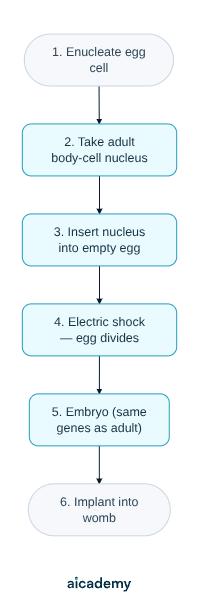
The precise steps, in the order you must reproduce them:

  1. Egg cell — remove the nucleus from an unfertilised egg cell (the egg is now "enucleated", empty of its nucleus).
  2. Body cell — take the nucleus from an adult body cell (e.g. a skin cell).
  3. Insert — put the adult body-cell nucleus into the empty egg cell.
  4. Shock — apply an electric shock to stimulate the egg cell to divide and form an embryo.
  5. Embryo — the embryo cells contain the same genetic information as the adult body cell.
  6. Implant — when the embryo is a ball of cells, insert it into the womb of an adult female to develop.

Applied walk-through — why the clone matches the adult, not the egg:

The egg cell's own nucleus is removed in step 1, so it contributes no genetic information. All the genetic instructions come from the adult body-cell nucleus inserted in step 3. That is why the resulting animal is genetically identical to the adult that donated the body cell — the egg provides the cell machinery, but the nucleus provides the DNA.

Adult cell cloning, in order: enucleated egg cell → adult body-cell nucleus inserted → electric shock → embryo → ball of cells implanted into a host female's womb.

Comparing All Four Methods

All four methods are asexual and produce genetically identical clones, but they differ in starting material and organism.

MethodOrganismOutline of how it works
CuttingsPlantsA part of the parent (e.g. a stem) is planted and grows into a new identical plant.
Tissue culturePlantsSmall groups of cells are grown on nutrient medium with hormones into many plantlets.
Embryo transplantAnimalsAn embryo's cells are split before specialising; identical embryos go to host mothers.
Adult cell cloningAnimalsAn adult body-cell nucleus is put into an enucleated egg, shocked, grown and implanted.

Benefits and risks (spec skill — WS 1.3, 1.4):

  • Agriculture: cloning lets farmers reliably reproduce animals or plants with desirable features (high milk yield, disease resistance). Risk: a cloned population has very low genetic variation, so a single disease or environmental change could wipe out the whole population.
  • Medicine: cloning could produce animals or cells for studying disease or making medicines, and underpins research into replacing damaged tissue. Risk: the techniques are difficult, expensive and have a low success rate.
  • Ethics: some people have ethical objections to cloning animals, especially concerns about animal welfare and where the technology might lead.

(Extra context — not required by AQA 8461.) Dolly the sheep was created in 1996 at the Roslin Institute and is the standard real-world example of adult cell cloning; you can name her, but the spec only requires the method.

Common Exam Mistakes

1. Saying clones are "exactly the same in every way"

Clones are genetically identical, but they can still look different because of their environment (e.g. sunlight, food, space). Write "genetically identical," not just "identical."

2. Mixing up which method clones plants and which clones animals

Cuttings and tissue culture clone plants. Embryo transplants and adult cell cloning clone animals. A common slip is to describe tissue culture for an animal — read the organism in the question first.

3. Forgetting to remove the egg cell's nucleus in adult cell cloning

The first step is removing the nucleus from the unfertilised egg cell. If you leave it in, the genetic explanation falls apart — the clone matches the adult body cell because the egg's own nucleus is gone.

4. Confusing embryo transplants with adult cell cloning

Embryo transplants split an embryo's cells (no adult nucleus, no electric shock). Adult cell cloning transfers an adult body-cell nucleus into an enucleated egg and uses an electric shock. They are different methods — do not blend the steps.

5. Saying the host mother passes on her genes

In both embryo transplants and adult cell cloning, the host (surrogate) female only carries the pregnancy. She contributes no genetic information to the offspring; the genome comes from the embryo or the donated nucleus.

Key terms

Clone
An organism that is genetically identical to another, produced asexually from a single parent.
Asexual reproduction
Reproduction involving only one parent and no fusion of gametes, so there is no mixing of genetic material.
Cuttings
The oldest, simplest cloning method, where a part of a parent plant is grown into a new identical plant.
Tissue culture
A laboratory method that grows small groups of plant cells on a nutrient medium with hormones into many identical plants.
Embryo transplant
Cloning animals by splitting a developing embryo's cells before they specialise, then transplanting them into host mothers.
Adult cell cloning
Cloning an existing adult by putting its body-cell nucleus into an enucleated egg, shocking it and implanting the embryo.
Mitosis
Cell division that produces genetically identical daughter cells.
Host mother
A surrogate female that carries the pregnancy in animal cloning but contributes no genes to the offspring.

Frequently asked questions

The four methods are cuttings and tissue culture, which clone plants, and embryo transplants and adult cell cloning, which clone animals. Cuttings are old and simple; tissue culture, embryo transplants and adult cell cloning are modern methods.

First the nucleus is removed from an unfertilised egg cell. The nucleus from an adult body cell is then inserted into the empty egg, and an electric shock stimulates it to divide into an embryo. When the embryo is a ball of cells it is implanted into the womb of an adult female to develop.

No. Clones are genetically identical, carrying the same DNA, but they can still look different because of their environment, such as differences in sunlight, food or space. The correct phrase is 'genetically identical', not just 'identical'.

Generate revision on any topic you study

Type any topic you're studying and Aicademy generates a complete lesson, quiz, and flashcard set, personalised to your level.

Lessons on anything

Structured, level-matched lessons on any topic you study

Practice quizzes

Find out what you actually know before the exam does

Flashcard sets

Lock in key concepts with instant revision cards

Ask Aica

Stuck on something? Get a clear explanation, any time

Prev

Genetic Engineering

Next

Darwin, Wallace and the Development of Evolution

Related lessons

11 min

Lesson

Genetic Engineering

AQA GCSE Biology · AQA 8461

1 month ago

10 min

Lesson

Stem Cells

AQA GCSE Biology · AQA 8461

1 month ago

Top students don’t revise more. They revise what counts.

Start revising free

Free to start. No card needed.