Track progress, take quizzes and save notes on this lesson.

Free forever · no card needed

Start free
Foundational

Selective Breeding

4.6.2.3 Selective breeding

Aligned to the AQA 8461 specification

Level
Foundational
Reading time
9 min
Published
16 June 2026
Updated
1 July 2026
On this page
  1. 1.What Selective Breeding Is
  2. 2.The Process Step by Step
  3. 3.Worked Example: Breeding a High-Yield Dairy Cow
  4. 4.What Humans Breed For
  5. 5.The Problem: Inbreeding and a Shrinking Gene Pool
  6. 6.Worked Example: Why Reduced Variation Is Dangerous
  7. 7.Common Exam Mistakes

Key takeaways

  • Selective breeding (artificial selection) is when humans choose which organisms reproduce based on a desired inherited characteristic, so that characteristic becomes more common in later generations.
  • Selective breeding must be repeated over many generations; describing only one round of breeding is incomplete and is the most common reason students lose a mark.
  • Humans selectively breed for disease resistance in crops, more meat or milk in farm animals, a gentle nature in dogs, and large or unusual flowers in ornamental plants.
  • Selective breeding does not create new genes; it acts on variation that already exists, making useful existing alleles more common.
  • Inbreeding reduces the gene pool and genetic variation, which causes inherited defects and leaves the population vulnerable to new diseases and environmental change.

What Selective Breeding Is

Selective breeding, also called artificial selection, is the process by which humans breed plants and animals for particular genetic characteristics. People choose which organisms get to reproduce, picking parents that have a feature they find useful or attractive.

This is not new technology. Humans have been doing it for thousands of years — every food crop grown today was bred from a wild plant, and every breed of farm animal and pet dog descends from wild ancestors that humans gradually shaped.

Selective breeding (artificial selection): humans choose which organisms reproduce, based on a desired inherited characteristic, so that the characteristic becomes more common in later generations.

The key word is genetic. The chosen characteristic must be one controlled by genes (such as coat colour, milk yield, or fruit size) so that it can be passed from parents to offspring. A characteristic caused only by the environment — for example, a plant that happens to be tall because it had extra fertiliser — cannot be selectively bred for, because it would not be inherited.

Selective breeding works on variation that already exists within a population. Humans do not create new genes; they simply decide which of the existing ones get passed on.

The Process Step by Step

Selective breeding follows the same repeating cycle whether the organism is a crop, a cow, or a dog. The crucial point is that it happens over many generations — a single round of breeding is rarely enough.
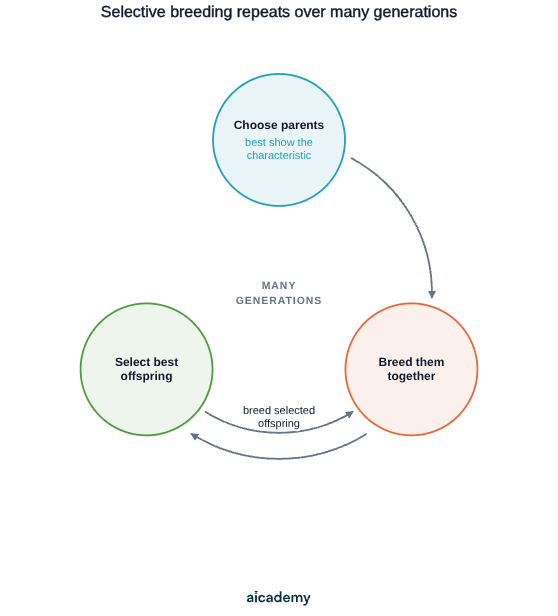
The steps in full:

  1. From a mixed population, choose the parents that best show the desired characteristic.
  2. Breed these chosen parents together.
  3. From their offspring, select those that best show the desired characteristic.
  4. Breed those selected offspring together.
  5. Repeat steps 3 and 4 over many generations, until eventually (nearly) all offspring show the desired characteristic.

At each generation, only the individuals closest to the target are allowed to reproduce. The ones that do not show the characteristic strongly are not bred from. Because the characteristic is inherited, each generation tends to show it a little more strongly than the last.

Exam tip: if a question asks you to describe selective breeding, you must mention selecting parents, breeding them, selecting the best offspring, and repeating over many generations. Leaving out "over many generations" is the single most common reason students lose a mark here.

Worked Example: Breeding a High-Yield Dairy Cow

Suppose a farmer starts with a mixed herd of cows that produce different amounts of milk, and wants a herd where every cow produces a large volume of milk. Here is how selective breeding achieves that.

GenerationWhat the farmer doesOutcome
StartMeasure milk yield across a mixed herdYields vary a lot
1Breed the highest-yielding cows with a bull from a high-yield motherCalves born
2Measure the daughters' yields; breed only the bestAverage yield rises slightly
3–10+Keep selecting and breeding only the highest yielders each generationAverage yield climbs each generation
Many generations laterNearly all cows are high-yieldingGoal achieved

The same logic applies to animals which produce more meat — a farmer breeds the largest, fastest-growing individuals each generation until the whole herd grows large quickly.

Two things to notice:

  • Bulls matter too. A bull cannot produce milk, so the farmer selects a bull whose mother and sisters were high yielders — the useful genes can be carried by an animal that does not itself show the characteristic.
  • It is slow. Each generation takes time (for cattle, several years), so reaching the goal can take decades. This is a genuine limitation of selective breeding compared with faster modern methods.

What Humans Breed For

The characteristic chosen can be selected for usefulness or for appearance. The AQA specification lists four standard examples — learn these, as they are the ones the exam expects you to be able to quote.

Characteristic bred forType of organismWhy it is useful or wanted
Disease resistanceFood cropsPlants that survive infection give more reliable harvests
More meat or milkFarm animals (cattle, sheep, pigs)Greater food yield from each animal
A gentle natureDomestic dogsSafe, calm pets and working animals
Large or unusual flowersGarden / ornamental plantsAttractive appearance for gardens and sale

The first two examples are about usefulness (food production), while the last two are more about appearance and temperament. In every case the principle is identical: humans decide which individuals reproduce, generation after generation, so the chosen feature spreads through the population.

Disease resistance in food crops is a particularly important example: a crop variety bred to resist a fungal disease can protect an entire harvest without the farmer needing as many chemical sprays.

Worth saving these ideas?

Turn what you've read into instant revision cards. Free to get started.

Make flashcards

The Problem: Inbreeding and a Shrinking Gene Pool

Selective breeding has a serious downside. Because breeders keep choosing from the same small group of "best" individuals, those individuals are often closely related. Breeding closely related organisms together is called inbreeding.

Gene pool: all the different alleles (gene versions) present in a population. Inbreeding reduces the size of the gene pool because the same few alleles are passed on again and again.

When the same alleles are repeatedly selected, the gene pool shrinks and the population loses genetic variation — the individuals become more and more genetically similar. This causes two linked problems:

  • Inherited defects and disease. Inbreeding makes it more likely that two copies of a harmful recessive allele come together in the same offspring. This is why some pedigree dog breeds are particularly prone to specific health problems — for example, breathing difficulties or hip disorders that are common within a breed.
  • Vulnerability to new threats. With little variation, there are few or no individuals with alleles that could resist a new disease or cope with an environmental change. If such a threat arrives, a large proportion of the population can be wiped out because almost none of them carry useful protective alleles.

In short: selective breeding trades long-term resilience for short-term gains in a chosen characteristic.

Worked Example: Why Reduced Variation Is Dangerous

It can be hard to see why low variation is risky, so work through this reasoning carefully — this is exactly the kind of "explain" question AQA asks.

Imagine two populations of wheat facing a new fungal disease:

PopulationGenetic variationWhat happens when the new disease arrives
Wild wheatHigh — many different allelesSome plants happen to carry resistance alleles and survive; the population recovers
Heavily selectively-bred wheatLow — gene pool reduced by selectionAlmost no plants carry resistance alleles, so most are killed; the harvest can fail

Step-by-step reasoning:

  1. Selective breeding repeatedly chose only high-yield plants, so other alleles — including any that gave disease resistance — were lost from the gene pool.
  2. A reduced gene pool means less genetic variation: the plants are nearly identical.
  3. When a new disease appears, resistance depends on having the right allele by chance.
  4. With little variation, few or no plants carry that allele.
  5. Therefore a single new disease can devastate the whole crop.

This is why maintaining wild varieties and seed banks matters: they preserve the genetic variation that intensively bred populations have lost.

(Extra context — not required by AQA 8461.) The 1840s Irish potato famine is often cited as a real example of low-variation crops being destroyed by a single disease (potato blight). You do not need this case for the exam.

Common Exam Mistakes

1. Forgetting "over many generations"

Selective breeding is gradual. A description that stops after breeding one pair of parents is incomplete — you must say the selection and breeding is repeated over many generations until the characteristic appears in (nearly) all offspring.

2. Confusing selective breeding with genetic engineering

These are different processes and usually different lessons. Selective breeding chooses which existing organisms reproduce and relies on natural reproduction over many generations. Genetic engineering directly transfers genes from one organism to another in a single generation. Do not mix the two in an answer.

3. Saying selective breeding "creates new genes"

It does not. Humans select from variation that already exists in the population. No new alleles are made — useful existing ones are simply made more common.

4. Vague answers about the risks

"It is bad for the animals" is too weak. Name the mechanism: inbreeding reduces the gene pool, which reduces variation, which makes the population more vulnerable to new diseases and inherited defects.

5. Mixing up natural selection and artificial selection

In natural selection the environment decides which organisms survive and reproduce. In artificial selection (selective breeding) humans decide. If a question says humans chose the parents, it is artificial selection.

Key terms

Selective breeding (artificial selection)
The process by which humans choose which organisms reproduce, based on a desired inherited characteristic, so it becomes more common in later generations.
Genetic characteristic
A feature controlled by genes, such as coat colour, milk yield or fruit size, so that it can be inherited from parents by offspring.
Inbreeding
Breeding closely related organisms together, which reduces the size of the gene pool because the same few alleles are passed on repeatedly.
Gene pool
All the different alleles (gene versions) present in a population.
Genetic variation
The differences in alleles between individuals in a population, lost as the gene pool shrinks through inbreeding.

Frequently asked questions

In selective breeding (artificial selection) humans decide which organisms reproduce, whereas in natural selection the environment decides which organisms survive and reproduce. If a question says humans chose the parents, it is artificial selection.

Breeders keep choosing from the same small group of best individuals, which are often closely related. This inbreeding reduces the gene pool and variation, making inherited defects more likely and leaving the population vulnerable to new diseases or environmental change.

No. Selective breeding works only on variation that already exists in a population. Humans do not create new genes or alleles; they simply decide which existing ones get passed on, making useful ones more common over many generations.

Generate revision on any topic you study

Type any topic you're studying and Aicademy generates a complete lesson, quiz, and flashcard set, personalised to your level.

Lessons on anything

Structured, level-matched lessons on any topic you study

Practice quizzes

Find out what you actually know before the exam does

Flashcard sets

Lock in key concepts with instant revision cards

Ask Aica

Stuck on something? Get a clear explanation, any time

Prev

Variation and Evolution by Natural Selection

Next

Genetic Engineering

Related lessons

11 min

Lesson

Genetic Engineering

AQA GCSE Biology · AQA 8461

1 month ago

9 min

Lesson

Cloning: Plants and Animals

AQA GCSE Biology · AQA 8461

1 month ago

Top students don’t revise more. They revise what counts.

Start revising free

Free to start. No card needed.