Vectors

Aligned to the Pearson Edexcel 1MA1 specification
- Level
- Intermediate
- Reading time
- 6 min
- Published
- 12 June 2026
- Updated
- 24 August 2026
On this page
Key takeaways
- A vector has both magnitude and direction; it is written as a column vector (x, y) where x is horizontal movement and y is vertical movement.
- To reverse a vector, negate both components: vector BA = -(vector AB). Forgetting this sign change is the most common error in vector path problems.
- Two vectors are parallel if one is a scalar multiple of the other; to prove lines are parallel in a vector proof, show their vectors differ only by a scalar factor.
- The magnitude of column vector (x, y) is sqrt(x^2 + y^2); never calculate it as x + y.
- For geometric proofs (Higher), express all vectors in terms of two base vectors a and b, then use scalar multiples to show parallel or equal lengths.
Adding and Subtracting Vectors (G25)
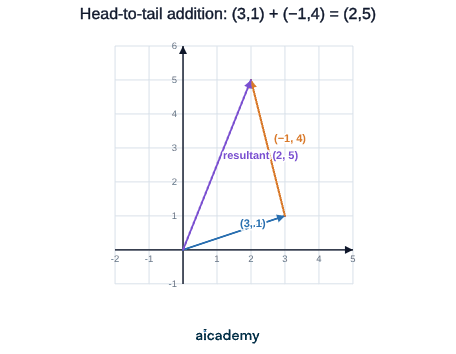
Adding vectors combines two displacements:
Geometrically: place the second vector's tail at the first vector's head; the result is the vector from the start to the finish.
Subtracting vectors:
Zero vector:
Worked example — and . Find .
✓
Reversing a vector:
Studying this for an exam?
Generate a personalised learning path for this subject. Free to get started.
Key terms
- vector
- A quantity with both magnitude and direction, represented as a column vector (x, y) or a bold/underlined letter.
- scalar
- A quantity with magnitude only, no direction; multiplying a vector by a scalar scales its length.
- column vector
- A way to write a vector as (x, y), where x is the horizontal component and y is the vertical component.
- magnitude
- The length (size) of a vector; for column vector (x, y), magnitude = sqrt(x^2 + y^2).
- resultant vector
- The single vector equivalent to two or more vectors combined by head-to-tail addition.
- parallel vectors
- Two vectors are parallel if one is a scalar multiple of the other; they point in the same or opposite directions.
- position vector
- A vector from the origin O to a point, describing that point's location.
Frequently asked questions
Vectors chain head to tail: vector AC = vector AB + vector BC. Add the corresponding components of each column vector. A common mistake is subtracting instead of adding.
Express both line segments as vectors in terms of base vectors. If one vector equals a scalar multiple of the other (e.g. MN = (1/2)*AB), the lines are parallel. Always state this conclusion explicitly to earn the proof marks.
A scalar has magnitude only (e.g. speed, length). A vector has both magnitude and direction (e.g. velocity, displacement). Multiplying a vector by a scalar changes its size but keeps its direction (or reverses it if the scalar is negative).
Generate revision on any topic you study
Type any topic you're studying and Aicademy generates a complete lesson, quiz, and flashcard set, personalised to your level.
Lessons on anything
Structured, level-matched lessons on any topic you study
Practice quizzes
Find out what you actually know before the exam does
Flashcard sets
Lock in key concepts with instant revision cards
Ask Aica
Stuck on something? Get a clear explanation, any time
Pythagoras and Trigonometry
Probability — Basics and Possibility Spaces
Related lessons
7 min
Constructions, Congruence and Transformations
Edexcel GCSE Mathematics · Pearson Edexcel 1MA1
4 months ago
7 min
7 min
Similarity, 3D Shapes and Coordinate Geometry
Edexcel GCSE Mathematics · Pearson Edexcel 1MA1
4 months ago