Similarity, 3D Shapes and Coordinate Geometry

Aligned to the Pearson Edexcel 1MA1 specification
- Level
- Intermediate
- Reading time
- 7 min
- Published
- 12 June 2026
- Updated
- 24 August 2026
On this page
Key takeaways
- For similar shapes, missing lengths scale by k (the linear scale factor), areas scale by k^2, and volumes scale by k^3 — never mix these up.
- Two triangles are similar if they share two equal angles (AA criterion); the third angle is then forced equal by the angle sum to 180 degrees.
- The distance between two points (x1, y1) and (x2, y2) is sqrt((x2-x1)^2 + (y2-y1)^2) — always square root the final sum.
- Hidden edges on plans and elevations are drawn as dashed lines; visible edges are solid. Confusing these misrepresents the 3D shape.
- To find the volume ratio of two similar solids, cube the linear scale factor; if given the volume ratio, cube-root it to get the length scale factor.
Coordinate Geometry Problems (G11)
Distance between two points and :
Worked example — find the distance between and :
✓
Checking if a triangle is right-angled: compute all three side lengths and test Pythagoras.
Worked example — vertices , , :
, , . Since , triangle is right-angled at . ✓
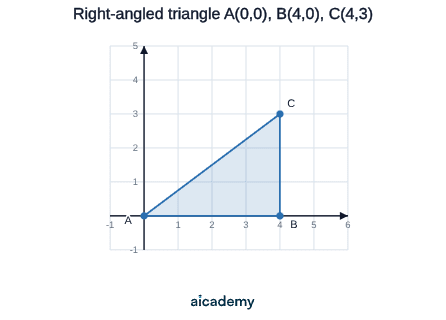
Area on a coordinate grid — use the grid or the triangle formula with the base and perpendicular height read from the coordinates.
Congruence and Similarity (G19)
Congruent shapes are identical in shape and size — one can be mapped exactly onto the other by rotation, reflection, or translation. Corresponding sides are equal; corresponding angles are equal; scale factor .
Similar shapes have the same angles and proportional sides — they are enlargements of each other. Scale factor may be any positive value; when the shapes are also congruent.
| Property | Congruent | Similar |
|---|---|---|
| Same angles | Yes | Yes |
| Same side lengths | Yes | Proportional (ratio ) |
| Same area | Yes | Area ratio |
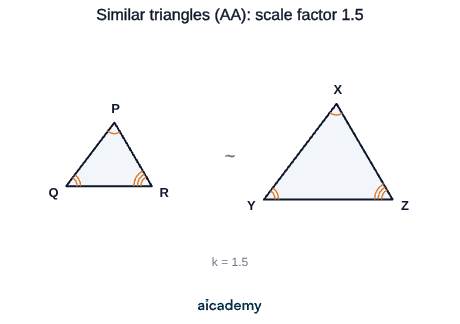
Identifying similar triangles: two triangles are similar if they share two equal angles (AA — the third angle is then forced equal by the angle sum).
Worked example — triangles and have and . Show they are similar and find if , , .
AA criterion: two pairs of equal angles → similar.
cm ✓
Studying this for an exam?
Generate a personalised learning path for this subject. Free to get started.
Key terms
- face
- A flat surface of a 3D solid.
- edge
- A line where two faces of a 3D solid meet.
- vertex
- A corner of a 3D solid where edges meet (plural: vertices).
- plan
- The 2D view of a 3D object seen from directly above.
- elevation
- The 2D view of a 3D object seen from the front or side.
- similar shapes
- Shapes with equal corresponding angles and sides in proportion; one is an enlargement of the other.
- congruent shapes
- Shapes that are identical in size and shape; scale factor equals 1.
- scale factor
- The ratio k of corresponding lengths in two similar shapes.
- cross-section
- The shape revealed when a solid is cut through with a flat plane, perpendicular to its length.
Frequently asked questions
Divide a known side of the larger shape by the corresponding side of the smaller shape: k = image side / object side. Then multiply unknown sides by k, multiply areas by k^2, and multiply volumes by k^3.
Congruent shapes are identical in size and shape (scale factor = 1); similar shapes have the same angles and proportional sides but can be different sizes (scale factor k, any positive value).
A plan is the view from directly above and shows full width and depth. Front and side elevations show height. Hidden edges appear as dashed lines in both.
Generate revision on any topic you study
Type any topic you're studying and Aicademy generates a complete lesson, quiz, and flashcard set, personalised to your level.
Lessons on anything
Structured, level-matched lessons on any topic you study
Practice quizzes
Find out what you actually know before the exam does
Flashcard sets
Lock in key concepts with instant revision cards
Ask Aica
Stuck on something? Get a clear explanation, any time
Circles, Sectors and Circle Theorems
Pythagoras and Trigonometry
Related lessons
7 min
Constructions, Congruence and Transformations
Edexcel GCSE Mathematics · Pearson Edexcel 1MA1
4 months ago
6 min
6 min
6 min