Straight-Line Graphs

Aligned to the Pearson Edexcel 1MA1 specification
- Topic
- Algebra
- Level
- Foundational
- Reading time
- 7 min
- Published
- 12 June 2026
- Updated
- 16 August 2026
On this page
Key takeaways
- Every straight line (except vertical) can be written as y = mx + c, where m is the gradient (steepness) and c is the y-intercept (where the line crosses the y-axis).
- Gradient = (y2 - y1) / (x2 - x1); a positive gradient slopes up left to right, a negative gradient slopes down.
- Parallel lines share the same gradient. Perpendicular lines have gradients that multiply to -1; the perpendicular gradient is the negative reciprocal -1/m.
- To find the equation of a line through a point (x1, y1) with gradient m, use y - y1 = m(x - x1) then rearrange to y = mx + c.
- On a real-world graph, the gradient gives the rate of change (e.g. speed on a distance-time graph) and the y-intercept gives the starting value.
The Equation y = mx + c
Every straight line (except vertical lines) can be written as , where:
- = gradient (steepness and direction)
- = -intercept (where the line crosses the -axis; the value of when )
Worked example — for the line :
- Gradient: (goes up 3 for every 1 right)
- -intercept: (crosses -axis at )
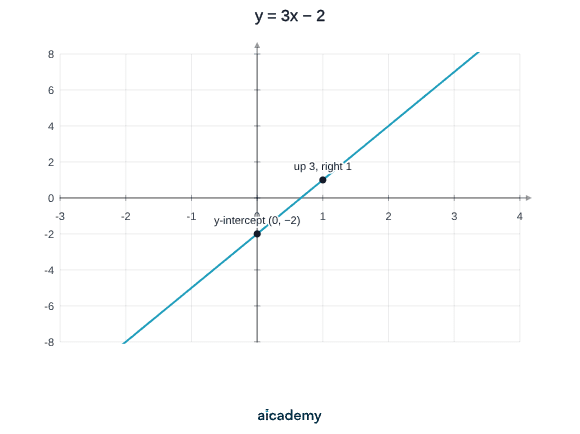
Reading the equation from a graph: identify where the line crosses the -axis (gives ) and pick two clear points to calculate the gradient (gives ).
Converting to :
Gradient ; -intercept . ✓
How much of this have you taken in?
Quiz yourself on this section, free, no card needed.
Parallel and Perpendicular Lines (Higher)
Parallel lines have the same gradient. If a line has gradient , any parallel line also has gradient .
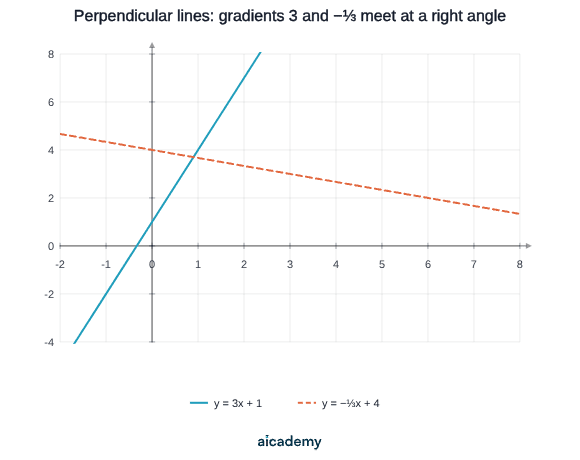
Perpendicular lines cross at right angles. If a line has gradient , a perpendicular line has gradient (the negative reciprocal). Their gradients multiply to .
Worked example — find the equation of the line perpendicular to that passes through .
Gradient of :
Perpendicular gradient:
Check: at : ✓
Key terms
- gradient
- The measure of a line's steepness, calculated as (change in y) / (change in x); positive slopes up, negative slopes down.
- y-intercept
- The value of y where a line crosses the y-axis; the constant c in y = mx + c.
- y = mx + c
- The standard form of a straight-line equation, where m is the gradient and c is the y-intercept.
- parallel lines
- Lines that never intersect; they have identical gradients.
- perpendicular lines
- Lines that cross at right angles; their gradients multiply to -1.
- origin
- The point (0, 0) where the x-axis and y-axis intersect.
- midpoint
- The point exactly halfway between two given points, found by averaging the x-coordinates and the y-coordinates separately.
Frequently asked questions
Rearrange the equation into the form y = mx + c. The coefficient of x is the gradient m. For example, 3x - 2y = 6 rearranges to y = (3/2)x - 3, so the gradient is 3/2.
The perpendicular gradient is the negative reciprocal: -1/4. In general, if the original gradient is m, the perpendicular gradient is -1/m. The two gradients always multiply to give -1.
The midpoint of (x1, y1) and (x2, y2) is ((x1+x2)/2, (y1+y2)/2) - average the x-values and average the y-values separately.
Generate revision on any topic you study
Type any topic you're studying and Aicademy generates a complete lesson, quiz, and flashcard set, personalised to your level.
Lessons on anything
Structured, level-matched lessons on any topic you study
Practice quizzes
Find out what you actually know before the exam does
Flashcard sets
Lock in key concepts with instant revision cards
Ask Aica
Stuck on something? Get a clear explanation, any time
Formulae, Rearranging and Functions
Quadratic and Other Graphs
Related lessons
7 min
6 min
Direct and Inverse Proportion, and Rates of Change
Edexcel GCSE Mathematics · Pearson Edexcel 1MA1
4 months ago
7 min
Solving Equations and Simultaneous Equations
Edexcel GCSE Mathematics · Pearson Edexcel 1MA1
4 months ago
6 min
Graph Transformations, Rates of Change, and Circles (Higher)
Edexcel GCSE Mathematics · Pearson Edexcel 1MA1
4 months ago
6 min