Track progress, take quizzes and save notes on this lesson.

Free forever · no card needed

Start free
Intermediate

Constructions, Congruence and Transformations

G2·G5·G6·G7·G8

Aligned to the Pearson Edexcel 1MA1 specification

Level
Intermediate
Reading time
6 min
Published
12 June 2026
Updated
1 July 2026
On this page
  1. 1.Ruler and Compass Constructions (G2)
  2. 2.Loci (G2)
  3. 3.Congruence Criteria (G5, G6)
  4. 4.Transformations (G7)
  5. 5.Combined Transformations (G8 Higher)
  6. 6.Common Exam Mistakes

Key takeaways

  • The four congruence criteria are SSS, SAS, ASA, and RHS. AAA proves similarity only, not congruence, since the triangles can be different sizes.
  • Construction arcs must be left visible in the final answer. Erasing them removes the evidence that the construction was done correctly and loses marks.
  • To fully describe a rotation, state the angle, the direction (clockwise or anticlockwise), and the centre. Any one missing loses marks.
  • Enlargement with a negative scale factor places the image on the opposite side of the centre and rotates it by 180 degrees.
  • A locus is the set of all points satisfying a given condition. Points equidistant from two fixed points lie on the perpendicular bisector of the segment joining them.

Ruler and Compass Constructions (G2)

Constructions must be done with ruler and compass only — no protractor. Leave all arcs visible in the final answer.

Perpendicular bisector of a line segment :

  1. Open the compass to more than half the length of .
  2. Draw arcs above and below the line from and (same compass setting).
  3. Connect the two intersection points — this is the perpendicular bisector.
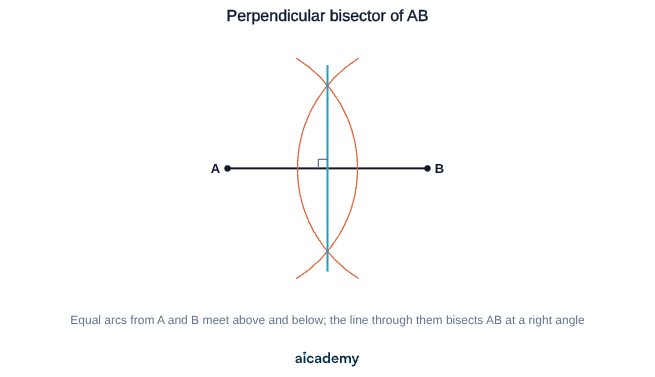
Result: every point on the perpendicular bisector is equidistant from and .

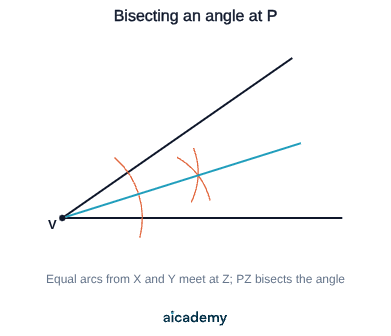
Bisecting an angle at :

  1. Draw an arc centred at that crosses both arms of the angle at and .
  2. Draw equal arcs from and that intersect at .
  3. Draw — this is the angle bisector.

Perpendicular from a point to a line (and at a point on a line): use the same principle — place the compass at the point, find two equal-distance points on the line, then bisect the resulting segment.

Shortest distance from a point to a line = the perpendicular distance. Any other path to the line is longer.

Loci (G2)

A locus (plural: loci) is the set of all points satisfying a given condition.

ConditionLocus
Fixed distance from point Circle centred at
Equal distance from two points , Perpendicular bisector of
Fixed distance from a lineTwo lines parallel to the original
Equal distance from two linesAngle bisector of the angle between the lines

Worked example — shade the region less than 3 cm from point and closer to than to .

Draw a circle of radius 3 cm centred at ; draw the perpendicular bisector of . Shade the intersection of the interior of the circle and the -side of the bisector.

Congruence Criteria (G5, G6)

Two triangles are congruent (identical in shape and size) if any one of these conditions holds:

CriterionWhat it means
SSSAll three sides equal
SASTwo sides and the included angle equal
ASATwo angles and the included side equal
RHSRight angle, hypotenuse, and one other side equal

AAA is not a congruence criterion — it only guarantees similarity (same shape, possibly different size).

G6 — isosceles triangle: the base angles of an isosceles triangle are equal. Proof: draw the perpendicular bisector from the apex to the base; two congruent right-angled triangles (RHS) imply the base angles are equal.

Pythagoras as derivation (G6): from the areas of squares on each side of a right-angled triangle, . Used to prove lengths and check right angles.

Transformations (G7)

The four standard transformations are rotation, reflection, translation and enlargement.

TransformationFully described byPreserves size?Preserves shape?
TranslationVector YesYes
RotationCentre, angle, directionYesYes
ReflectionMirror line equationYesYes
EnlargementCentre and scale factorNoYes

Enlargement with fractional scale factor (): the image is smaller than the object; all lengths are multiplied by .

Enlargement with negative scale factor (Higher): the image appears on the opposite side of the centre from the object and is also rotated by 180°. If scale factor , each point is twice as far from the centre but on the opposite side.

Coordinate enlargement — enlarge point from centre by factor :

How much of this have you taken in?

Quiz yourself on this section, free, no card needed.

Test myself

Combined Transformations (G8 Higher)

A combined transformation applies two or more transformations in sequence. The order matters — the result may differ if the order is swapped.

Invariant points are points that map to themselves under a transformation.

  • Under a reflection: all points on the mirror line are invariant.
  • Under a rotation: only the centre of rotation is invariant (if it lies on the object).
  • Under a translation: no points are invariant (unless the vector is zero).
  • Under an enlargement with : only the centre of enlargement is invariant.

Worked example — reflect shape in the -axis to get , then rotate by clockwise about the origin to get . Describe the single transformation that maps to .

After reflection in -axis: . After clockwise rotation: . Net effect: — a reflection in the line . ✓

(Extra context — any two reflections in perpendicular lines combine to give a rotation of 180° about their intersection; two reflections in parallel lines give a translation.)

Common Exam Mistakes

1. Congruence — using AAA as a criterion

AAA guarantees similarity, not congruence. Two triangles can have all the same angles but be different sizes. A congruence proof must use SSS, SAS, ASA, or RHS.

2. Describing a rotation — omitting direction or centre

A rotation needs three things: the angle, the direction (clockwise/anticlockwise), and the centre. Missing any one of these loses marks.

3. Enlargement — measuring from the wrong point

Enlargement is measured from the centre of enlargement, not from the origin or from the shape. If the centre is at and scale factor 2, move each vertex twice as far from , not twice as far from .

4. Constructions — erasing arcs

Construction arcs must remain visible — erasing them removes the evidence that the construction was done correctly.

MistakeCorrection
"Enlarge by scale factor from : point "With negative scale factor: (multiply and negate)
"SAS: sides 4, 5 and angle of 60° between them ≡ sides 4, 5 and angle of 60° adjacent to the 4-side"SAS requires the angle to be between (included by) the two given sides — different configurations are not necessarily congruent
"Perpendicular bisector: draw a line crossing through the midpoint of "The perpendicular bisector must be perpendicular to and pass through its midpoint — use compass arcs to guarantee this

Key terms

Congruent
Two shapes are congruent if they are identical in shape and size; one can be mapped onto the other by a combination of rotations, reflections, and translations.
Locus
The set of all points that satisfy a given geometric condition, for example all points a fixed distance from a point form a circle.
Perpendicular bisector
The line that cuts a line segment at its midpoint at a right angle; every point on it is equidistant from the two endpoints.
Angle bisector
A line that divides an angle into two equal parts; constructed using compass arcs from each arm of the angle.
Invariant point
A point that maps to itself under a transformation. Under reflection, every point on the mirror line is invariant.
Scale factor
The multiplier used in an enlargement. A fractional scale factor produces a smaller image; a negative scale factor also rotates the image by 180 degrees.

Frequently asked questions

For each vertex, find the vector from the centre of enlargement to that vertex, multiply it by the scale factor, and add the result back to the centre. Enlargement is measured from the centre, not from the origin.

SSS (all three sides equal), SAS (two sides and the included angle), ASA (two angles and the included side), RHS (right angle, hypotenuse, and one other side). Use whichever matches the information given in the question. AAA is not a valid criterion.

Open the compass to more than half the length of the segment. Draw arcs from each endpoint above and below the line using the same compass setting. Connect the two intersection points. Leave all arcs visible.

Generate revision on any topic you study

Type any topic you're studying and Aicademy generates a complete lesson, quiz, and flashcard set, personalised to your level.

Lessons on anything

Structured, level-matched lessons on any topic you study

Practice quizzes

Find out what you actually know before the exam does

Flashcard sets

Lock in key concepts with instant revision cards

Ask Aica

Stuck on something? Get a clear explanation, any time

Prev

Angles and Polygons

Next

Area, Perimeter and Volume

Related lessons

6 min

Lesson

Angles and Polygons

Edexcel GCSE Mathematics · Pearson Edexcel 1MA1

1 month ago

6 min

6 min

Lesson

Vectors

Edexcel GCSE Mathematics · Pearson Edexcel 1MA1

1 month ago

Top students don’t revise more. They revise what counts.

Start revising free

Free to start. No card needed.