Pythagoras and Trigonometry

Aligned to the Pearson Edexcel 1MA1 specification
- Level
- Intermediate
- Reading time
- 6 min
- Published
- 12 June 2026
- Updated
- 16 August 2026
On this page
Key takeaways
- Pythagoras' theorem: a^2 + b^2 = c^2, where c is the hypotenuse. Find the hypotenuse with c = sqrt(a^2 + b^2); find a shorter side with a = sqrt(c^2 - b^2).
- SOHCAHTOA applies only to right-angled triangles. For any triangle, use the sine rule (a/sin(A) = b/sin(B)) or cosine rule (a^2 = b^2 + c^2 - 2bc*cos(A)) at Higher tier.
- The area of any triangle is (1/2)*a*b*sin(C), where C is the included angle between sides a and b. This works even when the perpendicular height is unknown.
- Exact trig values must be memorised: sin(30) = 1/2, cos(30) = sqrt(3)/2, sin(45) = cos(45) = sqrt(2)/2, sin(60) = sqrt(3)/2, cos(60) = 1/2, tan(60) = sqrt(3).
- For 3D Pythagoras, apply the theorem twice: find a diagonal in a horizontal or vertical plane first, then use that length as a side in a second right-angled triangle.
Pythagoras' Theorem (G20)
In a right-angled triangle with legs , and hypotenuse :
The hypotenuse is the longest side, opposite the right angle.
Finding the hypotenuse:
Worked example: , . cm ✓
Finding a shorter side:
Worked example: , . cm ✓
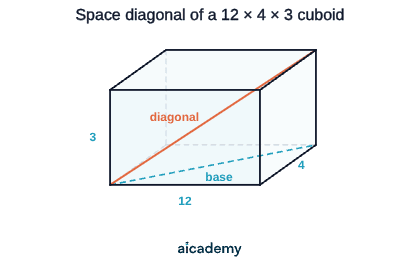
3D Pythagoras (Higher): apply the theorem twice — first in a horizontal or vertical plane, then use that result as a side in a second triangle.
Worked example — find the length of the space diagonal of a cuboid cm.
Base diagonal: . Space diagonal: cm ✓
Sine Rule and Cosine Rule (G22 Higher)
Use non-right-angled triangle rules when no right angle is present.
Sine rule (use when given two angles + one side, or two sides + an angle not between them):
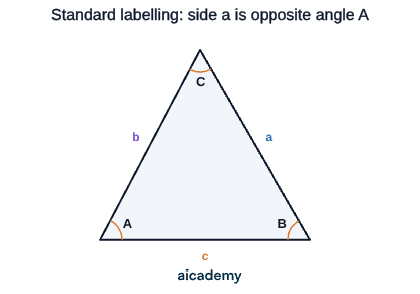
Worked example — in triangle : , , cm. Find .
. cm ✓
Cosine rule (use when given two sides + the included angle, or all three sides to find an angle):
Rearranged to find angle:
Worked example — , , . Find .
cm ✓
Studying this for an exam?
Generate a personalised learning path for this subject. Free to get started.
Key terms
- hypotenuse
- The longest side of a right-angled triangle, opposite the right angle; found using c = sqrt(a^2 + b^2).
- Pythagoras' theorem
- In a right-angled triangle: a^2 + b^2 = c^2, where c is the hypotenuse.
- sine rule
- For any triangle: a/sin(A) = b/sin(B) = c/sin(C); used when two angles and a side, or two sides and a non-included angle, are known.
- cosine rule
- For any triangle: a^2 = b^2 + c^2 - 2bc*cos(A); used when two sides and the included angle, or all three sides, are known.
- exact trigonometric values
- Specific surd or fraction values of sin, cos, and tan for 0, 30, 45, 60, and 90 degrees that must be known without a calculator.
Frequently asked questions
Use the sine rule when you know two angles and one side, or two sides and a non-included angle. Use the cosine rule when you know two sides and the included angle, or all three sides to find an angle.
If you know two sides a and b and the angle C between them, use area = (1/2)*a*b*sin(C). This formula applies to any triangle, including non-right-angled ones.
When two sides and a non-included angle are given, two different triangles may satisfy the conditions. The sine rule gives one angle; check whether 180 minus that angle also produces a valid triangle with the given information.
Generate revision on any topic you study
Type any topic you're studying and Aicademy generates a complete lesson, quiz, and flashcard set, personalised to your level.
Lessons on anything
Structured, level-matched lessons on any topic you study
Practice quizzes
Find out what you actually know before the exam does
Flashcard sets
Lock in key concepts with instant revision cards
Ask Aica
Stuck on something? Get a clear explanation, any time
Similarity, 3D Shapes and Coordinate Geometry
Vectors
Related lessons
7 min
Similarity, 3D Shapes and Coordinate Geometry
Edexcel GCSE Mathematics · Pearson Edexcel 1MA1
4 months ago
6 min
Graph Transformations, Rates of Change, and Circles (Higher)
Edexcel GCSE Mathematics · Pearson Edexcel 1MA1
4 months ago
7 min