Quadratic and Other Graphs

Aligned to the Pearson Edexcel 1MA1 specification
- Topic
- Algebra
- Level
- Intermediate
- Reading time
- 7 min
- Published
- 12 June 2026
- Updated
- 16 August 2026
On this page
Key takeaways
- A quadratic graph y = ax^2 + bx + c is a parabola: U-shaped when a > 0 (minimum), arch-shaped when a < 0 (maximum). The y-intercept is always c.
- The line of symmetry is x = -b/2a and the turning point lies on it. For y = (x+p)^2 + q (completed square form), the turning point is at (-p, q) -- the sign inside the bracket reverses.
- The reciprocal graph y = 1/x has two branches in the 1st and 3rd quadrants, never touches the axes, and does not pass through the origin.
- Every exponential graph y = k^x passes through (0, 1) because k^0 = 1. It never crosses the x-axis.
- On a speed-time graph the gradient equals acceleration and the area under the graph equals distance travelled.
Quadratic Graphs — Shape and Key Features
A quadratic function has the form where . Its graph is a parabola.
| Feature | Explanation |
|---|---|
| Shape | U-shape if ; ∩-shape if |
| -intercept | The value of (set ) |
| Roots | Where the graph crosses the -axis: set and solve |
| Turning point | The minimum (if ) or maximum (if ) of the parabola |
| Line of symmetry | Vertical line through the turning point: |
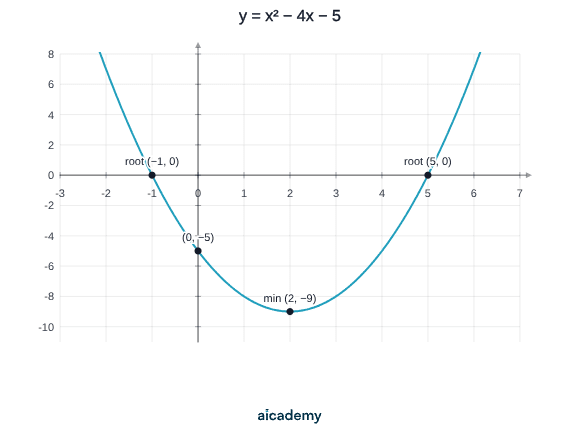
Worked example — sketch :
- -intercept: , so
- Roots: or
- Line of symmetry:
- Turning point: ; ; minimum at ✓
Cubic and Reciprocal Graphs
Cubic functions have the form .
- If : goes from bottom-left to top-right; may have one or two "bends"
- If : goes from top-left to bottom-right
- Simple example: passes through the origin, is symmetric about the origin
Key cubic sketch facts: has roots at .
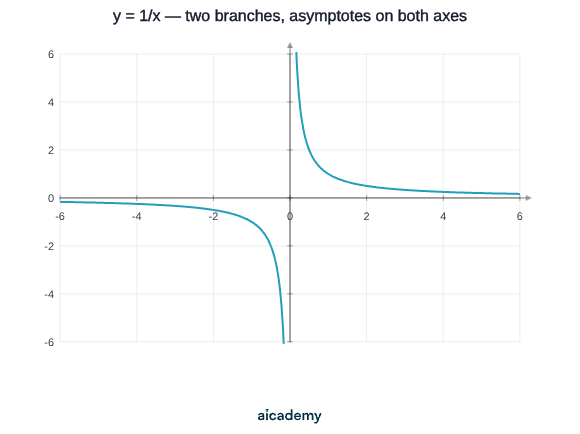
Reciprocal function: (where )
- Two branches: one in the first quadrant () and one in the third ()
- Has two asymptotes: the -axis () and the -axis () — the curve approaches but never touches them
- As , ; as ,
(Extra context — the general reciprocal has the same shape, scaled by ; not required to be named explicitly.)
Exponential and Trigonometric Graphs (Higher)
Exponential function: for a positive base
- If : exponential growth — graph rises steeply for , approaches zero for
- If : exponential decay — graph falls towards zero for
- Key values: for any valid , so every exponential graph passes through
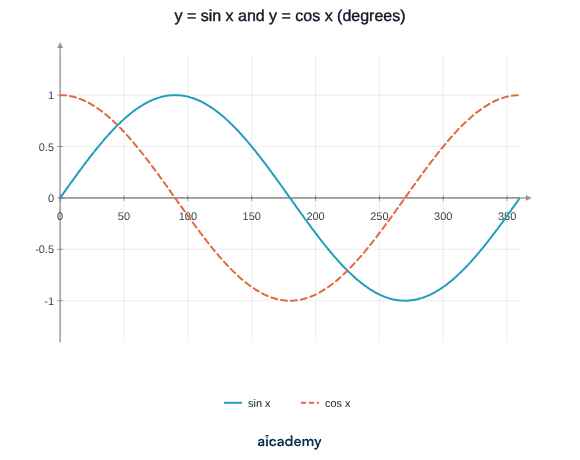
Trigonometric graphs (arguments in degrees):
| Function | Period | Range | Key values |
|---|---|---|---|
| 360° | ; ; ; | ||
| 360° | ; ; ; | ||
| 180° | all reals | undefined at ; ; |
The and graphs are identical in shape but shifted by 90°. has vertical asymptotes at .
Want more lessons like this one?
Generate lessons on anything you study. Free account, no card needed.
Key terms
- Parabola
- The curved shape of a quadratic graph; U-shaped for a positive leading coefficient and arch-shaped for a negative one.
- Turning point
- The minimum or maximum point of a parabola where the curve changes direction; found using the line of symmetry or completing the square.
- Line of symmetry
- The vertical line x = -b/2a that passes through the turning point of a parabola and divides it into two mirror-image halves.
- Asymptote
- A line that a curve approaches but never reaches; the reciprocal graph y = 1/x has asymptotes at x = 0 and y = 0.
- Roots
- The x-values where a graph crosses the x-axis, found by setting y = 0 and solving the equation.
- Exponential function
- A function of the form y = k^x where k is a positive constant not equal to 1; its graph always passes through (0, 1).
Frequently asked questions
Use the line of symmetry x = -b/2a to find the x-coordinate, then substitute back to find y. For Higher, complete the square to get a(x+p)^2 + q; the turning point is (-p, q).
Mark the y-intercept (value of c), the roots where the graph crosses the x-axis (set y = 0 and solve), and the turning point. Label the line of symmetry if asked.
y = 1/x is undefined at x = 0 and approaches but never reaches the axes (asymptotes). One branch is in the first quadrant where x > 0 and y > 0, the other in the third quadrant where both are negative.
Generate revision on any topic you study
Type any topic you're studying and Aicademy generates a complete lesson, quiz, and flashcard set, personalised to your level.
Lessons on anything
Structured, level-matched lessons on any topic you study
Practice quizzes
Find out what you actually know before the exam does
Flashcard sets
Lock in key concepts with instant revision cards
Ask Aica
Stuck on something? Get a clear explanation, any time
Straight-Line Graphs
Solving Equations and Simultaneous Equations
Related lessons
7 min
7 min
Solving Equations and Simultaneous Equations
Edexcel GCSE Mathematics · Pearson Edexcel 1MA1
4 months ago
6 min
Graph Transformations, Rates of Change, and Circles (Higher)
Edexcel GCSE Mathematics · Pearson Edexcel 1MA1
4 months ago
6 min