Track progress, take quizzes and save notes on this lesson.

Free forever · no card needed

Start free
Intermediate

Solving Equations and Simultaneous Equations

A17·A18·A19·A20

Aligned to the Pearson Edexcel 1MA1 specification

Topic
Algebra
Level
Intermediate
Reading time
6 min
Published
12 June 2026
Updated
1 July 2026
On this page
  1. 1.Solving Linear Equations
  2. 2.Solving Quadratic Equations — Factorising
  3. 3.The Quadratic Formula and Completing the Square (Higher)
  4. 4.Approximate Solutions from Graphs (A17 / A18)
  5. 5.Simultaneous Equations — Elimination and Substitution
  6. 6.Linear-Quadratic Simultaneous Equations (Higher)
  7. 7.Iteration (Higher)
  8. 8.Common Exam Mistakes

Key takeaways

  • Always rearrange a quadratic to the form ax^2 + bx + c = 0 before factorising; factorising only works when one side equals zero.
  • The discriminant b^2 - 4ac tells you the number of roots: positive gives two distinct roots, zero gives one repeated root, negative gives no real roots.
  • For iteration (Higher), rearrange to x = f(x), start from x0, and repeatedly apply the formula; if the sequence diverges, try a different rearrangement.
  • When solving x^2 = 9, both x = 3 and x = -3 are solutions; never assume only the positive square root.
  • To solve a linear equation with fractions, multiply through by the LCM of the denominators first to clear them, then collect like terms.

Solving Linear Equations

A linear equation has the variable to the first power only. Solve by performing inverse operations to isolate the variable.

Single-sided:

Unknown on both sides — collect variable terms on one side:

With fractions — multiply through by the LCM of denominators:

With brackets — expand first:

Solving Quadratic Equations — Factorising

A quadratic equation has the form . The standard method at Foundation tier is factorising.

Method:

  1. Rearrange so one side equals zero.
  2. Factorise the left side.
  3. Set each factor equal to zero.
  4. Solve each resulting linear equation.

Worked example — solve :

Worked example — solve (Higher):

Factorise (AC method): ; two numbers multiplying to and adding to : and .

The Quadratic Formula and Completing the Square (Higher)

When a quadratic does not factorise neatly, use the quadratic formula:

Worked example — solve (give answers to 2 d.p.):

The discriminant tells you how many real roots exist:

  • : two distinct real roots
  • : one repeated root
  • : no real roots

Solving by completing the square:

Approximate Solutions from Graphs (A17 / A18)

When an equation cannot be solved exactly by inspection, or when the question asks for an estimate, graph intersection provides approximate solutions.

Method — solving graphically: plot both and on the same axes. The -coordinates of the intersection points are the approximate solutions.

Worked example — linear equation from a graph (A17):

To solve , plot and . The lines cross at , so .

This matches the algebraic solution:

Worked example — quadratic from a graph (A18):

To solve approximately, plot . Read off where the graph crosses the -axis (where ).

Reading from the graph: or (to 1 d.p.)

Alternatively, rearrange to , plot and , and read the -coordinates of the intersections.

Worked example — simultaneous equations from a graph (A19):

To solve and simultaneously, plot both lines. They intersect at approximately , giving , .

Algebraic check: ✓ and ✓. The intersection point is the exact solution.

Key exam skill: read -values at intersections or axis crossings to 1 decimal place unless the question specifies otherwise. Show which graph you are reading from and label the intersection.

Something not quite clicking?

Ask Aica to explain any part of this differently. Free, takes 30 seconds.

Ask Aica

Simultaneous Equations — Elimination and Substitution

Two simultaneous equations are solved when values of and satisfy both at once.

Elimination method — multiply equations to match coefficients, then add or subtract:

Worked example — solve and :

Add: . Substitute: . Solution:

Check in both: ✓;

Substitution method:

Worked example — solve and :

Substitute into the second:

. Solution:

Linear-Quadratic Simultaneous Equations (Higher)

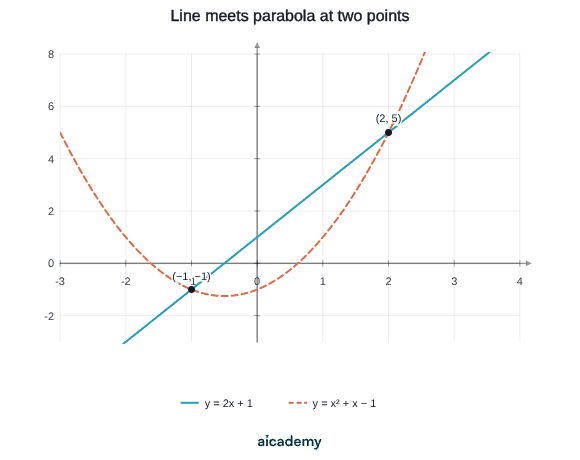
When one equation is quadratic, use substitution to reduce to a single quadratic.

Worked example — solve and :

Solutions: and

Geometrically, these are the intersection points of a line and a parabola.
Iteration (Higher)

Iteration finds approximate solutions to equations numerically by repeatedly applying a rearrangement of the equation.

Method: rearrange the equation into the form . Starting from an initial estimate , compute , then , and so on. The sequence converges to the root.

Worked example — show that can be rearranged to , and use iteration with to find the root to 3 s.f.

Rearrangement:

— converging to (3 s.f.) ✓

Common Exam Mistakes

1. Not rearranging to zero before factorising a quadratic

must be rearranged to before factorising. Factorising only works when one side equals zero.

2. Simultaneous equations — arithmetic error after elimination

After finding one variable, substitute back into one of the original equations (not a derived equation) and check the answer in the other equation.

3. Quadratic formula — sign error with

gives two solutions. Writing only the case means the second solution is missed — common when a question asks for two answers.

4. Linear-quadratic — expecting only one solution

A line can intersect a parabola at 0, 1, or 2 points. Unless the discriminant is zero or the equations produce an impossible result, there are usually two solution pairs to find and state.

MistakeCorrection
" has only solution "Factorise: ; solutions and — don't divide both sides by
"Solve : " (both square roots: and )
"Iteration diverges, so the formula is wrong"If iteration diverges, try a different rearrangement of the equation

Key terms

linear equation
An equation where the variable appears to the first power only; it has exactly one solution.
quadratic equation
An equation of the form ax^2 + bx + c = 0; it can have zero, one, or two real solutions.
discriminant
The expression b^2 - 4ac in the quadratic formula; its sign determines the number of real roots.
iteration
A numerical method for finding approximate roots by repeatedly applying a rearrangement of the form x = f(x) starting from an initial estimate.
completing the square
Rewriting a quadratic in the form (x + p)^2 + q to find its solutions or vertex.

Frequently asked questions

Use the quadratic formula x = (-b +/- sqrt(b^2 - 4ac)) / (2a) for ax^2 + bx + c = 0. This always works. For Higher tier, completing the square is also required.

A linear equation has the variable to the first power and gives one solution. A quadratic has an x^2 term and can give zero, one, or two solutions, found by factorising, the quadratic formula, or completing the square.

Plot both sides of the equation as separate functions. The x-coordinates of the intersection points are the approximate solutions, read to 1 decimal place unless the question specifies otherwise.

Generate revision on any topic you study

Type any topic you're studying and Aicademy generates a complete lesson, quiz, and flashcard set, personalised to your level.

Lessons on anything

Structured, level-matched lessons on any topic you study

Practice quizzes

Find out what you actually know before the exam does

Flashcard sets

Lock in key concepts with instant revision cards

Ask Aica

Stuck on something? Get a clear explanation, any time

Prev

Quadratic and Other Graphs

Next

Inequalities and Forming Equations

Related lessons

7 min

Lesson

Algebraic Manipulation

Edexcel GCSE Mathematics · Pearson Edexcel 1MA1

1 month ago

5 min

Lesson

Formulae, Rearranging and Functions

Edexcel GCSE Mathematics · Pearson Edexcel 1MA1

1 month ago

5 min

Lesson

Inequalities and Forming Equations

Edexcel GCSE Mathematics · Pearson Edexcel 1MA1

1 month ago

6 min

Lesson

Simultaneous Equations

Edexcel GCSE Mathematics · Pearson Edexcel 1MA1

1 month ago

6 min

Lesson

The Quadratic Formula

Edexcel GCSE Mathematics · Pearson Edexcel 1MA1

1 month ago

Top students don’t revise more. They revise what counts.

Start revising free

Free to start. No card needed.