Direct and Inverse Proportion, and Rates of Change

Aligned to the Pearson Edexcel 1MA1 specification
- Level
- Intermediate
- Reading time
- 6 min
- Published
- 12 June 2026
- Updated
- 16 August 2026
On this page
Key takeaways
- For direct proportion, write y = kx (or y = kx^2 etc.), find k from the given pair of values, then substitute to find the unknown. Do not scale using ratios for non-linear proportion.
- For inverse proportion, y = k/x (equivalently xy = k). The graph is a hyperbola, not a straight line.
- Compound unit formulas: speed = distance/time, density = mass/volume, pressure = force/area. Rearrange using the formula triangle. Never divide mass by density to get volume.
- The gradient of a straight-line real-world graph gives the rate of change: on a distance-time graph it is speed; on a velocity-time graph it is acceleration.
- For curved graphs (Higher), a tangent at a point gives the instantaneous rate of change; a chord between two points gives the average rate of change over that interval.
Compound Units (R11)
Compound units combine two or more base units. Formulas must be memorised:
Each formula rearranges as a triangle:
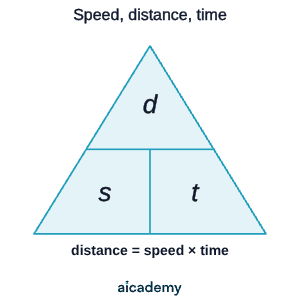
| Formula | Find distance | Find time |
|---|---|---|
Worked example — density:
An object has mass 450 g and volume 60 cm³. Find the density and material (iron ≈ 7.9 g/cm³, aluminium ≈ 2.7 g/cm³, wood ≈ 0.6 g/cm³).
g/cm³ — consistent with iron. ✓
Worked example — pressure:
A force of 120 N acts over an area of 0.4 m². Find the pressure.
N/m² (pascals) ✓
Unit pricing and rates of pay: "£12 per hour" means £12 for every 1 hour worked — a direct proportion with .
Gradient as Rate of Change (R14)
On a real-world graph, the gradient gives the rate at which the -quantity changes per unit of .
| Graph type | Gradient meaning |
|---|---|
| Distance-time | Speed (m/s, km/h) |
| Velocity-time | Acceleration (m/s²) |
| Cost against time | Rate of spending (£/day) |
| Mass against volume | Density (g/cm³) |
Direct proportion graphs are straight lines through the origin — the gradient is the constant of proportionality.
Inverse proportion graphs are hyperbolas — not linear, so the gradient is not constant.
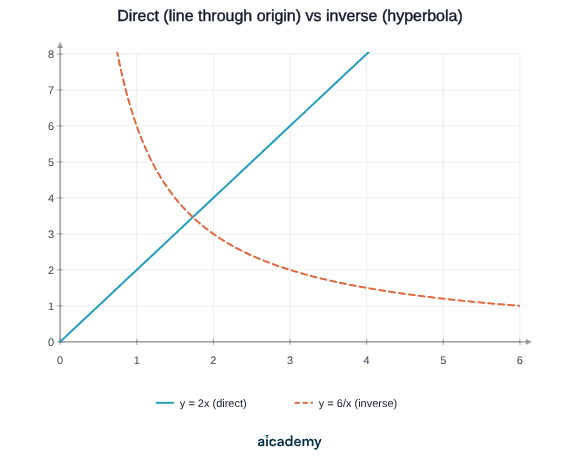
Worked example — a car journey: the distance-time graph is a straight line from to (time in hours, distance in km). The gradient is km/h — the car's constant speed. ✓
Want more lessons like this one?
Generate lessons on anything you study. Free account, no card needed.
Key terms
- Direct proportion
- A relationship where y = kx for a constant k; doubling x doubles y and the graph is a straight line through the origin.
- Inverse proportion
- A relationship where y = k/x for a constant k; doubling x halves y and the graph is a hyperbola.
- Constant of proportionality
- The fixed value k in a proportion equation such as y = kx or y = k/x, found by substituting a known pair of values.
- Compound unit
- A unit formed from two or more base units, such as m/s for speed or g/cm^3 for density.
- Instantaneous rate of change
- The rate of change at a single point on a curve, found as the gradient of the tangent to the curve at that point (Higher).
- Average rate of change
- The rate of change over an interval, found as the gradient of the chord joining the two endpoints on the curve (Higher).
Frequently asked questions
Direct proportion means y = kx: doubling x doubles y, and the graph is a straight line through the origin. Inverse proportion means y = k/x: doubling x halves y, and the graph is a hyperbola.
Substitute the given pair of values into the proportion equation and solve for k. For example, if y = kx and y = 20 when x = 4, then k = 20/4 = 5.
Average rate is the gradient of the chord joining two points on the curve. Instantaneous rate is the gradient of the tangent drawn at a single point. Only the tangent gives the rate at that exact moment.
Generate revision on any topic you study
Type any topic you're studying and Aicademy generates a complete lesson, quiz, and flashcard set, personalised to your level.
Lessons on anything
Structured, level-matched lessons on any topic you study
Practice quizzes
Find out what you actually know before the exam does
Flashcard sets
Lock in key concepts with instant revision cards
Ask Aica
Stuck on something? Get a clear explanation, any time
Percentages, Similarity and Growth
Angles and Polygons
Related lessons
5 min
6 min
7 min
6 min
Graph Transformations, Rates of Change, and Circles (Higher)
Edexcel GCSE Mathematics · Pearson Edexcel 1MA1
4 months ago