The Quadratic Formula

Aligned to the Pearson Edexcel 1MA1 specification
- Topic
- Algebra
- Level
- Intermediate
- Reading time
- 6 min
- Published
- 12 June 2026
- Updated
- 16 August 2026
On this page
Key takeaways
- The quadratic formula x = (-b +/- sqrt(b^2 - 4ac)) / 2a solves any quadratic ax^2 + bx + c = 0. Always rearrange into this standard form before reading off a, b, and c.
- The discriminant b^2 - 4ac tells you the number of real solutions before you complete the calculation: positive means two solutions, zero means one repeated solution, negative means no real solutions.
- Take care with the sign of b: if b = -4, then -b = +4. A sign error at this step invalidates both solutions.
- The -b and the +/- sqrt(...) term must both be divided by 2a. Writing -b +/- sqrt(b^2-4ac) / 2a (only dividing the square-root part) is a common layout error.
- Keep sqrt(b^2 - 4ac) at full calculator precision until the final step; rounding the square root early introduces error into both solutions.
Studying this for an exam?
Generate a personalised learning path for this subject. Free to get started.
The Discriminant
The expression under the square root is called the discriminant. It tells you how many real solutions the equation has — before you complete the full calculation.
| Discriminant value | Number of real solutions | Graph behaviour |
|---|---|---|
| Two distinct real solutions | Parabola crosses -axis twice | |
| One repeated solution | Parabola touches -axis once | |
| No real solutions | Parabola does not cross -axis |
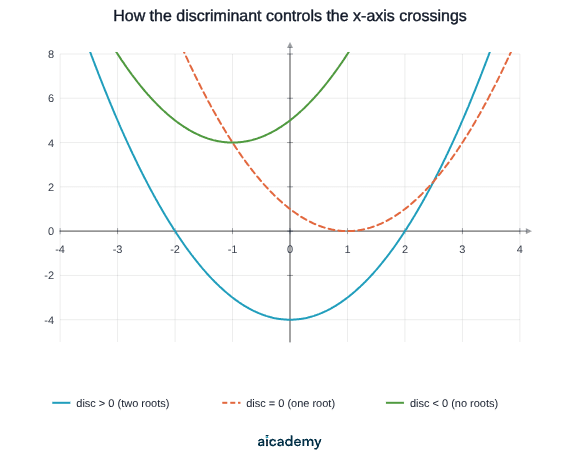
Worked example — Without fully solving, determine how many solutions has.
, , . Discriminant .
No real solutions. The parabola sits entirely above the -axis.
In exam questions, "show that the equation has no real solutions" means calculate the discriminant and show it is negative. You do not need to attempt the full formula.
Key terms
- Quadratic formula
- The formula x = (-b +/- sqrt(b^2 - 4ac)) / 2a used to solve any quadratic equation ax^2 + bx + c = 0.
- Discriminant
- The expression b^2 - 4ac inside the quadratic formula; its sign determines whether the quadratic has two, one, or no real solutions.
- Standard form
- A quadratic written as ax^2 + bx + c = 0 with all terms on one side; required before identifying a, b, and c.
- Repeated solution
- A single value of x that satisfies the equation; occurs when the discriminant equals zero, meaning the parabola just touches the x-axis.
Frequently asked questions
Use the formula when the quadratic does not factorise with integer pairs, when the answer must be a decimal or surd, or when a discriminant question is asked. If factors are obvious, factorising is faster.
The discriminant b^2 - 4ac tells you how many real solutions exist. Greater than zero gives two distinct solutions, equal to zero gives one repeated solution, less than zero means no real solutions.
Calculate b^2 - 4ac and show the result is negative. State that because the discriminant is less than zero the equation has no real solutions. You do not need to attempt the full formula.
Generate revision on any topic you study
Type any topic you're studying and Aicademy generates a complete lesson, quiz, and flashcard set, personalised to your level.
Lessons on anything
Structured, level-matched lessons on any topic you study
Practice quizzes
Find out what you actually know before the exam does
Flashcard sets
Lock in key concepts with instant revision cards
Ask Aica
Stuck on something? Get a clear explanation, any time
Simultaneous Equations
Trigonometry: SOHCAHTOA
Related lessons
5 min
Formulae, Rearranging and Functions
Edexcel GCSE Mathematics · Pearson Edexcel 1MA1
4 months ago
7 min
Solving Equations and Simultaneous Equations
Edexcel GCSE Mathematics · Pearson Edexcel 1MA1
4 months ago
6 min