Track progress, take quizzes and save notes on this lesson.

Free forever · no card needed

Start free
Intermediate

Simultaneous Equations

A19·A21

Aligned to the Pearson Edexcel 1MA1 specification

Topic
Algebra
Level
Intermediate
Reading time
6 min
Published
12 June 2026
Updated
1 July 2026
On this page
  1. 1.What Simultaneous Equations Are
  2. 2.The Elimination Method
  3. 3.Elimination with Scaling
  4. 4.The Substitution Method
  5. 5.Setting Up from a Context
  6. 6.Common Exam Mistakes

Key takeaways

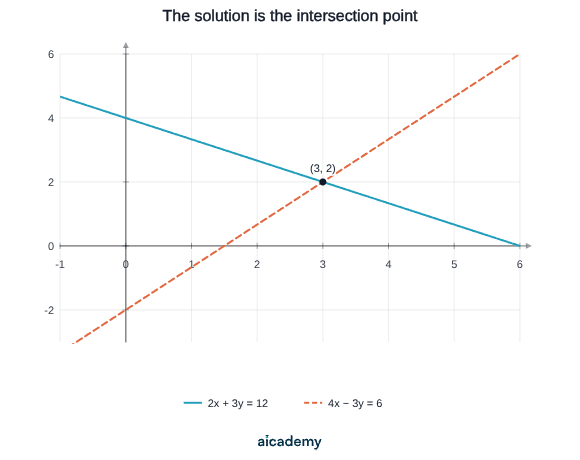
  • Simultaneous equations are two equations that must be satisfied by the same values of x and y at the same time; the solution is where the two lines intersect.
  • Elimination: scale one or both equations so that one variable's coefficient matches, then add or subtract to cancel it, leaving a single equation to solve.
  • Substitution: rearrange one equation to express y (or x) in terms of the other variable, then substitute into the second equation.
  • Always find both variables and check your answer in both original equations to catch arithmetic errors before they cost marks.
  • When forming equations from a context, define your variables clearly with units; examiners award marks for the definition, the equations, and the solution separately.

What Simultaneous Equations Are

Simultaneous equations are two equations that must both be satisfied by the same values of the unknowns at the same time. Finding these values is called solving simultaneously.

A single linear equation like has infinitely many solutions — any point on that line. A second equation like narrows the answer to one point: the unique pair of values that satisfies both equations simultaneously.

The solution is where the two lines cross. For and , that intersection is the point found algebraically below.
Number of equationsUnknownsSolutions
1 linear equation2 unknownsInfinitely many
2 linear equations2 unknownsOne pair (usually)

Two methods are required for GCSE: elimination and substitution. Both produce the same answer — the choice is down to which is faster for the structure of the equations given.

Linear simultaneous equations (two straight lines) are assessed at both Foundation and Higher. Linear/quadratic simultaneous equations are Higher tier only.

The Elimination Method

Elimination works by scaling one or both equations so that the coefficient of one variable becomes equal (or equal and opposite) in both equations. Adding or subtracting then removes that variable, leaving a single equation in one unknown.

Steps:

  1. Multiply one (or both) equations by a constant so the coefficients of one variable match.
  2. Add or subtract the equations to eliminate that variable.
  3. Solve the resulting single-variable equation.
  4. Substitute back to find the second variable.
  5. Check in both original equations.

Worked example — Solve simultaneously: and .

The coefficients of are already equal and opposite ( and ). Add the equations:

Substitute into the first equation: .

Check:

Solution: , .

Elimination with Scaling

When coefficients do not match, multiply one or both equations before eliminating.

Worked example — Solve: and .

To eliminate , make the -coefficients equal: multiply equation 1 by 3 and equation 2 by 2.

Add (coefficients are and , so they cancel):

Substitute into equation 1:

Check in equation 2:

Solution: , .

If the coefficients had the same sign (e.g., and ), subtract instead of add.

Eliminate the variable whose coefficients are easier to match. If one variable already appears with a simple coefficient (1, 2, 3), choose that one.

The Substitution Method

Substitution works by rearranging one equation to express one variable in terms of the other, then substituting that expression into the second equation.

Best used when one equation already has a variable with coefficient 1, making rearrangement simple.

Worked example — Solve: and .

The first equation gives directly. Substitute into the second:

Substitute back: .

Check:

Solution: , .

Worked example 2 — Solve: and .

Rearrange the first equation: . Substitute:

Then . Check:

Worth saving these ideas?

Turn what you've read into instant revision cards. Free to get started.

Make flashcards

Setting Up from a Context

Many GCSE questions describe a real-world situation and ask you to form and solve simultaneous equations. The method is: define your variables clearly, write two equations, then solve.

Worked example — Two shops sell pens and rulers. Shop A charges £1.20 for 2 pens and 1 ruler. Shop B charges £1.70 for 3 pens and 1 ruler. Both shops charge the same price per pen and the same price per ruler. Find the price of one pen.

Let = price of a pen (£) and = price of a ruler (£).

Subtract equation 1 from equation 2: .

Substitute: .

One pen costs 50p and one ruler costs 20p.

Define your variables at the start — write "let = ..." — and always state units. Examiners award marks for the definition, the equations, and the solution separately.

Common Exam Mistakes

1. Subtracting equations incorrectly

When subtracting equation 2 from equation 1, subtract every term. A common error is subtracting only the -terms and forgetting to subtract the constant. Write each equation on a separate line and work column by column.

2. Forgetting to find the second variable

Solving for completes only half the problem. You must substitute back to find . Stopping after finding one variable loses half the solution marks.

3. Not checking the solution

Substituting your answer into the original equations takes 20 seconds and catches arithmetic slips before they cost marks. Always check in both equations — not just the one you used to find the second variable.

4. Sign errors when multiplying to match coefficients

Multiplying by gives . The negative must be distributed to every term, including the constant. Writing is a common error.

5. Misidentifying which variable to eliminate

Both methods work on any pair of simultaneous equations. If elimination looks complicated, switch to substitution. Choose whichever method suits the structure of the equations, not habit.

Key terms

simultaneous equations
Two or more equations that must be satisfied by the same values of the unknowns at the same time.
elimination method
Solving simultaneous equations by scaling equations to match one variable's coefficient, then adding or subtracting to remove it.
substitution method
Solving simultaneous equations by expressing one variable in terms of the other and substituting into the second equation.

Frequently asked questions

Use elimination when both equations are in the form ax + by = c; it is fast when coefficients already match. Use substitution when one equation already has a variable with coefficient 1, making it easy to rearrange.

The solution to a pair of simultaneous equations is a pair of values (x, y) that satisfy both equations. Finding only one variable completes half the problem and loses half the solution marks.

Multiply every term in the equation, including the constant on the right-hand side. For example, multiplying 3x - 2y = 5 by -2 gives -6x + 4y = -10, not -6x + 4y = 5.

Generate revision on any topic you study

Type any topic you're studying and Aicademy generates a complete lesson, quiz, and flashcard set, personalised to your level.

Lessons on anything

Structured, level-matched lessons on any topic you study

Practice quizzes

Find out what you actually know before the exam does

Flashcard sets

Lock in key concepts with instant revision cards

Ask Aica

Stuck on something? Get a clear explanation, any time

Prev

Probability Trees

Next

The Quadratic Formula

Related lessons

6 min

Top students don’t revise more. They revise what counts.

Start revising free

Free to start. No card needed.