Inequalities and Forming Equations

Aligned to the Pearson Edexcel 1MA1 specification
- Topic
- Algebra
- Level
- Intermediate
- Reading time
- 6 min
- Published
- 12 June 2026
- Updated
- 16 August 2026
On this page
Key takeaways
- Solve linear inequalities like equations, but reverse the inequality sign whenever you multiply or divide both sides by a negative number.
- On a number line, use an open circle for strict inequalities (< or >) and a filled circle for inclusive ones (<= or >=).
- For a quadratic inequality, find the roots, sketch the parabola, then identify which region satisfies the inequality; for x^2 > 0 the solution is outside the roots.
- When forming an equation from a word problem, always state what your variable represents before writing the equation to secure method marks.
Representing Inequalities on a Number Line
Solutions to inequalities are represented as intervals on a number line.
| Symbol | Endpoint type | Drawn as |
|---|---|---|
| or | Open (not included) | Open circle |
| or | Closed (included) | Filled circle |
Examples:
: open circle at 3, arrow pointing right
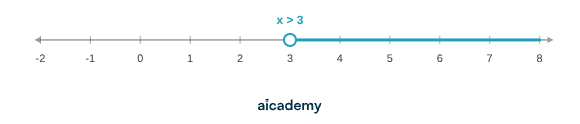
: open circle at , filled circle at , line between them
Integer solutions: if the question asks for integers satisfying an inequality, list them explicitly.
, integer:
Quadratic Inequalities (Higher)
To solve a quadratic inequality (e.g. ):
- Find the roots by setting the expression equal to zero and solving.
- Sketch the parabola (or reason from its shape).
- Identify which region satisfies the inequality.
Worked example — solve :
Roots: or
Parabola opens upward (). The expression is negative between the roots.
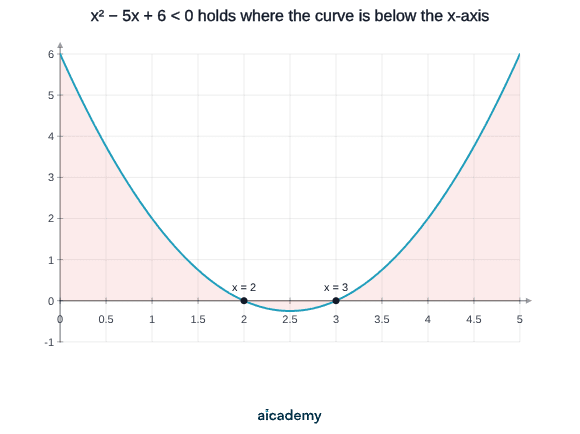
Solution:
Worked example — solve :
Roots: or
Parabola opens upward. The expression is non-negative outside the roots.
Solution: or
In set notation (Higher):
Worth saving these ideas?
Turn what you've read into instant revision cards. Free to get started.
Linear Inequalities in Two Variables (Higher)
A linear inequality in two variables defines a region of the coordinate plane.
Method:
- Draw the boundary line (solid if or ; dashed if or ).
- Test a point not on the line (usually the origin) to determine which side is the solution region.
- Shade the required region (or indicate with shading and labelling — check the question).
Worked example — show the region satisfying :
Draw the dashed line . Test origin: — TRUE. The origin is in the solution region; shade the region containing the origin.
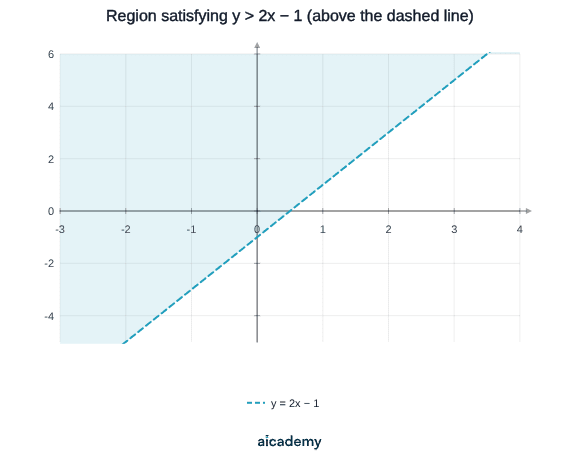
Combined inequalities — the feasible region satisfies all given inequalities simultaneously. Shade the overlapping area and label it R (or as directed).
Key terms
- inequality
- A mathematical statement comparing two expressions using <, >, <=, or >= rather than an equals sign.
- solution set
- All values of the variable that satisfy an inequality, represented on a number line or in set notation.
- integer solutions
- The whole-number values within the solution set of an inequality, listed explicitly when the question asks for them.
Frequently asked questions
Dividing by a negative flips the order of all numbers on the number line. For example, 4 > 2, but dividing both by -1 gives -4 < -2, so the inequality sign must reverse to remain true.
Factorise to find the roots (here x = 2 and x = 3). Sketch the upward parabola; the expression is negative between the roots, so the solution is 2 < x < 3.
A strict inequality (< or >) uses an open circle at the endpoint because that value is not included. An inclusive inequality (<= or >=) uses a filled circle because the endpoint is part of the solution.
Generate revision on any topic you study
Type any topic you're studying and Aicademy generates a complete lesson, quiz, and flashcard set, personalised to your level.
Lessons on anything
Structured, level-matched lessons on any topic you study
Practice quizzes
Find out what you actually know before the exam does
Flashcard sets
Lock in key concepts with instant revision cards
Ask Aica
Stuck on something? Get a clear explanation, any time
Solving Equations and Simultaneous Equations
Sequences
Related lessons
7 min
Solving Equations and Simultaneous Equations
Edexcel GCSE Mathematics · Pearson Edexcel 1MA1
4 months ago
7 min