Area, Perimeter and Volume

Aligned to the Pearson Edexcel 1MA1 specification
- Level
- Foundational
- Reading time
- 6 min
- Published
- 12 June 2026
- Updated
- 16 August 2026
On this page
Key takeaways
- The trapezium area formula is A = (1/2)(a + b)h where a and b are the parallel sides and h is the perpendicular height, not the slant side.
- Volume of any prism = cross-section area x length. Cylinder volume is pi*r^2*h and cylinder surface area is 2*pi*r^2 + 2*pi*r*h.
- Sphere, cone and pyramid formulae are given on the exam formula sheet: V = (4/3)*pi*r^3 for a sphere and V = (1/3)*pi*r^2*h for a cone.
- When converting units for area, square the length scale factor (1 m^2 = 10000 cm^2). For volume, cube it (1 m^3 = 1000000 cm^3).
- For composite solids, do not count the shared internal face in the surface area calculation. Add volumes of the component parts.
Spheres, Pyramids and Cones (G17)
These formulae are given on the exam formula sheet but must be applied correctly:
| Solid | Volume | Surface area |
|---|---|---|
| Sphere | ||
| Cone | ( = slant height) | |
| Pyramid | sum of base + triangular faces |
Worked example — cone:
Radius 5 cm, perpendicular height 12 cm. Slant height: cm.
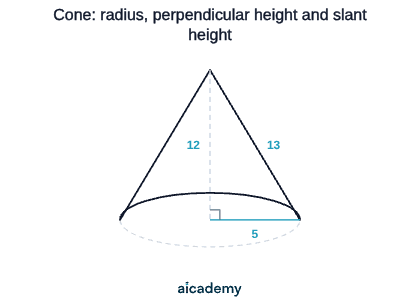
cm³
cm² ✓
Composite solids — add volumes of component parts (e.g., a hemisphere placed on top of a cylinder).
Want more lessons like this one?
Generate lessons on anything you study. Free account, no card needed.
Key terms
- Prism
- A 3D solid with a constant cross-section along its length. Its volume is cross-section area multiplied by length.
- Slant height
- The distance along the sloping face of a cone or pyramid from the apex to the base edge, found using Pythagoras.
- Composite shape
- A shape or solid made by combining two or more standard shapes; its area or volume is found by adding (or subtracting) the parts.
- Perpendicular height
- The vertical distance between two parallel sides, measured at a right angle. Used in area formulae for triangles, parallelograms, and trapezia.
Frequently asked questions
Curved surface area of a cone is pi*r*l where l is the slant height. Total surface area adds the circular base: pi*r*l + pi*r^2. Exam questions specify which one they want.
Use Pythagoras: slant height l = sqrt(r^2 + h^2), where r is the base radius and h is the perpendicular height. For example, r = 5 and h = 12 gives l = sqrt(25 + 144) = 13.
Split the shape into simpler pieces (rectangles, triangles, semicircles), calculate each area separately, then add them together. Subtract any piece that has been cut out from the overall shape.
Generate revision on any topic you study
Type any topic you're studying and Aicademy generates a complete lesson, quiz, and flashcard set, personalised to your level.
Lessons on anything
Structured, level-matched lessons on any topic you study
Practice quizzes
Find out what you actually know before the exam does
Flashcard sets
Lock in key concepts with instant revision cards
Ask Aica
Stuck on something? Get a clear explanation, any time
Constructions, Congruence and Transformations
Circles, Sectors and Circle Theorems
Related lessons
6 min
6 min
Circles, Sectors and Circle Theorems
Edexcel GCSE Mathematics · Pearson Edexcel 1MA1
4 months ago
7 min
Similarity, 3D Shapes and Coordinate Geometry
Edexcel GCSE Mathematics · Pearson Edexcel 1MA1
4 months ago