Angles and Polygons

Aligned to the Pearson Edexcel 1MA1 specification
- Level
- Foundational
- Reading time
- 6 min
- Published
- 12 June 2026
- Updated
- 16 August 2026
On this page
Key takeaways
- The interior angle sum of a polygon with n sides is (n - 2) x 180 degrees. The exterior angle sum of any convex polygon is always 360 degrees.
- Alternate angles are equal (Z-shape); corresponding angles are equal (F-shape); co-interior angles add to 180 degrees (C-shape) when lines are parallel.
- Each interior angle of a regular polygon equals the interior angle sum divided by n, not divided by (n - 2).
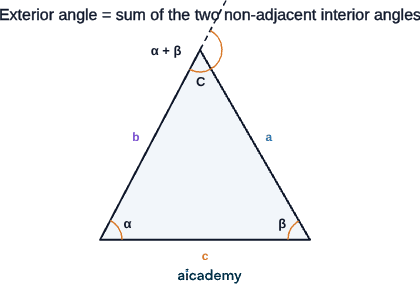
- An exterior angle of a triangle equals the sum of the two non-adjacent interior angles. This is a key shortcut in multi-step angle problems.
Angles on Parallel Lines (G3)
When a transversal crosses two parallel lines (marked ), three relationships hold:
| Pair type | Description | Size |
|---|---|---|
| Alternate angles | Z-shape; on opposite sides of transversal | Equal |
| Corresponding angles | F-shape; on same side of transversal | Equal |
| Co-interior (allied) angles | C-shape; between the parallel lines |
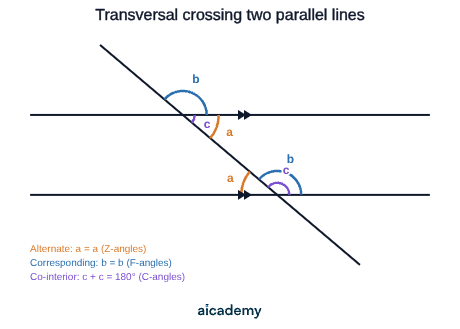
Worked example: two parallel lines cut by a transversal. One angle is . Find the alternate angle, the corresponding angle, and the co-interior angle.
- Alternate: (Z-pattern)
- Corresponding: (F-pattern)
- Co-interior: (C-pattern)
Multi-step reasoning: to find angles not in the obvious parallel-line pattern, use a combination of rules (e.g., angles on a straight line, then alternate angles) and show each step with a reason.
Angles in Triangles and Polygons (G3)
Triangle angle sum: angles in any triangle add to .
Exterior angle theorem: an exterior angle of a triangle equals the sum of the two non-adjacent interior angles.
Interior angle sum of a polygon with sides:
Exterior angle sum of any convex polygon (always).
| Polygon | Interior angle sum | Interior angle of regular polygon | |
|---|---|---|---|
| Triangle | 3 | ||
| Quadrilateral | 4 | ||
| Pentagon | 5 | ||
| Hexagon | 6 | ||
| Octagon | 8 |
Worked example — each interior angle of a regular polygon is . How many sides?
Each exterior angle . Number of sides . ✓
Want more lessons like this one?
Generate lessons on anything you study. Free account, no card needed.
Key terms
- Transversal
- A straight line that crosses two or more other lines, creating pairs of alternate, corresponding, and co-interior angles.
- Alternate angles
- A pair of equal angles formed on opposite sides of a transversal crossing parallel lines, making a Z-shape.
- Corresponding angles
- A pair of equal angles in the same position at each intersection when a transversal crosses parallel lines, making an F-shape.
- Co-interior angles
- A pair of angles between two parallel lines on the same side of a transversal that add to 180 degrees, making a C-shape.
- Exterior angle
- An angle formed outside a polygon by extending one side; for a triangle it equals the sum of the two non-adjacent interior angles.
- Regular polygon
- A polygon with all sides equal and all interior angles equal.
Frequently asked questions
Subtract the interior angle from 180 to get the exterior angle, then divide 360 by the exterior angle. For example, interior angle 156 gives exterior angle 24, so 360/24 = 15 sides.
Alternate angles (Z-shape) are equal. Co-interior angles (C-shape, also called allied angles) are between the parallel lines and add to 180 degrees. Mixing these up is a common exam error.
Yes. Mark schemes require you to write the angle rule used at each step, such as 'alternate angles' or 'angles on a straight line'. A correct number without a reason loses the reasoning marks.
Generate revision on any topic you study
Type any topic you're studying and Aicademy generates a complete lesson, quiz, and flashcard set, personalised to your level.
Lessons on anything
Structured, level-matched lessons on any topic you study
Practice quizzes
Find out what you actually know before the exam does
Flashcard sets
Lock in key concepts with instant revision cards
Ask Aica
Stuck on something? Get a clear explanation, any time
Direct and Inverse Proportion, and Rates of Change
Constructions, Congruence and Transformations
Related lessons
7 min
Constructions, Congruence and Transformations
Edexcel GCSE Mathematics · Pearson Edexcel 1MA1
4 months ago
6 min
6 min
Circles, Sectors and Circle Theorems
Edexcel GCSE Mathematics · Pearson Edexcel 1MA1
4 months ago