Completing the Square

Aligned to the Pearson Edexcel 1MA1 specification
- Topic
- Algebra
- Level
- Advanced
- Reading time
- 6 min
- Published
- 12 June 2026
- Updated
- 16 August 2026
On this page
Key takeaways
- To complete the square for x^2 + bx + c, write (x + b/2)^2 - (b/2)^2 + c. Halve the coefficient of x for the bracket, then subtract its square as a correction.
- The turning point of y = (x + p)^2 + q is at (-p, q). Note the sign flip: the x-coordinate is -p, not p.
- When a is not 1, factor out a from the first two terms only before completing the square. The correction constant inside the bracket must then be multiplied by a when expanding.
- To solve by completing the square, rearrange to get the squared bracket on its own, then take the square root of both sides. Always write +/- to get both solutions.
- If the question asks you to solve by completing the square or to write in the form (x + p)^2 + q, the quadratic formula will not earn those marks.
Finding the Turning Point of a Quadratic
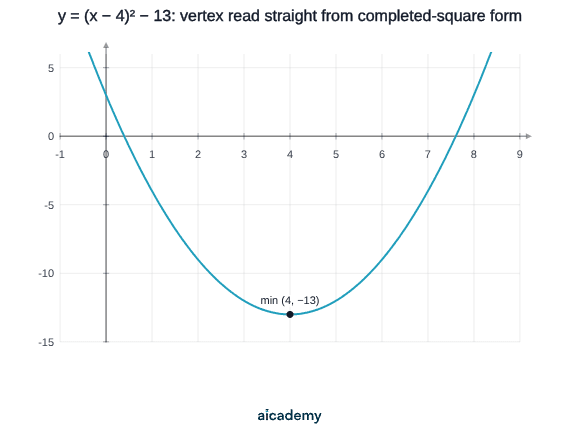
Once a quadratic is in completed square form , the turning point (vertex) of its graph can be read off directly.
The minimum value of is 0, which occurs when . At that point, .
Turning point: from the form .
Worked examples:
| Completed square form | Turning point | Type |
|---|---|---|
| Minimum | ||
| Minimum | ||
| Minimum | ||
| Maximum |
When the parabola opens upward (minimum turning point). When it opens downward (maximum turning point). The sign of does not affect the -coordinate of the vertex.
Worked example — Find the turning point of :
From the earlier worked example: .
Turning point: , and it is a minimum (coefficient of is positive).
Want more lessons like this one?
Generate lessons on anything you study. Free account, no card needed.
Key terms
- Completed square form
- The form a(x + p)^2 + q that a quadratic can be rewritten in, making the turning point and solutions easier to read off.
- Turning point
- The vertex of a parabola, where the curve changes from decreasing to increasing (minimum) or increasing to decreasing (maximum).
- Minimum
- A turning point where the parabola opens upward (coefficient of x^2 is positive) and the y-value is the lowest on the curve.
- Maximum
- A turning point where the parabola opens downward (coefficient of x^2 is negative) and the y-value is the highest on the curve.
Frequently asked questions
Rewrite the quadratic in the form (x + p)^2 + q. The turning point is (-p, q). For example, (x + 3)^2 - 7 has turning point (-3, -7), since the x-coordinate is the negative of the number inside the bracket.
Expanding (x + p)^2 gives x^2 + 2px + p^2. The p^2 term is introduced by squaring the bracket but was not in the original expression, so it must be subtracted to keep the expression equivalent.
Factor out the coefficient from the first two terms only: for 2x^2 + 12x + 5, write 2(x^2 + 6x) + 5. Complete the square inside the bracket, then multiply the correction by 2 when expanding.
Generate revision on any topic you study
Type any topic you're studying and Aicademy generates a complete lesson, quiz, and flashcard set, personalised to your level.
Lessons on anything
Structured, level-matched lessons on any topic you study
Practice quizzes
Find out what you actually know before the exam does
Flashcard sets
Lock in key concepts with instant revision cards
Ask Aica
Stuck on something? Get a clear explanation, any time
Circle Theorems
nth Term of Linear Sequences
Related lessons
7 min
Solving Equations and Simultaneous Equations
Edexcel GCSE Mathematics · Pearson Edexcel 1MA1
4 months ago
7 min
6 min