Track progress, take quizzes and save notes on this lesson.

Free forever · no card needed

Start free
Foundational

nth Term of Linear Sequences

A23·A24·A25

Aligned to the Pearson Edexcel 1MA1 specification

Topic
Algebra
Level
Foundational
Reading time
5 min
Published
12 June 2026
Updated
1 July 2026
On this page
  1. 1.Arithmetic Sequences and the Common Difference
  2. 2.The nth Term Formula
  3. 3.Finding the nth Term: Step by Step
  4. 4.Using the Formula to Find Specific Terms
  5. 5.Sequences from Context
  6. 6.Common Exam Mistakes

Key takeaways

  • For an arithmetic sequence with first term a and common difference d, the nth term is Tn = a + (n-1)d, which simplifies to dn + (a - d).
  • The coefficient of n in the nth term formula always equals the common difference d, not the first term of the sequence.
  • To find the constant c, substitute n = 1 and the first term: c = first term minus d. Always check by substituting n = 2.
  • To test whether a value k is in the sequence, set Tn = k and solve for n; if n is not a positive integer, k is not in the sequence.

Arithmetic Sequences and the Common Difference

An arithmetic sequence (also called a linear sequence) is a sequence where the difference between consecutive terms is always the same. This fixed difference is called the common difference, .

Examples:

SequenceCommon difference Pattern
3, 7, 11, 15, 19, …Adding 4 each time
20, 17, 14, 11, 8, …Subtracting 3 each time
1, 1.5, 2, 2.5, 3, …Adding 0.5 each time

To find : subtract any term from the next term. .

A sequence is arithmetic if and only if is constant throughout. If the differences between terms are not all the same, the sequence is not arithmetic (it may be quadratic or geometric — different rules apply).

The term-to-term rule for an arithmetic sequence is simply "add each time". The nth term formula is more powerful — it lets you find any term directly without listing all the ones before it.

The nth Term Formula

For an arithmetic sequence with first term and common difference , the nth term is:

This is more commonly derived and remembered as:

Both forms are equivalent. The first form ( where ) makes it easy to read off as the coefficient of .

What the formula tells you: gives the value of the term in position . is the first term, is the tenth term, and so on.

Structure of the formula:

  • The coefficient of is always the common difference .
  • The constant is found by substituting (or calculated as ).

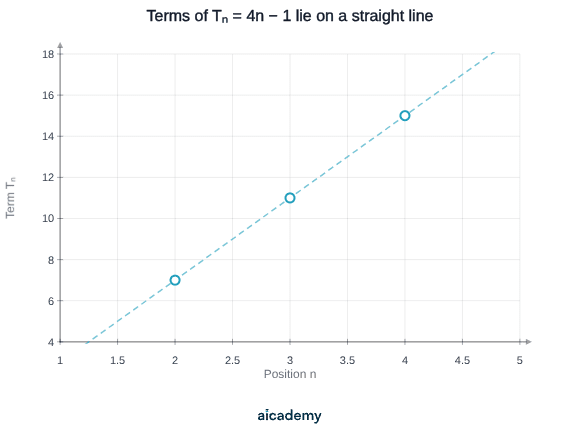
A linear (arithmetic) sequence always produces a formula of the form — a straight-line rule in . Plotting the terms against their position shows the points lie on a straight line whose gradient is the common difference .
Finding the nth Term: Step by Step

Step 1 — Find the common difference by subtracting consecutive terms.

Step 2 — Write the formula as .

Step 3 — Substitute and the first term to find : .

Step 4 — Check by substituting (and if unsure).

Worked example 1 — Find the nth term of: 3, 7, 11, 15, 19, …

, so the formula starts .

Substitute : .

Check: ✓ and

Worked example 2 — Find the nth term of: 20, 17, 14, 11, …

, so .

Substitute : .

Check:

Using the Formula to Find Specific Terms

Once the formula is found, substitute any value of to find the term at that position.

Worked example — Using :

CalculationTerm
13
1039
50199
100399

The formula is also used to test whether a particular value is in the sequence. Set equal to the value and solve for — if is a positive integer, the value is in the sequence.

Worked example — Is 85 a term in the sequence with ?

is not a positive integer, so 85 is not in the sequence.

Is 83 in the sequence? . Yes — it is the 21st term.

Want more lessons like this one?

Generate lessons on anything you study. Free account, no card needed.

Start generating

Sequences from Context

GCSE questions often present sequences through patterns or tables rather than as a list of numbers. The method is the same.

Worked example — A pattern of dots: Row 1 has 5 dots, row 2 has 8 dots, row 3 has 11 dots. How many dots in row 20?

The sequence is 5, 8, 11, … with .

; substitute : .

Row 20: dots.

Which row has 200 dots? . Row 66 has 200 dots.

Quadratic sequences (where second differences are constant) require a different method — finding the coefficient — and are Higher tier only.

Common Exam Mistakes

1. Confusing with the first term

The coefficient of in the formula is always , the common difference — not the first term. For the sequence 5, 8, 11, … the formula is , not .

2. Finding incorrectly

where is the first term. For 5, 8, 11, …: , giving . A common error is writing by using the first term directly as the constant.

3. Not checking the formula

Always substitute and into your formula and compare with the actual terms. This catches sign errors and incorrect values of before they propagate.

4. Stopping after writing the formula when asked for a specific term

"Find the 50th term" requires substituting into the formula. A formula alone does not answer this question.

5. Concluding a value is in the sequence without checking is a positive integer

If solving gives or , the value is not in the sequence. Both conditions must hold: must be a whole number greater than zero.

Key terms

arithmetic sequence
A sequence where consecutive terms differ by a fixed constant called the common difference; also called a linear sequence.
common difference
The fixed value added to each term to get the next term in an arithmetic sequence; it is the coefficient of n in the nth term formula.
nth term
A formula, usually of the form dn + c, that gives the value of the term at position n in a sequence without listing all previous terms.

Frequently asked questions

Find the common difference d by subtracting consecutive terms. Write Tn = dn + c. Substitute n = 1 and the first term to find c = first term - d. Check with n = 2.

Set the nth term formula equal to the number and solve for n. If the result is a positive whole number, that number is in the sequence at that position; otherwise it is not.

The term-to-term rule (add d each time) lets you find the next term but requires listing all previous terms. The nth term formula Tn = dn + c lets you find any term directly from its position.

Generate revision on any topic you study

Type any topic you're studying and Aicademy generates a complete lesson, quiz, and flashcard set, personalised to your level.

Lessons on anything

Structured, level-matched lessons on any topic you study

Practice quizzes

Find out what you actually know before the exam does

Flashcard sets

Lock in key concepts with instant revision cards

Ask Aica

Stuck on something? Get a clear explanation, any time

Prev

Completing the Square

Next

Probability Trees

Related lessons

5 min

Lesson

Sequences

Edexcel GCSE Mathematics · Pearson Edexcel 1MA1

1 month ago

Top students don’t revise more. They revise what counts.

Start revising free

Free to start. No card needed.