Circle Theorems

Aligned to the Pearson Edexcel 1MA1 specification
- Level
- Advanced
- Reading time
- 8 min
- Published
- 12 June 2026
- Updated
- 16 August 2026
On this page
Key takeaways
- The angle at the centre is twice the angle at the circumference when both are subtended by the same arc. A common error is inverting this and halving the wrong angle.
- An angle inscribed in a semicircle (with the diameter as its base) is always 90 degrees. This is a special case of the angle-at-centre theorem.
- Opposite angles in a cyclic quadrilateral add to 180 degrees. It is opposite pairs, not adjacent pairs, that are supplementary.
- A tangent meets the radius at 90 degrees at the point of tangency. Always mark this right angle on your diagram before writing any equations.
- The alternate segment theorem: the angle between a tangent and a chord equals the inscribed angle in the alternate (opposite) segment.
Angle at the Centre and Angle at the Circumference
Theorem 1 — Angle at the centre: The angle subtended at the centre by an arc is twice the angle subtended at the circumference by the same arc.
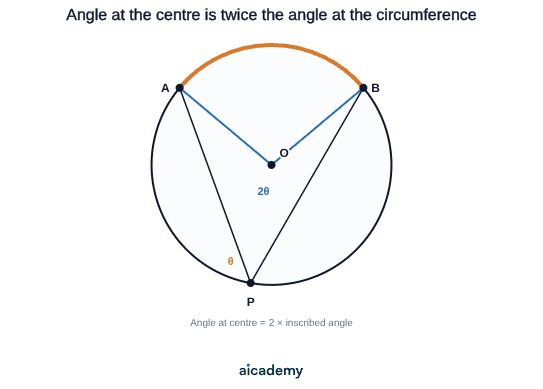
Worked example: If the angle at the centre is 80°, the angle at the circumference on the same arc is 40°. If the angle at the circumference is 35°, the angle at the centre is 70°.
Theorem 2 — Angle in a semicircle: An angle at the circumference subtended by a diameter is always 90°.
This is a special case of Theorem 1: the angle at the centre is 180° (a straight line = the diameter), so the angle at the circumference is .
| If you see… | Apply… |
|---|---|
| An angle at the centre and an angle at the circumference on the same arc | Theorem 1: centre = 2 × circumference |
| An angle in a semicircle (one side is the diameter) | Theorem 2: angle = 90° |
When using Theorem 1, confirm that both angles are subtended by the same arc. The angle at the circumference on the opposite arc uses the reflex angle at the centre, not the same one.
Angles in the Same Segment
Theorem 3 — Angles in the same segment: Angles subtended by the same arc at the circumference are equal.
If two angles both stand on the same chord from the same side, they are equal — regardless of where exactly on the arc the vertex is placed.
Worked example: Points A, B, C, D lie on a circle. Angle ADB = 42°. Find angle ACB if C is on the same arc as D.
Since angles ADB and ACB are in the same segment (both subtended by chord AB from the same arc): .
Theorem 4 — Cyclic quadrilateral: Opposite angles in a cyclic quadrilateral sum to 180°.
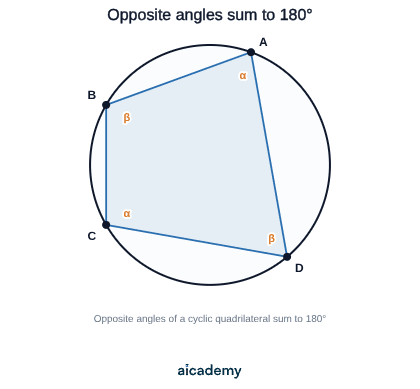
Worked example: In cyclic quadrilateral ABCD, angle A = 73° and angle B = 105°. Find angles C and D.
Check: ✓ and ✓
Tangent Theorems
Theorem 5 — Tangent-radius angle: A tangent to a circle is perpendicular to the radius drawn to the point of tangency.
Theorem 6 — Two tangents from an external point: Two tangent lines drawn from the same external point are equal in length.
If PT and PQ are both tangents from external point P to the same circle, then .
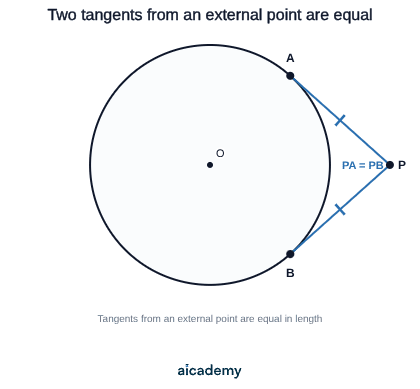
Worked example: Two tangents from point P touch a circle at points A and B. The angle APB = 50°. Find the angle AOB where O is the centre.
Since PA and PB are tangents: (Theorem 5).
In quadrilateral OAPB: angles sum to 360°.
Theorem 5 creates a right angle that is not always drawn in exam diagrams. Mark it in yourself before writing any equations.
Studying this for an exam?
Generate a personalised learning path for this subject. Free to get started.
Chord and Alternate Segment Theorems
Theorem 7 — Perpendicular from centre to a chord: The perpendicular from the centre of a circle to a chord bisects the chord.
Equivalently: the line from the centre to the midpoint of a chord is perpendicular to the chord.
Worked example: A chord of length 12 cm is 5 cm from the centre of a circle. Find the radius.
The perpendicular from the centre bisects the chord, creating a right-angled triangle with legs 5 cm and 6 cm (half of 12 cm).
Theorem 8 — Alternate segment theorem: The angle between a tangent and a chord drawn from the point of tangency equals the angle subtended by that chord in the alternate segment.
In other words: the angle in the triangle formed by the tangent and chord equals the angle in the opposite part of the circle.
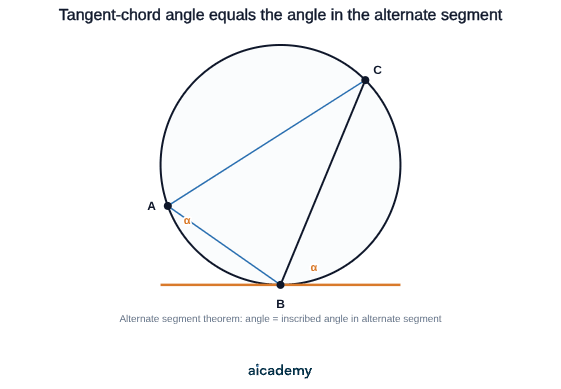
Worked example: A tangent meets a circle at point T. A chord TB makes an angle of 48° with the tangent. Find the angle subtended by TB in the alternate segment.
By the alternate segment theorem: the angle in the alternate segment = 48°.
Key terms
- Chord
- A straight line joining two points on the circumference of a circle but not passing through the centre.
- Arc
- A portion of the circumference of a circle between two points.
- Tangent
- A straight line that touches the circumference of a circle at exactly one point and is perpendicular to the radius at that point.
- Sector
- The region enclosed by two radii and the arc between them, shaped like a pie slice.
- Segment
- The region between a chord and the arc it cuts off.
- Cyclic quadrilateral
- A four-sided polygon whose four vertices all lie on the circumference of a circle; opposite angles sum to 180 degrees.
- Subtended angle
- An angle formed at a point by two lines drawn to the endpoints of an arc or chord.
- Alternate segment
- The region of a circle on the opposite side of a chord from the angle being considered, used in the alternate segment theorem.
Frequently asked questions
Identify what is given: two angles on the same arc means Theorem 1 or 3; a diameter means Theorem 2 (angle = 90); four points on the circle means Theorem 4 (opposite angles sum to 180); a tangent means Theorems 5, 6, or 8.
The angle between a tangent and a chord drawn from the point of tangency equals the angle subtended by that chord in the segment on the opposite side of the chord.
Yes, every step must name the theorem used in full, for example 'angles in the same segment are equal'. Writing only the number or a vague phrase loses the reasoning marks.
Generate revision on any topic you study
Type any topic you're studying and Aicademy generates a complete lesson, quiz, and flashcard set, personalised to your level.
Lessons on anything
Structured, level-matched lessons on any topic you study
Practice quizzes
Find out what you actually know before the exam does
Flashcard sets
Lock in key concepts with instant revision cards
Ask Aica
Stuck on something? Get a clear explanation, any time
Scatter Graphs and Sampling
Completing the Square
Related lessons
6 min
Circles, Sectors and Circle Theorems
Edexcel GCSE Mathematics · Pearson Edexcel 1MA1
4 months ago
7 min