Referendums in the UK

Aligned to the Pearson Edexcel 9PL0 specification
- Topic
- Electoral Systems
- Level
- Intermediate
- Reading time
- 15 min
- Published
- 9 September 2026
On this page
- 1.What a Referendum Is, and Who Gets to Call One
- 2.Why 1997 Marks the Turning Point
- 3.Devolution by Referendum, 1997–1998
- 4.The 2011 Alternative Vote Referendum
- 5.2014: Scottish Independence
- 6.2016: The EU Referendum and the Sovereignty Question
- 7.The Case For and Against Referendums in a Representative Democracy
- 8.Exam Focus: Common Mistakes
Key takeaways
- UK referendums are advisory in law unless the enabling Act says otherwise. Parliament decides each time whether to be bound: the 2011 AV referendum was binding by statute, the 2016 EU vote was not.
- Blair made referendums the standard route to constitutional change: Scotland and Wales in 1997, the Good Friday Agreement and a London mayor in 1998. The habit outlasted him: the 2011 Welsh powers vote was coalition-era.
- Turnout swings wildly, from 84.6% at the 2014 Scottish independence referendum down to 42.2% at the 2011 AV referendum and 34.1% in London in 1998, which undercuts the claim that referendums reliably raise participation.
- The 2016 EU referendum returned 51.9% Leave on 72.2% turnout. In Miller (2017) the Supreme Court held the result alone did not let ministers trigger Article 50; an Act of Parliament was required.
- A convention has grown that major constitutional change needs a referendum, but it is not a legal rule: the Human Rights Act 1998 and the removal of most hereditary peers in 1999 passed without one.
Why 1997 Marks the Turning Point
Before 1997, referendums were rare enough to be treated as constitutional oddities.
(Extra context — the specification asks about referendums since 1997. The two earlier votes below are background that explains why 1997 changed the habit, not assessable content in themselves.)
The 1975 referendum on continued membership of the European Communities was the first held UK-wide, and Harold Wilson called it largely to manage a split in his own party. In 1979 devolution referendums in Scotland and Wales were wrecked by a statutory rule requiring 40% of the whole registered electorate to vote Yes: Scotland produced a narrow Yes majority that fell short of the threshold, and Wales rejected devolution outright.
The Blair government elected in May 1997 arrived with a large constitutional reform programme and used referendums as its delivery mechanism. Within eighteen months it had put devolution to voters in Scotland, Wales, Northern Ireland and London. From that point a convention developed: significant constitutional change is put to a public vote first.
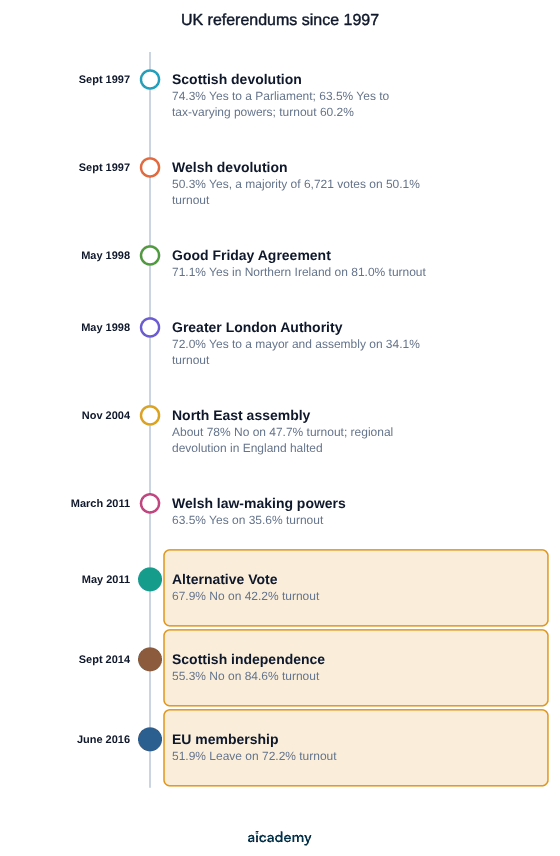
Notice the pattern: a dense cluster of devolution votes at the start, a long gap, then three high-stakes national questions in five years.
How much of this have you taken in?
Quiz yourself on this section, free, no card needed.
Key terms
- Referendum
- A vote putting a single question of policy or constitutional change directly to the electorate rather than leaving it to elected representatives.
- Advisory referendum
- A referendum whose outcome carries no legal force, leaving Parliament free in law to decide what, if anything, follows from it.
- Binding referendum
- A referendum whose enabling Act requires the result to be implemented, so that no further parliamentary decision is needed.
- Initiative
- A device found in Switzerland and several US states, but not in the UK, letting citizens force a public vote on a proposal by gathering a set number of signatures.
- Electoral Commission
- The independent regulator created by the Political Parties, Elections and Referendums Act 2000, which assesses referendum questions, designates lead campaign groups and enforces spending limits.
- Entrenchment
- Protecting a constitutional arrangement against easy repeal; in the UK a referendum result supplies political rather than legal protection.
- Parliamentary sovereignty
- The principle that Parliament may make or unmake any law, and that no Parliament can bind the ones that follow it.
Frequently asked questions
Usually not. Parliament is sovereign, so most UK referendums are advisory — the 2016 EU referendum among them. The exception is where the enabling Act states otherwise: the 2011 Alternative Vote referendum obliged ministers to implement a Yes result.
Two UK-wide ones: the Alternative Vote in May 2011 and EU membership in June 2016. Alongside them came regional votes on devolution in Scotland, Wales, Northern Ireland, London and the North East, plus local referendums on elected mayors and council tax.
Not in law. In R (Miller) v Secretary of State for Exiting the EU (2017) the Supreme Court ruled that ministers could not trigger Article 50 using prerogative powers, so Parliament passed an Act authorising it. Politically, ignoring the result was another matter.
Generate revision on any topic you study
Type any topic you're studying and Aicademy generates a complete lesson, quiz, and flashcard set, personalised to your level.
Lessons on anything
Structured, level-matched lessons on any topic you study
Practice quizzes
Find out what you actually know before the exam does
Flashcard sets
Lock in key concepts with instant revision cards
Ask Aica
Stuck on something? Get a clear explanation, any time
Electoral Systems: FPTP, AMS, STV and CPLS
Comparing Electoral Systems and Their Effects
Related lessons
14 min
12 min
20 min