Track progress, take quizzes and save notes on this lesson.

Free forever · no card needed

Start free
Intermediate

Comparing Electoral Systems and Their Effects

Paper 1, 3.3 Electoral system analysis

Aligned to the Pearson Edexcel 9PL0 specification

Level
Intermediate
Reading time
14 min
Published
9 September 2026
On this page
  1. 1.Why One Country Runs Four Electoral Systems
  2. 2.Three Devolution Bargains: How Each System Was Picked
  3. 3.Impact on Voter Choice
  4. 4.Impact on Party Representation
  5. 5.Impact on the Government Formed
  6. 6.Fair Representation Against Effective Government
  7. 7.Why FPTP Has Survived at Westminster
  8. 8.Exam Focus: Common Mistakes

Key takeaways

  • Each UK system was chosen for a job: FPTP for decisive Westminster government, AMS to check one-party dominance at Holyrood, STV for cross-community representation in Northern Ireland, CPLS for a proportional Senedd.
  • FPTP narrows voter choice. An Electoral Reform Society survey found 28% of voters voted tactically in 2024, and ballots cast for losers or beyond the winner's needs count as wasted votes.
  • Modelling by the Electoral Reform Society found that under AMS the 2024 result would have given Labour 236 seats rather than 411, Reform UK 94 rather than 5, and the Greens 42 rather than 4.
  • FPTP normally delivers single-party majority government — since 1945 the UK has had one coalition, in 2010–15 — while AMS, STV and CPLS usually produce coalition or minority governments.
  • The UK elects a Parliament, not a Prime Minister. Andy Burnham became PM on 20 July 2026 after being elected Labour leader unopposed, without any general election taking place.

Why One Country Runs Four Electoral Systems

The UK does not have an electoral system. It has four, running side by side, and the specification asks you to explain why.

BodySystemIn use since
House of CommonsFPTPThe modern single-member form dates from 1885
English local councilsFPTP
Scottish ParliamentAMS1999
Northern Ireland AssemblySTV1998
Scottish and Northern Irish councilsSTV2007 (Scotland); long-established in Northern Ireland
Senedd CymruCPLS7 May 2026, replacing AMS

Three explanations account for the pattern, and a strong answer weighs them against each other:

  1. Purpose. Westminster's system is built to manufacture a governing majority. The devolved systems were built to represent a divided electorate accurately. Different jobs, different tools.
  2. Political bargaining. Every devolved system was the product of a negotiation in which somebody needed reassurance — a minority community, a junior coalition partner, or a smaller party.
  3. Incumbency. Westminster is the one body whose system its own winners control. As the Financial Times put it in May 2026, parties in power have by definition won under the existing rules and have little incentive to scrap them.

Explanation 3 is the one candidates leave out, and it is the one that carries the most evaluative weight. Systems in the UK have been reformed wherever the reformers were not the beneficiaries of the old rules.

Three Devolution Bargains: How Each System Was Picked

Scotland — AMS, to stop anyone winning outright. The Scottish Constitutional Convention, which designed the Parliament through the late 1980s and early 1990s, was dominated by Labour and the Liberal Democrats. Labour was persuaded to accept a proportional element partly because its partners insisted, and partly because AMS made an outright SNP majority look arithmetically improbable. The design worked for a decade and then failed on its own terms: the SNP won a majority at Holyrood in 2011 and used it to secure the 2014 independence referendum. At the election of 7 May 2026 the system reverted to type, with the six largest parties returning SNP 57, Labour 17, Reform UK 17, Green 15, Conservative 12, Liberal Democrat 10 — nobody near the 65 seats a majority requires in a 129-member chamber.

Northern Ireland — STV, to guarantee both communities are heard. Under the Good Friday Agreement of 1998 the Assembly is elected by STV from five-member constituencies, and ministerial posts are then shared out among parties in proportion to their Assembly strength. Proportionality here is not a preference but a precondition of peace: an FPTP Assembly would hand near-total control to whichever community was locally larger. The results bear the design out. In 2022 the two largest parties, Sinn Féin and the DUP, took 50% of the vote and 58% of the seats, while five smaller parties and two independents shared the rest. Since 3 February 2024 Michelle O'Neill of Sinn Féin has been First Minister and Emma Little-Pengelly of the DUP deputy First Minister.

Wales — AMS, then CPLS. The Senedd used AMS from 1999. It was then expanded from 60 to 96 members elected from 16 six-member constituencies by closed list, and that system was used for the first time on 7 May 2026. Wales is the one UK legislature in recent years to have replaced its own electoral system, and the first result under the new one removed Labour, which had led every Welsh government since 1999, from office.

Impact on Voter Choice

The specification names voter choice as the first of three impacts. It has several distinct components, and answers score better for separating them.

Choice between parties. FPTP presents a real choice only where the seat is competitive. In a safe seat the outcome is settled before the campaign starts, which depresses turnout and diverts party resources to the marginals that decide the election.

Tactical voting. Because only the leading two candidates can realistically win, voters are pushed towards the least-bad viable option rather than their preference. An Electoral Reform Society survey found 28% of voters voted tactically in 2024, and the campaign group Best for Britain openly advised centre-left voters on which candidate was best placed locally to beat the Conservatives. Proportional systems reduce this pressure because a vote for a smaller party can still return a member.

Wasted votes. Under FPTP a ballot counts for nothing if it went to a loser or exceeded the winner's requirement. In a seat won on 34% of the vote, around 70% of the ballots fall into one of those categories.

Choice between candidates of the same party. This is where the four systems separate most sharply, and it cuts against the proportional systems as often as for them.

SystemWhat the voter actually chooses
FPTPOne candidate. Party selection committees choose who is on the ballot
AMSA constituency candidate and a party list, so voters can split their ticket between two parties
STVIndividual candidates in rank order, including ranking one candidate of a party above another
CPLSA party, and nothing else. The party fixes the order in which its candidates take the seats

STV maximises choice; CPLS minimises it. A student who claims proportional systems give voters more choice has half the picture: the Senedd's closed list gives Welsh voters less say over who represents them than FPTP does.

Impact on Party Representation

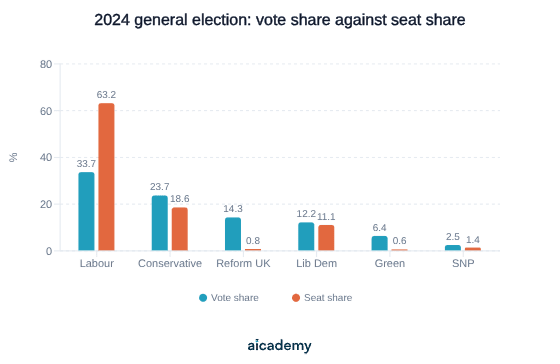
Grouped bars pairing vote share with seat share at the 2024 general election: Labour 33.7 and 63.2 per cent, Conservative 23.7 and 18.6, Reform UK 14.3 and 0.8, Lib Dem 12.2 and 11.1, Green 6.4 and 0.6, SNP 2.5 and 1.4.

The chart shows the shape of the problem better than the numbers do. For Labour the seat bar towers over the vote bar; for Reform UK and the Greens it has almost disappeared. The Liberal Democrats, whose support is regionally concentrated, are the one party whose two bars nearly match — despite polling a smaller share than Reform UK.

Worked comparison — the same votes under a different system. Modelling by the Electoral Reform Society applied the Additional Member System to the 2024 result:

PartyActual seats (FPTP)Modelled seats (AMS)Change
Labour411236−175
Conservative121157+36
Reform UK594+89
Green442+38

Labour's 174-seat majority becomes a shortfall of roughly 90 seats. The same voters, on the same day, produce a governing majority under one system and a hung parliament under another. That is the single most persuasive piece of evidence in this content area, in either direction: it shows FPTP distorting representation, and it shows proportionality removing the clear outcome FPTP delivered.

The devolved comparison confirms it. At the Senedd election of 7 May 2026, CPLS gave Plaid Cymru 43 of 96 seats on 35.4% of the vote and the Greens 2 on 6.7% — an over-reward of 9.4 points for the largest party against Labour's 29.5 points at Westminster in 2024.

Studying this for an exam?

Generate a personalised learning path for this subject. Free to get started.

Create a learning path

Impact on the Government Formed

FPTP's defenders rest their case here. Since the Second World War the UK has had a single coalition government, in 2010–15. Proportional systems make coalition or minority government the norm.

OutcomeUnder FPTPUnder AMS, STV or CPLS
Single-party majorityThe usual result: 1979, 1997, 2019, 2024Rare — the SNP's Holyrood majority of 2011 is the standout exception
Coalition2010–15 Conservative–Liberal DemocratRoutine; in Northern Ireland power-sharing is compulsory, with ministries shared out in proportion to party strength
Minority government2017–19, when the Conservatives governed with DUP confidence and supplyCommon; the SNP has governed as a minority at Holyrood for long stretches

The devolved results of 7 May 2026 illustrate the pattern. In Scotland the SNP's 57 seats left it short of a majority, and John Swinney was reappointed First Minister that month. In Wales no party won a majority, Plaid Cymru finishing six seats short of the 49 needed in a 96-member Senedd, and Labour did not provide the First Minister for the first time since devolution began in 1999.

Coalitions carry their own risks, which a balanced answer must name. Devolved government in Northern Ireland broke down in 2022, and the cooperation agreement between Labour and Plaid Cymru in Wales, struck in 2021, collapsed before its term was out.

One further point that catches candidates out. No UK electoral system elects a Prime Minister. Voters elect a Parliament, and the monarch appoints whoever can command the confidence of the Commons. Andy Burnham became Prime Minister on 20 July 2026 after being elected Labour leader unopposed on 17 July, having entered the Commons at the Makerfield by-election only a month earlier. No general election took place. Whatever system Westminster used, that outcome would have been possible.

Fair Representation Against Effective Government

Every argument in this content area collapses into one trade-off, and the strongest essays say so explicitly.

The case that fair representation matters more:

  • A government resting on 33.7% of the vote claims a mandate most voters did not give it, and the 2024 majority of 174 was built on the most disproportional result in British electoral history.
  • Multi-party competition makes FPTP results increasingly arbitrary. Polling by YouGov on 6–7 September 2026 had Labour 23%, Reform UK 23%, the Conservatives 20%, the Greens 12% and the Liberal Democrats 11–12%. With five parties bunched, tiny shifts in vote share can swing enormous numbers of seats.
  • A system designed for two-party politics is being asked to referee a five-party contest. That is what the results of 7 May 2026 exposed: a counting rule built for an era of two-party dominance reflects opinion less and less well as support fragments.
  • Wasted votes and safe seats depress turnout, which fell to 59.7% in 2024, the lowest since 2001.

The case that effective government matters more:

  • FPTP produces a government that can act. Coalition negotiation moves the choice of government from voters to party managers, and the resulting programme was in nobody's manifesto.
  • Accountability is clearer. A single governing party can be blamed and removed, as in 1979, 1997 and 2024. In a coalition, responsibility is shared and therefore blurred.
  • The constituency link survives. One named MP is answerable to a defined area, reinforced by the Recall of MPs Act 2015, which allows a by-election if 10% of a constituency's electors sign a petition after serious misconduct.
  • Coalitions can be unstable, as Northern Ireland in 2022 and the Welsh cooperation agreement both showed.

The counter to the "effective government" case is that AMS and STV both preserve a constituency link while improving proportionality, so the choice is not as stark as FPTP's defenders present it. Making that point is worth more than another example.

Why FPTP Has Survived at Westminster

Given the strength of the case against it, the interesting question is why FPTP is still here.

1. The beneficiaries hold the pen

Changing the Westminster system requires an Act of Parliament passed by MPs elected under the existing rules. In 2024 the two largest parties took 82% of the seats on 57% of the votes. Both are structurally advantaged, whichever is in office.

2. The question has been asked and answered

The 2011 referendum rejected the Alternative Vote by 67.9% to 32.1%. Reformers cannot easily demand a second national vote on electoral reform having lost the first so heavily, even though AV is not a proportional system and was nobody's first choice.

3. Governing parties lose interest on arrival

The pattern repeats: Labour was committed to examining reform before 1997 and dropped it after winning a majority of 179; the same incentive applied after 2024. Reform is attractive to a party that is losing under the current rules and unattractive to one that has just won under them.

4. The public is not mobilised

Electoral reform has rarely ranked among voters' leading concerns. Referendums on devolution, the peace settlement and EU membership drew turnouts of 60.2%, 81.0% and 72.2%; the 2011 vote on the counting method managed 42.2%.

5. The argument has genuinely strong defenders

Constituency representation, single-party accountability and the ability to eject a government decisively are real advantages, not rhetorical cover. The honest judgement is that FPTP survives because of a combination of self-interest and a defensible case — and deciding how much of each is doing the work is exactly what the 30-mark question rewards.

Exam Focus: Common Mistakes

1. Listing systems instead of analysing effects

Section 3.3 is not about how the systems work — that is 3.1. It asks about impact on voter choice, party representation and the government formed. Structure the answer around those three effects, and the AO2 marks follow.

2. Claiming proportional systems give voters more choice

They give a wider range of parties a realistic chance. They do not automatically give voters more say over individuals: the Senedd's closed list gives none at all. Distinguish choice of party from choice of candidate.

3. Treating coalition as a failure

Coalition and minority government are ordinary outcomes across most of Europe and across most of the devolved UK. Judge them on whether they governed effectively, not on the fact that they existed.

4. Treating the modelled AMS figures as a prediction

The Electoral Reform Society's exercise reallocates the votes actually cast in 2024 under a different counting rule. Under AMS many of those voters would have behaved differently, because tactical voting is far less necessary. The modelling shows what the rule does to a fixed set of votes, not what the election would have produced.

5. Forgetting that voters do not elect a Prime Minister

The UK elects a Parliament. Andy Burnham took office on 20 July 2026 without a general election, which is a feature of the constitution rather than a fault in the electoral system — and confusing the two costs precision marks.

6. Blaming the system for what the voters did

Turnout fell to 59.7% in 2024 and support fragmented across five parties. The counting rule is only part of the explanation for either: FPTP is widely argued to depress turnout in safe seats, but it does not decide how many parties voters choose to support. Section 3.3 is about what a counting rule does to a given set of votes, so keep the two apart: say which part of an outcome came from how people voted and which part came from how the votes were converted into seats.

Key terms

Safe seat
A constituency where one party's lead is large enough to survive ordinary swings in opinion, so it changes hands rarely if at all.
Marginal seat
A constituency where the winning margin is small enough that a modest swing would hand it to a rival, making it a target for concentrated campaigning.
Tactical voting
Voting for a candidate who is not your first preference because they have the best chance of defeating the candidate you least want to win.
Wasted vote
A ballot that contributes nothing to the outcome, either because it went to a losing candidate or because it exceeded what the winner needed to take the seat.
Minority government
A government formed by a party holding fewer than half the seats in the legislature, which must win support from other parties for each measure it wants to pass.
Coalition government
A government in which two or more parties share ministerial office under a negotiated joint programme, as the Conservatives and Liberal Democrats did from 2010 to 2015.
Confidence and supply
An arrangement under which a smaller party agrees to back a minority government on budgets and confidence votes without joining it or taking ministerial posts.

Frequently asked questions

Because each was designed for a different job. Westminster kept FPTP for decisive single-party government, while the systems introduced with devolution were deliberately proportional: AMS in Scotland, STV in Northern Ireland for cross-community representation, and a closed list in Wales from 2026.

A vote that changes nothing: one cast for a losing candidate, or cast for the winner beyond the number needed to win. In a seat taken on 34% of the vote, around 70% of ballots can be counted as wasted — a central argument for replacing FPTP.

On the available modelling, usually. Applying AMS to the 2024 result leaves Labour about 90 seats short of a majority. Supporters call that fairer bargaining; critics say it shifts the choice of government from voters on polling day to party negotiations afterwards.

Generate revision on any topic you study

Type any topic you're studying and Aicademy generates a complete lesson, quiz, and flashcard set, personalised to your level.

Lessons on anything

Structured, level-matched lessons on any topic you study

Practice quizzes

Find out what you actually know before the exam does

Flashcard sets

Lock in key concepts with instant revision cards

Ask Aica

Stuck on something? Get a clear explanation, any time

Prev

Referendums in the UK

Next

Three Key General Elections

Related lessons

14 min

Lesson

Electoral Systems: FPTP, AMS, STV and CPLS

A-Level Politics · Pearson Edexcel 9PL0

2 hours ago

18 min

Lesson

Party Systems and Party Success

A-Level Politics · Pearson Edexcel 9PL0

2 hours ago

16 min

Lesson

Three Key General Elections

A-Level Politics · Pearson Edexcel 9PL0

2 hours ago

Top students don’t revise more. They revise what counts.

Start revising free

Free to start. No card needed.