Democracy and Participation

Aligned to the Pearson Edexcel 9PL0 specification
- Level
- Intermediate
- Reading time
- 12 min
- Published
- 9 September 2026
On this page
- 1.Direct Democracy: The People Decide Themselves
- 2.Representative Democracy: Elected Decision-Makers
- 3.Where the Two Systems Overlap and Diverge
- 4.The Case For and Against Direct Democracy
- 5.The Case For and Against Representative Democracy
- 6.Is There a Participation Crisis?
- 7.Reforming UK Democracy
- 8.Exam Focus: Common Mistakes
Key takeaways
- Direct democracy means citizens decide policy themselves; representative democracy means they elect others to decide for them. The UK is representative, with direct elements such as referendums.
- Representative democracy offers expertise, accountability between elections and protection for minorities; critics point to unrepresentative outcomes, weak mandates and the risk of an elective dictatorship.
- Direct democracy gives decisions the strongest legitimacy but risks the tyranny of the majority and asks voters to rule on complex issues without expertise.
- The participation crisis argument rests on falling turnout (59.7% in 2024, the lowest since 2001) and collapsed party membership; against it, referendum turnouts and pressure group activity remain high.
- A democratic deficit is a fault in the system: decisions rest with people whose authority is not properly grounded or who escape accountability; remedies include votes at 16, electoral reform and compulsory voting.
Something not quite clicking?
Ask Aica to explain any part of this differently. Free, takes 30 seconds.
Is There a Participation Crisis?
The participation crisis argument holds that citizens have withdrawn from formal politics. The clearest evidence is general election turnout.
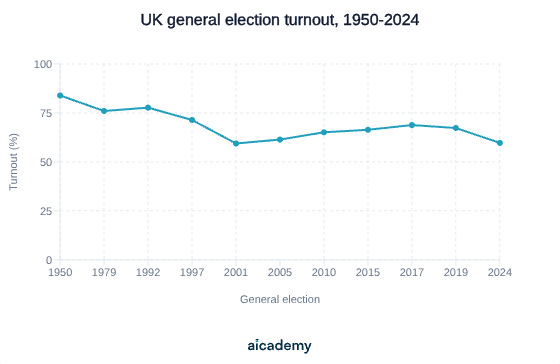
The 2024 figure of 59.7% was the lowest at any general election since 2001. Party membership tells a similar story: the Conservatives reported around 2.8 million members in 1953 and Labour claimed just over a million in 1952; both now count members in the hundreds of thousands.
The counter-argument is that participation has changed form, not collapsed:
| Evidence of decline | Evidence of continued engagement |
|---|---|
| 2024 general election turnout 59.7% | 2014 Scottish independence referendum turnout 84.6% |
| Mass party membership has collapsed since the 1950s | Pressure group membership runs into millions — the National Trust alone reports several million members |
| Falling trust in politicians and parties | E-petitions attract signatures on a scale no party can match |
| Turnout among 18–24s consistently below the average | Single-issue and online campaigning has grown substantially |
A safer exam judgement is that the UK has a participation shift rather than a simple crisis: engagement with parties and elections has fallen while engagement with causes has risen. Say which matters more for democratic health, and why.
Key terms
- Legitimacy
- The rightful use of power, exercised in accordance with agreed rules or criteria — such as a government's right to govern after winning an election.
- Direct democracy
- A system in which citizens decide policy questions themselves rather than delegating the decision to elected representatives.
- Representative democracy
- A system in which citizens elect representatives who make decisions on their behalf and are held accountable at the next election.
- Pluralist democracy
- A system in which power is dispersed among many competing groups, with government responding to the balance of pressure between them.
- Democratic deficit
- A flaw in a democratic system where decisions are taken by people whose authority is not properly grounded: they were not chosen with enough democratic input, or cannot be held to account for what they decide.
- Participation crisis
- A sustained decline in citizens' engagement with formal politics: choosing not to vote, not joining political parties, and not standing for public office.
- Mandate
- The authority a governing party claims to implement its manifesto, granted by winning a general election.
Frequently asked questions
The UK is a representative democracy: voters elect MPs to make decisions for them. It contains direct democratic elements — referendums, e-petitions and the recall of MPs — but these supplement representative institutions rather than replace them.
A democratic deficit is a flaw in the system itself — outcomes that do not reflect voters' wishes. A participation crisis is about citizens' behaviour — falling turnout and party membership. A system can have one without the other.
Not on its own. Turnout at general elections has fallen, but referendum turnouts have been high (84.6% in the 2014 Scottish independence referendum) and pressure group membership and e-petition signing have grown, suggesting participation has shifted form rather than disappeared.
Generate revision on any topic you study
Type any topic you're studying and Aicademy generates a complete lesson, quiz, and flashcard set, personalised to your level.
Lessons on anything
Structured, level-matched lessons on any topic you study
Practice quizzes
Find out what you actually know before the exam does
Flashcard sets
Lock in key concepts with instant revision cards
Ask Aica
Stuck on something? Get a clear explanation, any time
The Franchise and Debates over Suffrage
Related lessons
14 min
18 min
15 min
14 min