Track progress, take quizzes and save notes on this lesson.

Free forever · no card needed

Start free
Intermediate

Devolution in the UK

Paper 2, 1.3 The role and powers of devolved bodies in the UK, and the impact of this devolution on the UK

Aligned to the Pearson Edexcel 9PL0 specification

Level
Intermediate
Reading time
20 min
Published
9 September 2026
On this page
  1. 1.Devolution Is Not Federalism
  2. 2.Scotland: Parliament and Government
  3. 3.Wales: From Assembly to Parliament
  4. 4.Northern Ireland: Power-Sharing at Stormont
  5. 5.Devolution in England: The Missing Piece
  6. 6.Comparing the Three Devolved Settlements
  7. 7.The Impact of Devolution on the UK
  8. 8.Exam Focus: Common Mistakes

Key takeaways

  • Devolution disperses power without transferring sovereignty: Westminster created the devolved bodies by ordinary statute and retains the legal authority to amend or abolish them.
  • Scotland has 129 MSPs elected by AMS; the Senedd has 96 members elected by closed list from May 2026; the Northern Ireland Assembly has 90 MLAs elected by STV under mandatory power-sharing.
  • Devolution is asymmetric. Scotland has income tax and welfare powers Wales lacks, justice is devolved in Scotland and Northern Ireland but not Wales, and England has no legislature of its own.
  • The Sewel convention says Westminster will not normally legislate on devolved matters without consent, but the Supreme Court confirmed in 2017 that courts will not enforce it.
  • The May 2026 elections left the SNP largest in Scotland and Plaid Cymru largest in Wales; Rhun ap Iorwerth then formed a minority Welsh Government, the first from outside Welsh Labour since 1999.

Devolution Is Not Federalism

Devolution is the transfer of specified powers from central government to elected bodies in parts of the state, without transferring legal sovereignty.

That last clause is the one that matters. In a federal system such as the United States, sovereignty is constitutionally divided: Washington cannot abolish Wyoming, and the states' powers are guaranteed by a document neither level can rewrite alone. In the UK, the devolved bodies exist because Westminster passed ordinary Acts — the Scotland Act 1998, the Government of Wales Act 1998 and the Northern Ireland Act 1998 — and what an ordinary Act created, an ordinary Act can amend.
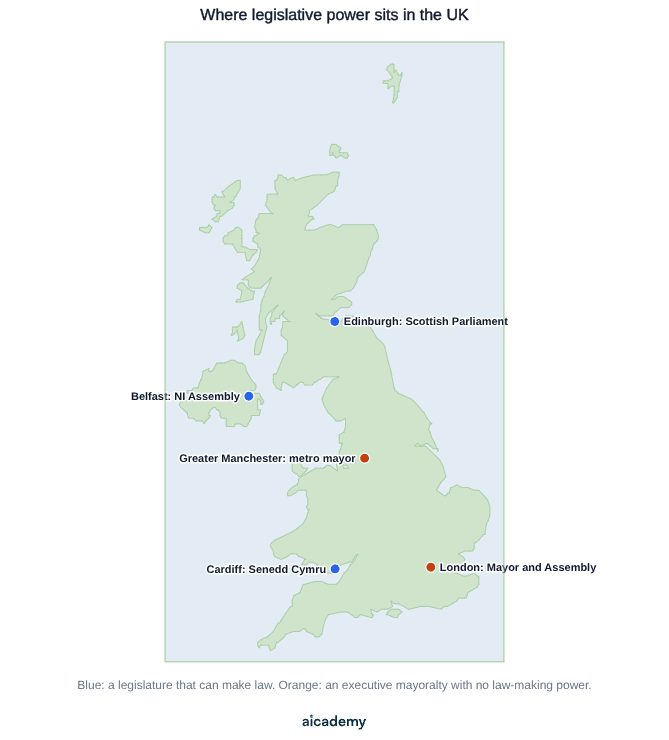
Schematic map of the UK marking the three capitals with law-making legislatures - Edinburgh, Cardiff and Belfast - alongside London, which has a mayor and assembly but no English parliament, and Manchester as an example of an English metro mayor.

Three features of the UK settlement follow:

  • It is asymmetric. The three devolved bodies hold different powers, and England has no legislature of its own.
  • It is reversible in law. Westminster suspended the Northern Ireland Assembly by statute several times in the 2000s, and the Assembly again stopped sitting from 2022 until February 2024 after power-sharing broke down.
  • It is entrenched in politics, not in law. The Scotland Act 2016 declares the Scottish Parliament and Government a permanent part of the UK's constitutional arrangements — but that declaration is itself in an ordinary Act, so its protection is political rather than legal.

Scotland: Parliament and Government

The Scotland Act 1998 created a Parliament with primary legislative power using a reserved powers model: the Act lists what Westminster keeps, and everything not listed is devolved.

FeatureDetail
Members129 MSPs — 73 constituency, 56 from eight regional lists
Electoral systemAdditional Member System
Reserved to WestminsterDefence, foreign affairs, immigration and nationality, the constitution, macroeconomic policy, most social security
DevolvedHealth, education, policing and criminal justice, transport, housing, environment, agriculture, local government
TaxPower to set rates and bands of income tax on non-savings income, from the Scotland Act 2016

Powers have grown in three steps. The Scotland Act 2012 followed the Calman Commission; the independence referendum of 18 September 2014 — 55.3% No on an 84.6% turnout — produced the Smith Commission, whose recommendations became the Scotland Act 2016, devolving income tax rates and bands and a substantial group of welfare benefits.

Worked example — testing legislative competence. In 2022 the Scottish Government asked whether the Scottish Parliament could legislate for an independence referendum without Westminster's agreement. Work through it the way the Supreme Court did:

  1. Start from the reserved list. The Scotland Act 1998 reserves "the Union of the Kingdoms of Scotland and England" and the Parliament of the United Kingdom.
  2. Ask what the bill relates to. The government argued a referendum would be merely advisory and so would not relate to a reserved matter.
  3. Apply the test. The Court held in November 2022 that a referendum on independence would relate to reserved matters whatever its legal status, because its purpose and likely political effect concerned the Union itself.
  4. Outcome. The Parliament lacked competence. A lawful referendum would require Westminster's agreement, as in 2014.

That case is the clearest demonstration available that devolution disperses power without dispersing sovereignty.

The Scottish Government. Section 1.3 asks for the Parliament and the Government, and they are separate things. The Scottish Government is the executive: a First Minister nominated by Parliament and appointed by the monarch, who then selects Cabinet Secretaries and junior ministers from among MSPs. It is accountable to Parliament rather than to Westminster — through First Minister's Questions, committee scrutiny, and a vote of no confidence that would force its resignation. Its powers run to everything not reserved by Schedule 5 of the Scotland Act 1998: health, education, justice, policing, transport, the environment, and since the Scotland Acts 2012 and 2016 substantial income tax and welfare powers.

As of September 2026, John Swinney leads it, having been reappointed First Minister after the election of 7 May 2026. The largest parties were SNP 57, Labour 17, Reform UK 17, Green 15, Conservative 12, Liberal Democrat 10 — the SNP the largest but short of the 65 seats needed for a majority in a chamber of 129. Like the Welsh Government formed the same month, it is therefore a minority government, governing by assembling support issue by issue rather than commanding a reliable majority.

Both AMS in Scotland and the closed list in Wales produced minority governments in May 2026, while first-past-the-post at Westminster produced a majority of 174 in 2024. That contrast is the single most useful devolution example for a question on what electoral systems do to the type of government appointed.

Wales: From Assembly to Parliament

Welsh devolution began weakest and has changed most. The Government of Wales Act 1998 created an Assembly with secondary legislative power only: it could fill in the detail of Westminster statutes but could not make primary law.

The trajectory since:

StepEffect
Government of Wales Act 2006Separated the legislature from the executive and allowed law-making powers to be transferred subject-by-subject
Referendum, March 201163.5% yes on a 35.6% turnout, granting primary law-making power in devolved fields
Wales Act 2014Devolved some tax powers, including landfill and stamp duty equivalents
Wales Act 2017Moved Wales to the reserved powers model already used in Scotland
Senedd and Elections (Wales) Act 2020Renamed the body Senedd Cymru / Welsh Parliament and lowered the voting age to 16
May 2026 electionExpanded to 96 members elected by closed proportional list

The 9PL0 specification still uses the phrase "Welsh Assembly (Senedd)". The body's legal name has been Senedd Cymru / Welsh Parliament since 2020, and its members are Members of the Senedd. Use the current name in your answers and recognise the older wording if a question uses it.

The most important difference from Scotland is that policing and criminal justice are not devolved to Wales. Health, education, transport, housing, environment, agriculture and local government are.

The May 2026 election was the first under the new arrangements: 96 members returned from 16 six-member constituencies formed by pairing Westminster seats, allocated by the D'Hondt formula from a single party ballot. The result was Plaid Cymru 43, Reform UK 34, Labour 9, Conservative 7, Green 2, Liberal Democrat 1 on a turnout of 51.6% — the highest at any Senedd election and the first above 50%. Labour left government in Wales for the first time since devolution began in 1999, and Plaid Cymru finished as the largest party without an overall majority.

The Welsh Government that followed. Spec section 1.3 asks for the Parliament and the Government in each nation, and Wales in 2026 shows why the distinction matters. Winning 43 of 96 seats left Plaid Cymru six short of a majority, so the government had to be assembled rather than simply formed. Rhun ap Iorwerth was nominated First Minister on 12 May 2026 with 45 votes — Plaid's 43 Members plus the two Greens — and appointed his Cabinet, with Sioned Williams as Deputy First Minister, on 13 May. He is the first First Minister from outside Welsh Labour since devolution began in 1999.

It is a minority government: it holds no majority and must win the support or abstention of other parties for each budget and each bill. The Senedd holds it to account through committee scrutiny, questions to ministers, and ultimately a vote of no confidence, in the way the Commons holds the UK government to account — but without a governing majority to absorb rebellions.

This is the clearest recent illustration of what a proportional system does to executive formation. Under the old Additional Member System Welsh Labour governed for over two decades; the first election under the closed list produced a minority government dependent on another party within a week. Use it when a question asks what electoral systems do to the type of government appointed.

Northern Ireland: Power-Sharing at Stormont

Devolution in Northern Ireland is part of a peace settlement, so its institutions are built to prevent majority rule rather than to deliver it.

The Belfast/Good Friday Agreement (1998), endorsed by 71.1% in a referendum on an 81% turnout and given effect by the Northern Ireland Act 1998, established:

  • An Assembly of 90 MLAs, five from each of 18 constituencies, elected by Single Transferable Vote — a system chosen to give both communities proportional representation.
  • Mandatory power-sharing: the First Minister and deputy First Minister hold a joint office with equal powers, and neither can act without the other. If one resigns, both offices fall.
  • Ministries allocated by the D'Hondt formula, so parties receive departments in proportion to their Assembly strength instead of negotiating a coalition.
  • Cross-community consent for key votes, requiring support from both unionist and nationalist designations.
  • Three strands: institutions within Northern Ireland, a North–South Ministerial Council with the Republic of Ireland, and a British–Irish Council.

Policing and justice were devolved in April 2010, later than the rest of the settlement, because of their sensitivity.

The system's weakness is that it can stop. Because neither community can govern alone, either can bring the institutions down by withdrawing. The Assembly has spent long periods not sitting, including from early 2017 to January 2020 and again from 2022 until February 2024.

As of September 2026 the Assembly and Executive are sitting. Michelle O'Neill (Sinn Féin) has been First Minister and Emma Little-Pengelly (DUP) deputy First Minister since 3 February 2024 — the first time an Irish nationalist has held the office of First Minister, and a direct consequence of Sinn Féin becoming the largest party.

Something not quite clicking?

Ask Aica to explain any part of this differently. Free, takes 30 seconds.

Ask Aica

Devolution in England: The Missing Piece

England contains roughly 84% of the UK population and has no legislature of its own. Every proposed fix runs into that arithmetic.

OptionWhat has happened
An English ParliamentNone has existed since the Acts of Union 1707. It would represent five-sixths of the UK and would rival Westminster, raising the question of what the UK Parliament would be left to do
Regional assembliesPut to a referendum in the North East in November 2004 and rejected by 78%; the wider programme was abandoned
London governmentThe Greater London Authority was created in 2000 after a 1998 referendum: a directly elected Mayor plus a 25-member London Assembly, with powers over transport, policing and planning
Combined authorities and metro mayorsGroups of councils pooled powers under directly elected mayors from 2017, covering transport, skills, housing and, in some areas, policing
English votes for English lawsIntroduced in Commons procedure in October 2015, giving English MPs a veto stage on England-only legislation; scrapped in July 2021

The underlying problem is the West Lothian question, named after the constituency of Tam Dalyell, who asked in 1977 why he would be able to vote at Westminster on schools in England while having no vote on schools in his own constituency once they were devolved. English votes for English laws was the only serious attempt at an answer, and it was abandoned after six years.

English devolution is executive, not legislative: a metro mayor administers budgets and services but cannot pass law. That distinction is worth stating explicitly, because the profile of these offices can suggest more power than they carry. The point was underlined in June 2026 when Andy Burnham, then Mayor of Greater Manchester, won a Commons seat at the Makerfield by-election on 18 June, on his way to becoming Prime Minister on 20 July 2026 — the route to national power still runs through Westminster.

Comparing the Three Devolved Settlements

Questions on 1.3 frequently ask you to compare the devolved bodies rather than describe them one at a time. The table below is the comparison in one place.

ScotlandWalesNorthern Ireland
Founding statuteScotland Act 1998Government of Wales Act 1998Northern Ireland Act 1998
LegislatureScottish Parliament, 129 MSPsSenedd Cymru / Welsh Parliament, 96 members from May 2026Northern Ireland Assembly, 90 MLAs
Electoral systemAdditional Member SystemClosed Proportional List System from May 2026Single Transferable Vote
ExecutiveScottish Government led by a First MinisterWelsh Government led by a First MinisterExecutive with a joint First and deputy First Minister
How the executive formsMajority or minority government, as at WestminsterMajority or minority governmentMandatory power-sharing, ministries allocated by D'Hondt
Primary law-makingFrom 1999From 2011, after a referendumFrom 1999
How competence is definedReserved powers modelReserved powers model, since the Wales Act 2017Reserved and excepted matters
Income taxRates and bands devolved, from the Scotland Act 2016Partial rate-varying power, from the Wales Act 2014Not devolved
Policing and criminal justiceDevolvedNot devolvedDevolved since April 2010

Three points the table is designed to make:

  • Scotland holds the widest powers. It has controlled rates and bands of income tax since 2016 and has had justice and policing from the start, which is why its settlement is often described as among the most extensive of any sub-state legislature.
  • Wales has travelled the furthest. It began with no power to make primary law and no reserved powers model, and by 2026 had both, a larger chamber and a different electoral system.
  • Northern Ireland is designed differently, not simply given different powers. Power-sharing, D'Hondt allocation of ministries and cross-community consent exist to guarantee both communities a share of government, which is why its institutions can be brought down by either of them.

Who decides whether a devolved body has overstepped? The Supreme Court. Law officers can refer a bill to the Court before it receives Royal Assent, and the Court can rule that a measure falls outside legislative competence, as it did on the proposed Scottish independence referendum in November 2022. That jurisdiction is the practical proof that devolved legislatures operate inside limits set by Westminster statute, while the UK Parliament operates inside none.

The Impact of Devolution on the UK

The specification asks about the impact of devolution on the UK, not simply what each body does. Three effects matter most.

1. Policy divergence. The same services are now delivered on different terms in different nations:

PolicyEnglandScotlandWalesNorthern Ireland
Prescription chargesChargedAbolished 2011Abolished 2007Abolished 2010
University tuition feesChargedNot charged for Scottish-domiciled studentsCharged, with Welsh Government supportCharged at a lower cap
Minimum unit pricing for alcoholNoYes, from May 2018Yes, from March 2020No
Default speed limit on restricted roads30mph30mph20mph, from September 202330mph

Divergence is the strongest argument that devolution works: policies are made closer to the people affected, and each nation acts as a test bed. Wales introduced deemed consent for organ donation in December 2015 and England followed in 2020.

2. Funding and resentment. Block grants are adjusted by the Barnett formula, a population-based rule dating from 1978 that was intended as a temporary fix. It does not measure need, and it produces higher per-head public spending in Scotland, Wales and Northern Ireland than in England — a persistent source of English grievance and of devolved complaints that the formula squeezes them over time.

3. The union under strain. Devolution was intended to strengthen the union by answering nationalist demands. The evidence cuts both ways. Support for independence has not disappeared since the 2014 referendum, national majorities in Scotland and Northern Ireland diverged from the UK-wide result in the 2016 EU referendum, and the elections of 7 May 2026 left nationalist parties the largest in both Scotland and Wales. Against that, no further independence referendum has been held, and the Supreme Court confirmed in 2022 that one cannot be called by Edinburgh alone.

The Sewel convention is where these tensions meet. It provides that Westminster will not normally legislate on devolved matters without consent, and it was written into the Scotland Act 2016 and the Wales Act 2017. The word "normally" was left in, and the Supreme Court held in 2017 that the convention is policed politically rather than by the courts. Devolution therefore rests, at the crucial point, on restraint.

Exam Focus: Common Mistakes

1. Calling the UK federal

Devolution disperses power; federalism divides sovereignty. Westminster created the devolved bodies by ordinary statute and retains the legal authority to amend them. "Quasi-federal" is a defensible description of the practice, but say why: the political cost of using the legal power has become prohibitive.

2. Treating the three settlements as identical

Scotland has income tax and welfare powers Wales lacks. Justice is devolved in Scotland and Northern Ireland but not in Wales. Northern Ireland has mandatory power-sharing that neither of the others has. Asymmetry is the point of the topic.

3. Using pre-2026 Senedd detail

Since the election of 7 May 2026 the Senedd has 96 members elected by a closed proportional list system, not 60 elected by the Additional Member System. Answers using the old figures are describing a body that no longer exists in that form.

4. Saying the Sewel convention prevents Westminster legislating on devolved matters

It says Westminster will not "normally" do so, and the Supreme Court confirmed in 2017 that courts will not enforce it. It restrains politically, not legally — which is exactly the distinction 1.3 is testing.

5. Describing metro mayors as devolved legislatures

An English metro mayor holds executive powers over transport, skills and housing budgets. No English body can pass primary law. Blurring this makes the case for English devolution look stronger than it is.

6. Writing about devolution without writing about England

The specification lists devolution in England first. An answer covering only Scotland, Wales and Northern Ireland has left out the part of the UK containing about 84% of its population, and cannot then assess the impact of devolution on the union.

7. Reaching no judgement on impact

A 30-mark Evaluate question carries 10 AO3 marks. Decide whether devolution has strengthened the union by accommodating national identity or weakened it by giving nationalist parties a platform, and use dated evidence — the 2014 referendum, the 2022 Supreme Court ruling and the May 2026 results — to support the line you take.

Key terms

Devolution
The transfer of specified powers from central government to elected bodies in parts of the state, without transferring legal sovereignty.
Reserved matters
The policy areas a devolved statute holds back for Westminster, such as defence, foreign affairs and immigration; anything not listed is devolved.
Legislative competence
The range of subjects on which a devolved legislature is legally entitled to pass law; a measure outside it can be struck down by the courts.
Sewel convention
The understanding that Westminster will not normally legislate on a devolved matter without the consent of the devolved legislature.
Power-sharing
An arrangement requiring the main community blocs to govern jointly, used in Northern Ireland so that neither unionists nor nationalists can govern alone.
Barnett formula
The population-based rule used to adjust the block grants paid to Scotland, Wales and Northern Ireland when comparable spending in England changes.
Minority government
A government whose party or coalition holds fewer than half the seats in the legislature, so it needs votes or abstentions from others to pass its business.
Joint office
An office held by two people of equal status who can only act together, as with Northern Ireland's First Minister and deputy First Minister.
West Lothian question
The problem that MPs from devolved nations can vote at Westminster on matters affecting England only, while English MPs have no say on the same matters elsewhere.

Frequently asked questions

Devolution hands powers down from a sovereign centre that can take them back; federalism splits sovereignty constitutionally between two tiers, so neither can abolish the other. Westminster created the devolved bodies by ordinary Act and could in law amend them the same way.

Health, education, transport, housing, environment, agriculture and local government are devolved to all three. Scotland and Northern Ireland also control policing and justice; Wales does not. Defence, foreign affairs, immigration and the constitution stay at Westminster.

England contains about 84% of the UK population, so an English Parliament would rival Westminster itself. Instead England has combined authorities with directly elected mayors, and a 2004 referendum on a North East regional assembly was rejected by 78%.

Generate revision on any topic you study

Type any topic you're studying and Aicademy generates a complete lesson, quiz, and flashcard set, personalised to your level.

Lessons on anything

Structured, level-matched lessons on any topic you study

Practice quizzes

Find out what you actually know before the exam does

Flashcard sets

Lock in key concepts with instant revision cards

Ask Aica

Stuck on something? Get a clear explanation, any time

Prev

Constitutional Reform since 1997

Next

Debates on Further Constitutional Reform

Related lessons

15 min

Lesson

Constitutional Reform since 1997

A-Level Politics · Pearson Edexcel 9PL0

2 hours ago

21 min

Lesson

Debates on Further Constitutional Reform

A-Level Politics · Pearson Edexcel 9PL0

2 hours ago

14 min

Lesson

Electoral Systems: FPTP, AMS, STV and CPLS

A-Level Politics · Pearson Edexcel 9PL0

2 hours ago

Top students don’t revise more. They revise what counts.

Start revising free

Free to start. No card needed.