Track progress, take quizzes and save notes on this lesson.

Free forever · no card needed

Start free
Intermediate

Electronic Structure

4.1.1.7 Electronic structure

Aligned to the AQA 8462 specification

Level
Intermediate
Reading time
6 min
Published
2 July 2026
On this page
  1. 1.Electrons Fill the Lowest Energy Levels First
  2. 2.How Many Electrons Each Shell Holds
  3. 3.Writing Electronic Structures
  4. 4.The First 20 Elements
  5. 5.Drawing Electron Shell Diagrams
  6. 6.Linking Structure to the Periodic Table
  7. 7.Common Exam Mistakes

Key takeaways

  • Electrons occupy the lowest available energy levels first, filling the innermost shell before the next one begins.
  • The shells fill 2, then 8, then 8 for the first 20 elements, so the maximum electrons are 2 in the first shell and 8 in the second and third for these elements.
  • Electronic structure is written as numbers separated by commas from the inside out, for example sodium is 2,8,1.
  • The number of occupied shells equals the period number, and the number of electrons in the outer shell equals the group number for the main groups.
  • You can draw an electronic structure as circles (shells) around the nucleus with the correct number of electrons on each shell.

Electrons Fill the Lowest Energy Levels First

Electrons are arranged around the nucleus in energy levels, also called shells. The key rule is that electrons occupy the lowest available energy level first — the innermost shell fills before any electron goes into the next one out.

This happens because electrons are most stable when they are closest to the positive nucleus. Only once a shell is full does the next shell begin to fill.

AQA accepts answers written in terms of energy levels or shells. The two words mean the same thing here, so use whichever you prefer.

The arrangement of electrons across these shells is called the atom's electronic structure (or electron configuration). It controls how an atom behaves chemically, so it underpins bonding and the whole layout of the periodic table.

How Many Electrons Each Shell Holds

For the first 20 elements, the shells fill in a fixed pattern:

Shell (energy level)Maximum electrons (first 20 elements)
1st (innermost)2
2nd8
3rd8
4thbegins after 3rd has 8 (for K and Ca)

So the filling order for the first 20 elements is 2, then 8, then 8, and then the fourth shell starts. Potassium and calcium are the reason the third shell stops at 8 for these elements: their last electrons go into the fourth shell once the third holds 8.

Worked example — potassium (19 electrons). Fill the first shell with 2, the second with 8 (total 10), the third with 8 (total 18), and the last 1 electron goes into the fourth shell. The structure is 2,8,8,1. The third shell does not take a ninth electron here; the fourth shell opens instead.

Writing Electronic Structures

An electronic structure is written as numbers separated by commas, from the innermost shell outwards. Each number is the count of electrons in that shell, and the numbers must add up to the total number of electrons (the atomic number for a neutral atom).

Worked example — sodium (atomic number 11, so 11 electrons).

  • First shell: 2 (full)
  • Second shell: 8 (full)
  • Third shell: the remaining 1

So sodium is written 2,8,1. Check: , matching the atomic number.

ElementAtomic numberElectronic structure
Hydrogen11
Carbon62,4
Oxygen82,6
Neon102,8
Sodium112,8,1
Chlorine172,8,7
Argon182,8,8
Calcium202,8,8,2

Always check your numbers total the atomic number. That single check catches most slips.

The First 20 Elements

You must be able to give the electronic structure of every one of the first 20 elements, in both numbers and diagram form. The full list:

NumberElementStructureNumberElementStructure
1Hydrogen111Sodium2,8,1
2Helium212Magnesium2,8,2
3Lithium2,113Aluminium2,8,3
4Beryllium2,214Silicon2,8,4
5Boron2,315Phosphorus2,8,5
6Carbon2,416Sulfur2,8,6
7Nitrogen2,517Chlorine2,8,7
8Oxygen2,618Argon2,8,8
9Fluorine2,719Potassium2,8,8,1
10Neon2,820Calcium2,8,8,2

Read down the pattern: each shell fills up neatly, and the outer number climbs by one across a row before a new shell starts. That regularity is exactly what the periodic table is built on.

Worth saving these ideas?

Turn what you've read into instant revision cards. Free to get started.

Make flashcards

Drawing Electron Shell Diagrams

The diagram form shows the nucleus in the centre with circles (shells) around it, and the correct number of electrons drawn on each circle as crosses or dots. Fill the inner shells first, and spread the outer electrons around the circle.

Sodium, structure 2,8,1, is drawn like this:
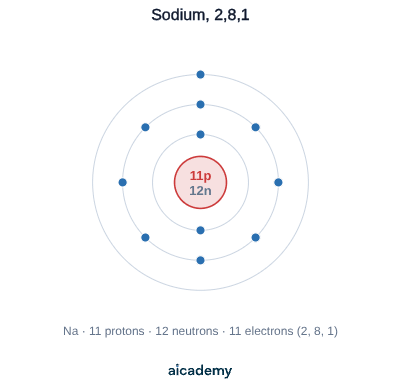
The two inner electrons sit on the first shell, eight fill the second, and a single electron sits alone on the outer shell. That lone outer electron is why sodium is a very reactive Group 1 metal.

Chlorine, structure 2,8,7, has seven electrons on its outer shell:
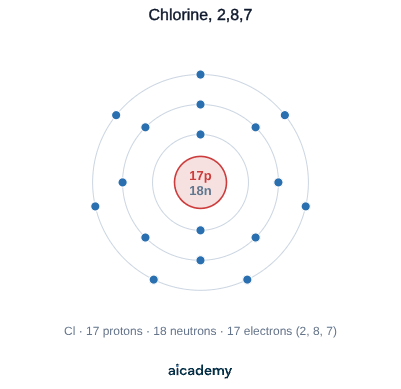
When you draw these by hand, keep the electron counts exact: an examiner counts the electrons on each shell, so 2,8,7 must show exactly seven on the outer circle.

Linking Structure to the Periodic Table

Electronic structure explains an atom's position in the periodic table, which is the single most useful thing it gives you.

  • The number of occupied shells equals the period (row) number.
  • The number of electrons in the outer shell equals the group number (for the main groups, Groups 1 to 7 and Group 0).

Worked example — chlorine, 2,8,7. It has 3 occupied shells, so it is in Period 3. It has 7 outer-shell electrons, so it is in Group 7. Both are correct: chlorine is a Period 3, Group 7 halogen.

ElementStructureOccupied shells → periodOuter electrons → group
Lithium2,12 → Period 21 → Group 1
Carbon2,42 → Period 24 → Group 4
Calcium2,8,8,24 → Period 42 → Group 2

Group 0 (the noble gases) is the exception to the outer-electron rule: helium has 2 outer electrons but sits in Group 0 because its outer shell is full. Every other noble gas has 8 outer electrons.

Common Exam Mistakes

1. Overfilling the first shell

The first shell holds a maximum of 2 electrons. Writing hydrogen as anything but 1, or helium as anything but 2, is wrong. Only the first shell has this small limit.

2. Putting a ninth electron in the third shell for element 19 or 20

For the first 20 elements the third shell stops at 8. Potassium is 2,8,8,1 and calcium is 2,8,8,2; the extra electrons open the fourth shell rather than making the third hold 9.

3. The numbers not adding up to the atomic number

The electron counts must total the atomic number for a neutral atom. If 2,8,2 is written for an element with atomic number 11, the total is 12 and the structure is wrong.

4. Drawing the wrong number of outer electrons

Diagrams are marked by counting electrons on each shell. Draw exactly the right number on the outer shell, because it is the outer shell that determines group and reactivity.

5. Reading the structure from the outside in

Electronic structures are written innermost shell first. For sodium that is 2,8,1, not 1,8,2. Always start counting from the shell nearest the nucleus.

Key terms

Energy level (shell)
A region around the nucleus at a fixed distance where electrons are found.
Electronic structure
The arrangement of electrons in the shells of an atom, written as numbers such as 2,8,1.
Outer shell
The highest occupied energy level of an atom, which controls its chemical reactions.

Frequently asked questions

Sodium has 11 electrons arranged as 2,8,1. Two electrons fill the first shell, eight fill the second shell, and the last electron goes into the third shell, which is why sodium is in Group 1 and Period 3.

For the first 20 elements, the first shell holds up to 2 electrons and the second and third shells each hold up to 8. Electrons always fill the lowest shell first before the next one begins.

Draw the nucleus in the centre, then draw circles around it for the shells. Add electrons as crosses or dots on each circle, filling the inner shells first: 2 on the first, then up to 8 on each of the next shells for the first 20 elements.

Generate revision on any topic you study

Type any topic you're studying and Aicademy generates a complete lesson, quiz, and flashcard set, personalised to your level.

Lessons on anything

Structured, level-matched lessons on any topic you study

Practice quizzes

Find out what you actually know before the exam does

Flashcard sets

Lock in key concepts with instant revision cards

Ask Aica

Stuck on something? Get a clear explanation, any time

Prev

Atomic Structure, Isotopes and Relative Atomic Mass

Next

The Periodic Table and Its Development

Related lessons

8 min

Lesson

Ionic Bonding

AQA GCSE Chemistry · AQA 8462

20 days ago

7 min

Lesson

Covalent Bonding

AQA GCSE Chemistry · AQA 8462

20 days ago

Top students don’t revise more. They revise what counts.

Start revising free

Free to start. No card needed.