Atomic Structure, Isotopes and Relative Atomic Mass

Aligned to the AQA 8462 specification
- Level
- Advanced
- Reading time
- 6 min
- Published
- 2 July 2026
- Updated
- 16 August 2026
On this page
Key takeaways
- A proton has a relative charge of +1, a neutron 0 and an electron −1; in a neutral atom the number of protons equals the number of electrons, so there is no overall charge.
- The atomic number is the number of protons, and every atom of the same element has the same number of protons; the mass number is the total number of protons plus neutrons.
- An atom has a radius of about 0.1 nm and its nucleus is less than 1/10 000 of that, yet almost all of the atom's mass is in the nucleus.
- Isotopes are atoms of the same element with the same number of protons but different numbers of neutrons, so they have the same atomic number but different mass numbers.
- Relative atomic mass is the average mass of an element's atoms, weighted by the abundance of each isotope, calculated as the sum of (isotope mass × percentage) divided by 100.
Isotopes
Isotopes are atoms of the same element with different numbers of neutrons. They have the same number of protons (so the same atomic number) but different mass numbers.
Chlorine, for example, exists as two isotopes:
| Isotope | Protons | Neutrons | Mass number |
|---|---|---|---|
| Chlorine-35 | 17 | 18 | 35 |
| Chlorine-37 | 17 | 20 | 37 |
Both are chlorine because both have 17 protons. They differ only in neutron number, which changes the mass but not the identity of the element.
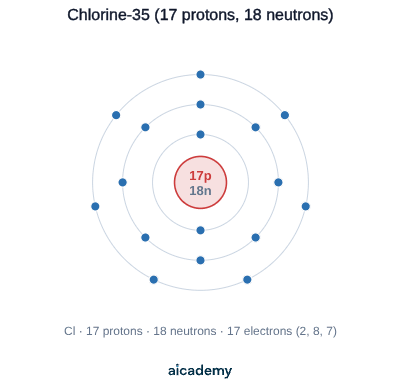
Isotopes of an element have the same chemical properties, because chemical reactions depend on the electrons, and isotopes have the same number of electrons arranged in the same way. Only physical properties that depend on mass, such as density, differ slightly.
Studying this for an exam?
Generate a personalised learning path for this subject. Free to get started.
Key terms
- Atomic number
- The number of protons in an atom, which defines the element.
- Mass number
- The total number of protons and neutrons in an atom.
- Isotopes
- Atoms of the same element with the same number of protons but different numbers of neutrons.
- Relative atomic mass
- The average mass of the atoms of an element, taking account of the abundance of each isotope.
Frequently asked questions
An isotope is an atom of the same element with the same number of protons but a different number of neutrons. Isotopes therefore have the same atomic number but different mass numbers, and they react in the same way chemically.
Multiply each isotope's mass number by its percentage abundance, add these together, then divide by 100. For chlorine, (35 × 75 + 37 × 25) ÷ 100 = 35.5.
Subtract the atomic number from the mass number. The atomic number gives the protons, and mass number minus atomic number gives the neutrons, because mass number is protons plus neutrons.
Generate revision on any topic you study
Type any topic you're studying and Aicademy generates a complete lesson, quiz, and flashcard set, personalised to your level.
Lessons on anything
Structured, level-matched lessons on any topic you study
Practice quizzes
Find out what you actually know before the exam does
Flashcard sets
Lock in key concepts with instant revision cards
Ask Aica
Stuck on something? Get a clear explanation, any time
The Development of the Atomic Model
Electronic Structure
Related lessons
7 min
7 min
5 min
7 min