Track progress, take quizzes and save notes on this lesson.

Free forever · no card needed

Start free
Intermediate

Ionic Bonding

4.2.1.1 Chemical bonds·4.2.1.2 Ionic bonding·4.2.1.3 Ionic compounds

Aligned to the AQA 8462 specification

Level
Intermediate
Reading time
8 min
Published
2 July 2026
On this page
  1. 1.The Three Types of Chemical Bond
  2. 2.How Ions Form: Electron Transfer
  3. 3.Working Out Ion Charges From the Group Number
  4. 4.Dot-and-Cross Diagrams for Ionic Bonding
  5. 5.The Giant Ionic Lattice
  6. 6.Reading the Formula From a Model
  7. 7.Limitations of the Diagrams and Models
  8. 8.Common Exam Mistakes

Key takeaways

  • Ionic bonding happens between a metal and a non-metal: outer-shell electrons transfer from the metal atom to the non-metal atom, forming positive and negative ions.
  • The charge on an ion follows its group: Group 1 forms 1+, Group 2 forms 2+, Group 6 forms 2-, and Group 7 forms 1-, so each ion gains a full outer shell like a noble gas.
  • An ionic compound is a giant lattice of oppositely charged ions held together by strong electrostatic forces acting in all directions.
  • Sodium chloride is the named example: Na loses one electron to become Na+ and Cl gains it to become Cl-, giving the formula NaCl.
  • Dot-and-cross, ball-and-stick and 2D or 3D diagrams each show only part of the truth: none shows the true scale, the forces, or the fact that the lattice repeats in every direction.

The Three Types of Chemical Bond

Every chemical bond falls into one of three types, and each depends on how the outer-shell electrons behave. Knowing which type applies comes down to which kinds of element are involved.

  • Ionic bonding occurs between a metal and a non-metal. Electrons are transferred, forming charged ions that attract each other.
  • Covalent bonding occurs between non-metals. Electrons are shared in pairs between atoms.
  • Metallic bonding occurs in metallic elements and alloys. Atoms share a pool of delocalised electrons.
Bond typeBetweenWhat happens to electrons
IonicMetal + non-metalTransferred from metal to non-metal
CovalentNon-metal + non-metalShared in pairs
MetallicMetal(s) / alloyDelocalised and shared across the structure

All three bonds are electrostatic: they involve the attraction between positive and negative charges. In ionic bonding those charges are whole ions.

This lesson covers ionic bonding in full: the transfer of electrons between a metal and a non-metal.

How Ions Form: Electron Transfer

When a metal reacts with a non-metal, the metal atom loses its outer-shell electrons and the non-metal atom gains them. Both atoms end up with a full outer shell, matching the stable electronic structure of a noble gas.

A metal atom that loses electrons has more protons than electrons, so it becomes a positive ion (a cation). A non-metal atom that gains electrons has more electrons than protons, so it becomes a negative ion (an anion).

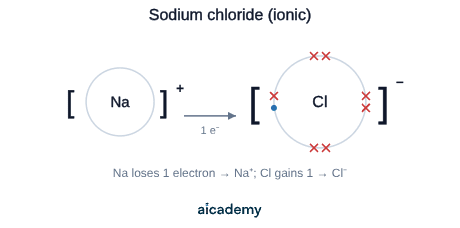
Take sodium (electronic structure 2,8,1) reacting with chlorine (2,8,7):

  • Sodium loses its single outer electron: it becomes with the structure 2,8 (like neon).
  • Chlorine gains that one electron: it becomes with the structure 2,8,8 (like argon).

The electron leaves sodium and joins chlorine. Nothing is destroyed: the total number of electrons is conserved, which is why the charges balance.

Working Out Ion Charges From the Group Number

You are expected to work out the charge on an ion directly from its group in the periodic table, for Groups 1, 2, 6 and 7. The rule follows from how many electrons an atom must lose or gain to reach a full outer shell.

GroupOuter electronsElectrons lost or gainedIon chargeExamples
11lose 11+Na⁺, K⁺, Li⁺
22lose 22+Mg²⁺, Ca²⁺
66gain 22−O²⁻, S²⁻
77gain 11−Cl⁻, Br⁻

Metals in Groups 1 and 2 form positive ions by losing electrons. Non-metals in Groups 6 and 7 form negative ions by gaining electrons. Each resulting ion has the electronic structure of a noble gas.

Worked example. What is the charge on a calcium ion and an oxide ion? Calcium is in Group 2, so it loses 2 electrons to form . Oxygen is in Group 6, so it gains 2 electrons to form . The 2+ and 2− charges balance one-to-one, so calcium oxide is .

Dot-and-Cross Diagrams for Ionic Bonding

A dot-and-cross diagram shows where each electron came from. One atom's electrons are drawn as dots, the other's as crosses. For ions you draw the transferred electron ending up on the non-metal, and you write the charge on each ion outside square brackets.

The diagram below shows sodium transferring its single outer electron to chlorine. The lone outer electron (drawn as a cross) leaves sodium; chlorine's outer shell (dots) gains it, completing an octet.
For magnesium oxide, magnesium (Group 2) transfers two electrons to oxygen (Group 6):

Written as a diagram, both of magnesium's outer electrons move into oxygen's outer shell, giving and . The formula is MgO.

In the exam, show the outer shells only, write the charge on each ion, and put square brackets around each ion. Empty inner shells are not needed.

Studying this for an exam?

Generate a personalised learning path for this subject. Free to get started.

Create a learning path

The Giant Ionic Lattice

An ionic compound is not made of separate molecules. It is a giant ionic lattice: a regular, repeating 3D arrangement of huge numbers of positive and negative ions. The ions are held together by strong electrostatic forces of attraction that act in all directions between oppositely charged ions.

The named example you must know is sodium chloride. In the NaCl lattice, the Na⁺ and Cl⁻ ions alternate in a cubic pattern that repeats in every direction, so each ion is surrounded on all sides by ions of the opposite charge.

There are no individual "NaCl molecules". The formula NaCl gives the ratio of ions (1:1), not the number in one particle.

Because the electrostatic forces act throughout the whole structure and are strong, a great deal of energy is needed to break them apart. That is why ionic compounds have high melting and boiling points, a property covered in the properties lesson. The strength and all-directional nature of the bonding is the point to remember here.

Reading the Formula From a Model

The spec expects you to deduce the empirical formula of an ionic compound from a diagram or model of its lattice. The empirical formula is the simplest whole-number ratio of the ions present.

There are two reliable methods.

Method 1 — from the model. Count the ions shown, then simplify the ratio. If a model shows 8 sodium ions and 8 chloride ions, the ratio is 8:8, which simplifies to 1:1, giving NaCl.

Method 2 — balancing charges. The compound must be electrically neutral, so the positive and negative charges must cancel.

Worked example — magnesium chloride. Magnesium forms and chloride is . To balance one 2+ charge you need two 1− charges, so you need one and two :

The ratio is 1:2, so the formula is .

Worked example — calcium fluoride. Calcium is (Group 2) and fluoride is (Group 7). One 2+ needs two 1−, giving .

Limitations of the Diagrams and Models

No single diagram shows the whole truth about ionic bonding. The spec asks you to describe the limitations of each representation, so you must know what each one leaves out.

RepresentationWhat it shows wellWhat it fails to show
Dot-and-crossWhich atom each electron came from; the transferThe real 3D lattice; ion sizes; the forces
2D diagramThe ratio of ions in one layerThe third dimension; that the pattern repeats
Ball-and-stickThe 3D geometry and repeating arrangementThe sticks imply covalent bonds; ions look too far apart; ignores their real size
3D space-fillingRelative ion sizes and close packingHard to see ions behind the front layer; still finite, not truly giant

A common exam phrase: ball-and-stick models show gaps and sticks that do not really exist between ions, and no model can show that the lattice extends indefinitely in all directions.

Common Exam Mistakes

1. Getting the direction of electron transfer wrong

The metal loses electrons and the non-metal gains them. Metals become positive, non-metals become negative. Reversing this is a frequent slip in dot-and-cross questions.

2. Forgetting the charges on the ions

A dot-and-cross diagram for an ionic compound must show the charge on each ion and square brackets around it. and without charges describe atoms, not the ions in the compound.

3. Saying ionic compounds are made of molecules

Ionic compounds are giant lattices, not molecules. Do not describe "NaCl molecules". The formula shows the ratio of ions only.

4. Confusing which group gains and which loses

Groups 1 and 2 lose electrons (they have few outer electrons to shed); Groups 6 and 7 gain electrons (they need only one or two to fill the shell). Check the group number before deciding.

5. Not simplifying to the empirical formula

is not accepted; it simplifies to MgO. Always give the simplest whole-number ratio of ions.

Key terms

Ion
A charged particle formed when an atom loses or gains electrons, giving it more or fewer electrons than protons.
Ionic bond
The strong electrostatic force of attraction between oppositely charged ions in a compound.
Giant ionic lattice
A regular 3D arrangement of huge numbers of oppositely charged ions held by electrostatic forces acting in all directions.
Dot-and-cross diagram
A diagram that uses dots and crosses to show which atom each electron came from during bonding.
Empirical formula
The simplest whole-number ratio of the different ions or atoms in a compound.

Frequently asked questions

Use the group number. Group 1 ions are 1+, Group 2 are 2+, Group 6 are 2-, and Group 7 are 1-. Metals in Groups 1 and 2 lose electrons to become positive; non-metals in Groups 6 and 7 gain electrons to become negative, each reaching a full outer shell.

Sodium loses one electron to form Na+ and chlorine gains one to form Cl-. The 1+ and 1- charges balance with one of each ion, so the ratio is 1:1 and the formula is NaCl.

A dot-and-cross diagram shows which electrons transfer and where they come from, but it does not show the ions' real sizes, the 3D giant lattice, or the electrostatic forces holding the ions together.

Generate revision on any topic you study

Type any topic you're studying and Aicademy generates a complete lesson, quiz, and flashcard set, personalised to your level.

Lessons on anything

Structured, level-matched lessons on any topic you study

Practice quizzes

Find out what you actually know before the exam does

Flashcard sets

Lock in key concepts with instant revision cards

Ask Aica

Stuck on something? Get a clear explanation, any time

Prev

Transition Metals

Next

Covalent Bonding

Related lessons

7 min

Lesson

Covalent Bonding

AQA GCSE Chemistry · AQA 8462

19 days ago

6 min

Lesson

Metallic Bonding

AQA GCSE Chemistry · AQA 8462

19 days ago

6 min

Lesson

Electronic Structure

AQA GCSE Chemistry · AQA 8462

19 days ago

Top students don’t revise more. They revise what counts.

Start revising free

Free to start. No card needed.