Track progress, take quizzes and save notes on this lesson.

Free forever · no card needed

Start free
Intermediate

Covalent Bonding

4.2.1.1 Chemical bonds·4.2.1.4 Covalent bonding

Aligned to the AQA 8462 specification

Level
Intermediate
Reading time
7 min
Published
2 July 2026
On this page
  1. 1.What a Covalent Bond Is
  2. 2.Single, Double and Triple Bonds
  3. 3.Dot-and-Cross for the Diatomic Molecules
  4. 4.Dot-and-Cross for HCl, H₂O, NH₃ and CH₄
  5. 5.Displayed Formulae: Bonds as Lines
  6. 6.Limitations of the Diagrams
  7. 7.Common Exam Mistakes

Key takeaways

  • A covalent bond is a shared pair of electrons between two non-metal atoms, and each shared pair counts towards the outer shell of both atoms.
  • A single covalent bond is one shared pair, a double bond is two shared pairs, and a triple bond is three shared pairs; oxygen has a double bond and nitrogen has a triple bond.
  • In a displayed formula each single covalent bond is drawn as one straight line between the two atoms.
  • Covalently bonded substances can be small molecules, very large molecules (polymers), or giant covalent structures such as diamond and silicon dioxide.
  • Dot-and-cross and displayed formulae show the bonds but not the molecule's real shape, the atoms' relative sizes, or the fact that the electrons are actually indistinguishable.

What a Covalent Bond Is

A covalent bond is a shared pair of electrons between two atoms. Covalent bonding happens between non-metal atoms: most non-metallic elements and the compounds of non-metals are held together this way.

When two non-metal atoms bond, neither can afford to lose electrons, so instead they share. Each atom contributes one electron to a shared pair, and that pair is attracted to the nucleus of both atoms at once. This shared attraction is the bond, and covalent bonds are strong.

A covalent bond = a shared pair of electrons, attracted to both nuclei. The shared pair counts towards the outer shell of both atoms.

Substances made of covalent bonds come in three forms, all covered elsewhere in this topic:

  • Small molecules — a few atoms, such as or .
  • Very large molecules (polymers) — long chains of repeating units.
  • Giant covalent structures — networks of billions of atoms, such as diamond and silicon dioxide.

This lesson focuses on how the bonds form in small molecules and how to draw them.

Single, Double and Triple Bonds

The number of shared pairs between two atoms depends on how many electrons each atom needs to fill its outer shell. Atoms share just enough pairs to give every atom a full outer shell (2 for hydrogen, 8 for most others).

Shared pairsName of bondShown asExample
1Single bondone line (–)H–H, Cl–Cl
2Double bondtwo lines (=)O=O
3Triple bondthree lines (≡)N≡N

Hydrogen atoms have 1 outer electron and need 1 more, so they share one pair: a single bond.

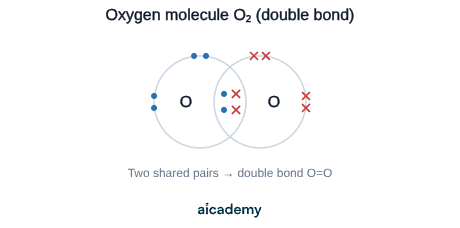
Oxygen atoms have 6 outer electrons and need 2 more, so two oxygen atoms share two pairs: a double bond, O=O.

Nitrogen atoms have 5 outer electrons and need 3 more, so two nitrogen atoms share three pairs: a triple bond, N≡N.

Count the outer electrons first. The number an atom needs to reach a full shell tells you how many bonds it forms.

Dot-and-Cross for the Diatomic Molecules

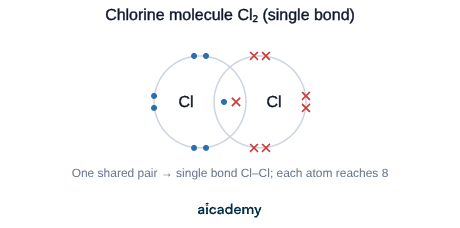
A dot-and-cross diagram uses dots for one atom's electrons and crosses for the other's, so you can see that each bond is a genuinely shared pair. Only the outer shell is drawn.

The four you must be able to draw as diatomic molecules are , , and . The diagram below shows chlorine: each atom brings 7 outer electrons, and they share one pair to give both a full shell of 8.
Oxygen needs a double bond. Two oxygen atoms, each with 6 outer electrons, share two pairs so both reach 8:
Nitrogen needs a triple bond: two nitrogen atoms (5 outer electrons each) share three pairs, giving N≡N. Hydrogen is the simplest of all: two atoms, one shared pair, H–H.

Dot-and-Cross for HCl, H₂O, NH₃ and CH₄

The remaining four required molecules combine hydrogen or a central atom with others. The rule is unchanged: share enough pairs so every atom fills its outer shell. Hydrogen needs 2; carbon, nitrogen, oxygen and chlorine need 8.

MoleculeCentral atom (outer e⁻)Bonds formedEach shared pair fills
HClCl (7) + H (1)1 single bondCl → 8, H → 2
H₂OO (6) + 2 H (1 each)2 single bondsO → 8, each H → 2
NH₃N (5) + 3 H (1 each)3 single bondsN → 8, each H → 2
CH₄C (4) + 4 H (1 each)4 single bondsC → 8, each H → 2

Hydrogen chloride (HCl). Chlorine (7 outer electrons) and hydrogen (1) share one pair, giving Cl a full shell of 8 and H a full shell of 2. Chlorine also keeps 3 non-bonding pairs.

Water (H₂O). Oxygen has 6 outer electrons and forms two single bonds, one to each hydrogen. This gives oxygen 8 electrons (2 in each shared pair plus 2 lone pairs) and each hydrogen 2.

Ammonia (NH₃). Nitrogen has 5 outer electrons and forms three single bonds, one to each of three hydrogens, reaching 8. One lone pair is left on the nitrogen.

Methane (CH₄). Carbon has 4 outer electrons and forms four single bonds, one to each of four hydrogens, reaching 8. Every electron on carbon is used in bonding, and each hydrogen reaches 2.

To check any dot-and-cross diagram: count the electrons around each atom. Every hydrogen must show 2, and carbon, nitrogen, oxygen or chlorine must show 8.

Studying this for an exam?

Generate a personalised learning path for this subject. Free to get started.

Create a learning path

Displayed Formulae: Bonds as Lines

A displayed formula shows every atom and draws each covalent bond as a line. A single bond is one line, a double bond is two lines, a triple bond is three. Displayed formulae are quicker to draw than dot-and-cross and are what the exam usually wants once bonding is understood.

    H
    |
H — C — H     H — N — H     H — O — H     H — Cl
    |             |
    H             H
  methane        ammonia       water        HCl
   (CH4)          (NH3)        (H2O)        (HCl)

For the diatomic molecules:

  • Hydrogen: H–H
  • Chlorine: Cl–Cl
  • Oxygen: O=O (double)
  • Nitrogen: N≡N (triple)

A line represents a shared pair, so one line = one bond = one shared pair. Do not draw lone pairs in a displayed formula; those only appear in the dot-and-cross version.

Displayed formulae for polymers use a repeating unit in brackets, showing that the same covalent bonding pattern repeats along a long chain.

Limitations of the Diagrams

Both dot-and-cross diagrams and displayed formulae simplify reality, and the spec asks you to state their limitations.

DiagramWhat it shows wellWhat it fails to show
Dot-and-crossWhich atom each electron came from; how pairs are sharedThe 3D shape; the real relative sizes of atoms; that electrons are actually identical
Displayed formulaEvery atom and every bond clearlyThe 3D shape; bond angles; lone pairs; relative atom sizes
Ball-and-stick / 3DThe shape and bond anglesAtoms look too far apart; sticks over-emphasise the bonds

Dots and crosses are only a bookkeeping device. In a real molecule the shared electrons are indistinguishable — you cannot actually tell which atom an electron "came from".

Recognising these limits is a common short-answer question: name the diagram, then say precisely what it leaves out.

Common Exam Mistakes

1. Drawing the wrong number of bonds

Count the outer electrons: oxygen needs a double bond, nitrogen a triple bond. Drawing O–O or N–N instead of O=O and N≡N leaves the atoms with incomplete shells.

2. Forgetting hydrogen fills at 2, not 8

Hydrogen has only one shell, which is full with 2 electrons. Do not try to give a hydrogen atom 8 electrons in a diagram.

3. Confusing covalent bonding with ionic

Covalent bonds are shared electrons between non-metals; there is no transfer and no charges. Do not put charges or brackets on a covalent dot-and-cross diagram.

4. Leaving out lone pairs in dot-and-cross diagrams

In HCl, H₂O and NH₃, the non-bonding electrons still belong to the central atom. Show them, or the atom appears to have too few electrons.

5. Using lines and dots in the same diagram inconsistently

Choose one representation. A displayed formula uses lines for bonds only; a dot-and-cross diagram uses dots and crosses. Mixing them loses clarity and marks.

Key terms

Covalent bond
A shared pair of electrons between two non-metal atoms, attracted to both nuclei.
Single bond
A covalent bond made of one shared pair of electrons, drawn as one line.
Double bond
A covalent bond made of two shared pairs of electrons, drawn as two lines.
Displayed formula
A diagram showing every atom and every covalent bond, with each single bond drawn as a line.
Small molecule
A substance made of a small, fixed number of atoms joined by covalent bonds, such as H₂O or CO₂.

Frequently asked questions

A covalent bond is a shared pair of electrons between two non-metal atoms. The shared pair is attracted to the nuclei of both atoms, which holds them together, and it counts towards the outer shell of each atom.

Each oxygen atom has 6 outer electrons and needs 2 more to fill its shell. Two oxygen atoms share two pairs of electrons, forming a double covalent bond (O=O), so both atoms reach a full outer shell of 8.

Carbon has 4 outer electrons and hydrogen has 1 each. Carbon shares one electron with each of four hydrogen atoms, forming four single bonds. Each shared pair has one dot and one cross, giving carbon a full shell of 8 and each hydrogen a full shell of 2.

Generate revision on any topic you study

Type any topic you're studying and Aicademy generates a complete lesson, quiz, and flashcard set, personalised to your level.

Lessons on anything

Structured, level-matched lessons on any topic you study

Practice quizzes

Find out what you actually know before the exam does

Flashcard sets

Lock in key concepts with instant revision cards

Ask Aica

Stuck on something? Get a clear explanation, any time

Prev

Ionic Bonding

Next

Metallic Bonding

Related lessons

8 min

Lesson

Ionic Bonding

AQA GCSE Chemistry · AQA 8462

19 days ago

6 min

Lesson

Metallic Bonding

AQA GCSE Chemistry · AQA 8462

19 days ago

6 min

Lesson

Electronic Structure

AQA GCSE Chemistry · AQA 8462

19 days ago

Top students don’t revise more. They revise what counts.

Start revising free

Free to start. No card needed.