Track progress, take quizzes and save notes on this lesson.

Free forever · no card needed

Start free
Advanced

Atomic Structure, Isotopes and Relative Atomic Mass

4.1.1.4 Relative electrical charges of subatomic particles·4.1.1.5 Size and mass of atoms·4.1.1.6 Relative atomic mass

Aligned to the AQA 8462 specification

Level
Advanced
Reading time
6 min
Published
2 July 2026
On this page
  1. 1.Subatomic Particles and Their Charges
  2. 2.Atomic Number and Mass Number
  3. 3.The Size and Scale of Atoms
  4. 4.Isotopes
  5. 5.Relative Atomic Mass from Isotope Abundance
  6. 6.Common Exam Mistakes

Key takeaways

  • A proton has a relative charge of +1, a neutron 0 and an electron −1; in a neutral atom the number of protons equals the number of electrons, so there is no overall charge.
  • The atomic number is the number of protons, and every atom of the same element has the same number of protons; the mass number is the total number of protons plus neutrons.
  • An atom has a radius of about 0.1 nm and its nucleus is less than 1/10 000 of that, yet almost all of the atom's mass is in the nucleus.
  • Isotopes are atoms of the same element with the same number of protons but different numbers of neutrons, so they have the same atomic number but different mass numbers.
  • Relative atomic mass is the average mass of an element's atoms, weighted by the abundance of each isotope, calculated as the sum of (isotope mass × percentage) divided by 100.

Subatomic Particles and Their Charges

Every atom is built from three subatomic particles: protons, neutrons and electrons. Protons and neutrons sit together in the central nucleus; electrons occupy the space around it.

Each particle has a relative electrical charge:

ParticleRelative chargeWhere it is
Proton+1In the nucleus
Neutron0In the nucleus
Electron−1Around the nucleus

Because a proton is +1 and an electron is −1, they cancel exactly. In a neutral atom the number of electrons equals the number of protons, so the positive and negative charges balance and the atom has no overall charge.

If the numbers of protons and electrons are not equal, the particle is an ion, not a neutral atom. Losing electrons gives a positive ion; gaining electrons gives a negative ion.

This balance of charge is the reason atoms are neutral, and it is the starting point for working out the make-up of any atom or ion.

Atomic Number and Mass Number

Two numbers describe any atom. The atomic number is the number of protons. The mass number is the total number of protons and neutrons.

The atomic number defines the element. All atoms of a given element have the same number of protons, and different elements have different numbers of protons. Change the number of protons and you have a different element entirely.

Atoms are written with the mass number on top and the atomic number on the bottom, before the symbol. For sodium:

From this you can read off everything:

  • Atomic number = 11 → 11 protons
  • A neutral atom has equal protons and electrons → 11 electrons
  • Neutrons = mass number − atomic number = 23 − 11 = 12 neutrons

Worked example — an ion. For : protons = 12, neutrons = 24 − 12 = 12. The 2+ charge means the atom has lost 2 electrons, so electrons = 12 − 2 = 10.

The Size and Scale of Atoms

Atoms are extraordinarily small. The radius of an atom is about 0.1 nm, which is m.

The nucleus is far smaller still: its radius is less than 1/10 000 of the radius of the whole atom, roughly m. Almost all of the atom is empty space, with the electrons occupying the volume around the tiny nucleus.

FeatureApproximate radius
Whole atom0.1 nm = m
Nucleusabout m (< 1/10 000 of the atom)

Yet despite its tiny size, almost all of the mass of the atom is in the nucleus, because protons and neutrons carry the mass while electrons are nearly massless.

To picture the scale: if an atom were the size of a large sports stadium, the nucleus would be about the size of a pea at the centre. Everything else is the space where the electrons are found.

The relative masses of the particles make this clear: a proton and a neutron each have a relative mass of 1, while the electron's relative mass is so small it is treated as very small (effectively negligible).

Isotopes

Isotopes are atoms of the same element with different numbers of neutrons. They have the same number of protons (so the same atomic number) but different mass numbers.

Chlorine, for example, exists as two isotopes:

IsotopeProtonsNeutronsMass number
Chlorine-35171835
Chlorine-37172037

Both are chlorine because both have 17 protons. They differ only in neutron number, which changes the mass but not the identity of the element.
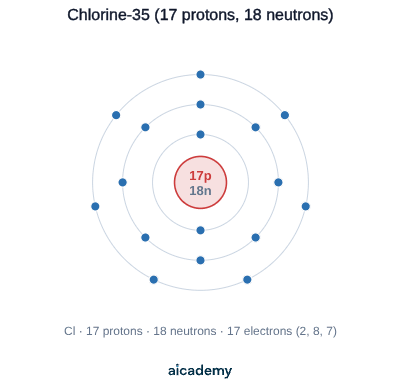
Isotopes of an element have the same chemical properties, because chemical reactions depend on the electrons, and isotopes have the same number of electrons arranged in the same way. Only physical properties that depend on mass, such as density, differ slightly.

Studying this for an exam?

Generate a personalised learning path for this subject. Free to get started.

Create a learning path

Relative Atomic Mass from Isotope Abundance

Because most elements are a mixture of isotopes, we use an average mass called the relative atomic mass (Ar). It is an average value that takes account of the abundance of each isotope — a weighted average, not a simple one.

The formula is:

Worked example 1 — chlorine. Chlorine is 75% chlorine-35 and 25% chlorine-37.

The answer, 35.5, is closer to 35 than to 37 because the lighter isotope is more abundant. That matches the value on the periodic table.

Worked example 2 — boron. Boron is 20% boron-10 and 80% boron-11.

The result, 10.8, lies close to 11 because boron-11 is the more abundant isotope.

Common Exam Mistakes

1. Confusing atomic number and mass number

Atomic number is the number of protons and defines the element; mass number is protons plus neutrons. To find neutrons, subtract atomic number from mass number, not the other way round.

2. Forgetting to adjust electrons for an ion

A neutral atom has equal protons and electrons, but an ion does not. A 2+ ion has lost 2 electrons; a 1− ion has gained 1. Adjust the electron count using the charge.

3. Treating relative atomic mass as a simple average

Ar is a weighted average by abundance, so you multiply each isotope mass by its percentage before adding. Simply averaging 35 and 37 to get 36 for chlorine is wrong; the answer is 35.5.

4. Dividing by the wrong number

After summing (mass × percentage) for each isotope, divide by 100 when abundances are percentages (or by the total abundance if fractions are given). Dividing by the number of isotopes instead gives a wrong Ar.

5. Saying isotopes react differently

Isotopes have the same electronic structure, so they behave the same in chemical reactions. Only mass-dependent physical properties differ, so do not claim one isotope is more reactive than another.

Key terms

Atomic number
The number of protons in an atom, which defines the element.
Mass number
The total number of protons and neutrons in an atom.
Isotopes
Atoms of the same element with the same number of protons but different numbers of neutrons.
Relative atomic mass
The average mass of the atoms of an element, taking account of the abundance of each isotope.

Frequently asked questions

An isotope is an atom of the same element with the same number of protons but a different number of neutrons. Isotopes therefore have the same atomic number but different mass numbers, and they react in the same way chemically.

Multiply each isotope's mass number by its percentage abundance, add these together, then divide by 100. For chlorine, (35 × 75 + 37 × 25) ÷ 100 = 35.5.

Subtract the atomic number from the mass number. The atomic number gives the protons, and mass number minus atomic number gives the neutrons, because mass number is protons plus neutrons.

Generate revision on any topic you study

Type any topic you're studying and Aicademy generates a complete lesson, quiz, and flashcard set, personalised to your level.

Lessons on anything

Structured, level-matched lessons on any topic you study

Practice quizzes

Find out what you actually know before the exam does

Flashcard sets

Lock in key concepts with instant revision cards

Ask Aica

Stuck on something? Get a clear explanation, any time

Prev

The Development of the Atomic Model

Next

Electronic Structure

Related lessons

6 min

Lesson

Electronic Structure

AQA GCSE Chemistry · AQA 8462

20 days ago

7 min

Top students don’t revise more. They revise what counts.

Start revising free

Free to start. No card needed.