Track progress, take quizzes and save notes on this lesson.

Free forever · no card needed

Start free
Intermediate

The Periodic Table and Its Development

4.1.2.1 The periodic table·4.1.2.2 Development of the periodic table·4.1.2.3 Metals and non-metals

Aligned to the AQA 8462 specification

Level
Intermediate
Reading time
8 min
Published
2 July 2026
On this page
  1. 1.How the Periodic Table Is Arranged
  2. 2.Groups and Periods
  3. 3.Why Position Predicts Reactivity
  4. 4.The Early Periodic Table
  5. 5.Mendeleev's Insight
  6. 6.From Atomic Weight to Atomic Number
  7. 7.Metals and Non-metals
  8. 8.Common Exam Mistakes

Key takeaways

  • Elements are arranged in the periodic table in order of increasing atomic (proton) number, which places elements with similar properties in the same vertical column.
  • The vertical columns are groups and the horizontal rows are periods; elements in the same group have the same number of electrons in their outer shell, which is why they react similarly.
  • Mendeleev arranged elements by atomic weight but left gaps for undiscovered elements and switched some pairs out of strict weight order, and his predictions were later confirmed.
  • Knowledge of isotopes explained why ordering by atomic weight sometimes gave the wrong sequence; ordering by atomic number removed these anomalies.
  • Elements that react to form positive ions are metals; those that do not are non-metals. Metals are on the left and towards the bottom, non-metals to the right and top.

How the Periodic Table Is Arranged

The periodic table lists every known element in order of increasing atomic number — the number of protons in each atom. Reading left to right along each row, the atomic number goes up by one at every step: hydrogen is 1, helium 2, lithium 3, and so on.

Arranging elements this way does something powerful. Elements with similar chemical properties end up in the same vertical column. This repeating pattern of properties is why the table is called periodic: similar properties recur at regular intervals as you move through the elements.

TermMeaning
Atomic numberNumber of protons; sets the order of elements
GroupVertical column of the table
PeriodHorizontal row of the table

A student is always supplied with a periodic table in the exam, so the skill being tested is reading position and relating it to structure and reactivity, not memorising the whole table.

Groups and Periods

The columns and rows of the table carry specific meaning, and the two are often confused.

A group is a vertical column. The group number tells you how many electrons are in the outer shell of each atom in that group. Group 1 elements have one outer electron; Group 7 elements have seven; Group 0 (the noble gases) have a full outer shell. Because chemical reactions involve the outer electrons, elements in the same group react in similar ways.

A period is a horizontal row. Moving across a period, each element has one more proton and one more electron than the last, and the outer shell gradually fills up. The period number tells you how many occupied electron shells the atoms have.

Group 1 elementElectronic structureOuter electrons
Lithium (Li)2, 11
Sodium (Na)2, 8, 11
Potassium (K)2, 8, 8, 11

Each of these sits in Group 1 because each has exactly one outer electron, which is the reason they share the reactions of the alkali metals.

Why Position Predicts Reactivity

Because the group number equals the number of outer-shell electrons, position in the table lets you predict how an element behaves before you have seen any data on it.

An atom is most stable when its outer shell is full. Elements react to gain, lose or share electrons until they reach that stable arrangement. A Group 1 atom has one outer electron to lose, so it forms a 1+ ion. A Group 7 atom needs one more electron to fill its outer shell, so it forms a 1− ion. The diagram below highlights Group 1, the reactive metals whose single outer electron drives their chemistry.
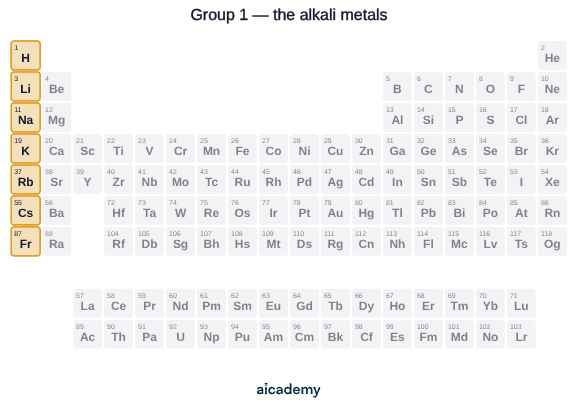
The group number gives the number of outer-shell electrons (except Group 0, which has a full outer shell). This single fact explains why a whole group reacts alike.

Knowing this, you can predict, for example, that any Group 1 metal reacts vigorously with water, or that reactivity changes in a steady trend down a group.

The Early Periodic Table

Before protons, neutrons and electrons were discovered, chemists had no atomic number to work with, so early attempts at a periodic table classified elements in order of their atomic weight.

This caused problems. Ordering strictly by weight sometimes placed elements in a group with different properties from the rest of the column. Many elements were still undiscovered, leaving the table incomplete, and forcing every known element into a fixed weight order meant some ended up in the wrong place. Early tables were therefore both incomplete and, in places, wrong.

The breakthrough was to stop treating atomic weight as an unbreakable rule and instead prioritise grouping elements by their properties. That shift is credited to Dmitri Mendeleev.

Want more lessons like this one?

Generate lessons on anything you study. Free account, no card needed.

Start generating

Mendeleev's Insight

In 1869 the Russian chemist Dmitri Mendeleev produced a table that overcame the earlier problems in two clever ways.

First, he left gaps for elements he believed existed but had not yet been discovered, rather than forcing the known elements into a continuous sequence. He even used the gaps to predict the properties of the missing elements. When elements such as gallium and germanium were later found, their properties matched his predictions closely, which convinced other scientists his table was correct.

Second, he was willing to change the order of a few elements, placing a slightly heavier element before a lighter one where their properties demanded it, rather than following atomic weight blindly.

Mendeleev's two key moves: leaving gaps for undiscovered elements (and predicting their properties), and swapping a few pairs out of strict atomic-weight order to keep similar elements together.

His predictions being confirmed was the strongest evidence that the periodic arrangement reflected something real about the elements.

From Atomic Weight to Atomic Number

Mendeleev's occasional need to swap pairs of elements out of weight order looked like an untidy fix at the time. The discovery of isotopes later explained why it was necessary.

Isotopes are atoms of the same element with different numbers of neutrons, so the same element can contain atoms of different masses. The atomic weight shown for an element is an average across its isotopes. This means atomic weight does not always increase neatly from one element to the next: an element with heavier isotopes can appear before a lighter neighbour if ordering by weight alone. Ordering instead by atomic number (proton number), which is always a whole number that increases by one from element to element, removes these anomalies completely.

Ordering ruleProblem
By atomic weightAveraged over isotopes; occasionally out of sequence, so some elements land in the wrong group
By atomic numberAlways a whole number increasing by one; every element falls into the correct group

This is why the modern table is arranged by atomic number, and why Mendeleev's swaps turned out to be correct all along.

Metals and Non-metals

The periodic table splits into metals and non-metals, and the exam defines the difference in terms of ions, not just physical appearance.

An element that reacts to form positive ions is a metal. An element that does not easily form positive ions is a non-metal. Metals sit on the left and towards the bottom of the table, while non-metals sit towards the right and top. Most elements are metals.

This chemical definition links back to electron arrangement. Metals have few outer electrons and lose them easily to form positive ions; non-metals have nearly full outer shells and tend to gain or share electrons instead.

PropertyMetalsNon-metals
Ion formedPositive ionsDo not easily form positive ions
PositionLeft and bottomRight and top
Typical state at room temperatureMostly solidMixed (gases, liquid, solids)
Conduct electricityYesMostly poor conductors

Common Exam Mistakes

1. Confusing groups and periods

A group is a vertical column; a period is a horizontal row. Only group number tells you the number of outer-shell electrons. Mixing the two loses easy marks.

2. Saying the table is ordered by atomic weight

The modern table is ordered by atomic number (proton number). Atomic weight was the old rule and caused the anomalies that atomic number later fixed.

3. Forgetting Group 0's outer shell

The group number equals the outer electrons for Groups 1–7, but Group 0 elements have a full outer shell (eight electrons, or two for helium), not zero. Do not write "zero outer electrons".

4. Defining a metal by shininess alone

The mark-scheme definition is chemical: a metal reacts to form positive ions. Physical properties like shine and conductivity support the answer but are not the defining test.

5. Crediting Mendeleev only with "making a table"

Explain how he improved it: he left gaps for undiscovered elements and predicted their properties, and he changed the order of some pairs rather than following atomic weight strictly.

6. Saying isotopes were what Mendeleev used

Mendeleev worked before isotopes were known. Isotopes were discovered later and explained why ordering by atomic weight sometimes failed, justifying his swaps.

Key terms

Atomic number
The number of protons in the nucleus of an atom; it decides an element's position in the periodic table.
Group
A vertical column of the periodic table; its elements have the same number of outer-shell electrons and react similarly.
Period
A horizontal row of the periodic table, listing elements in order of increasing atomic number.
Metal
An element that reacts to form positive ions; metals occupy the left and lower part of the periodic table.
Non-metal
An element that does not easily form positive ions; non-metals occupy the right and upper part of the periodic table.

Frequently asked questions

Ordering by atomic number puts every element in the correct group so that elements in a column share properties. Mendeleev's atomic-weight order occasionally placed elements wrongly; the discovery of isotopes later explained these anomalies, and atomic number fixed them.

A group is a vertical column; elements in a group have the same number of outer-shell electrons and similar chemical properties. A period is a horizontal row, showing elements in order of increasing atomic number across the table.

Metals react to form positive ions and sit on the left and towards the bottom of the table. Non-metals do not easily form positive ions and sit towards the right and top. Most elements are metals.

Generate revision on any topic you study

Type any topic you're studying and Aicademy generates a complete lesson, quiz, and flashcard set, personalised to your level.

Lessons on anything

Structured, level-matched lessons on any topic you study

Practice quizzes

Find out what you actually know before the exam does

Flashcard sets

Lock in key concepts with instant revision cards

Ask Aica

Stuck on something? Get a clear explanation, any time

Prev

Electronic Structure

Next

Group 0: The Noble Gases

Related lessons

6 min

Lesson

Electronic Structure

AQA GCSE Chemistry · AQA 8462

20 days ago

5 min

Lesson

Group 0: The Noble Gases

AQA GCSE Chemistry · AQA 8462

20 days ago

5 min

7 min

Lesson

Group 7: The Halogens

AQA GCSE Chemistry · AQA 8462

20 days ago

Top students don’t revise more. They revise what counts.

Start revising free

Free to start. No card needed.