Mitosis and the Cell Cycle

Aligned to the AQA 8461 specification
- Topic
- Cell biology
- Level
- Intermediate
- Reading time
- 9 min
- Published
- 16 June 2026
- Updated
- 25 August 2026
On this page
Key takeaways
- A chromosome is a long coiled molecule of DNA carrying many genes; human body cells have 46 chromosomes arranged as 23 pairs, making them diploid.
- The cell cycle has three overall stages: growth and DNA replication, mitosis (the nucleus divides), then cytokinesis (the cytoplasm and membranes divide).
- DNA must replicate before mitosis so that each chromosome is copied, allowing both daughter cells to receive a full identical set.
- Mitosis produces two genetically identical diploid daughter cells, each with the same 46 chromosomes as the parent cell.
- Mitosis is used for growth, development, repair and replacement of cells, and asexual reproduction, which produces offspring that are clones of the parent.
Stage 1: Growth and DNA Replication
Before a cell can divide it must first grow and prepare. Two things happen in this longest stage.
First, the cell increases the number of its sub-cellular structures — it makes more ribosomes and more mitochondria so that each daughter cell will have enough to function.
Second, the DNA replicates. Each chromosome is copied to form two identical copies, joined together. So a cell that started with 46 single chromosomes now holds 46 doubled chromosomes — 92 copies of DNA in total, still organised as 46 pairs of copies.
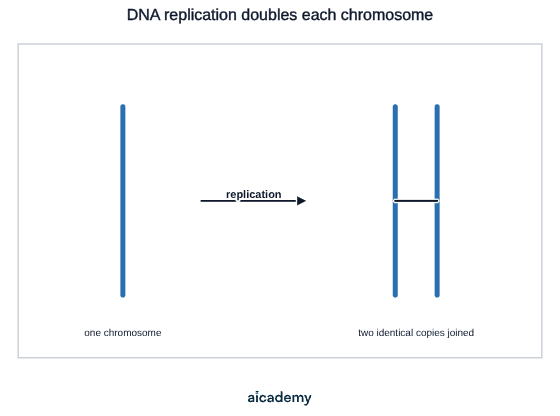
Replication must finish before mitosis begins. If the DNA were not copied first, each daughter cell would receive only half a set of chromosomes.
This careful copying is what allows the two daughter cells to end up genetically identical to each other and to the original cell.
Stage 2: Mitosis — Separating the Chromosomes
Mitosis is the stage where the nucleus divides. The copied chromosomes are separated so that each end of the cell receives one complete set.
One copy of each chromosome is pulled to each end of the cell. Because the chromosomes were copied in Stage 1, both ends receive a full, identical set of 46 chromosomes. The nucleus then divides into two.
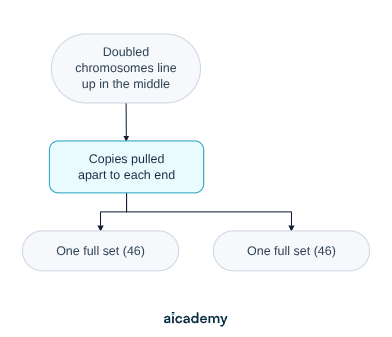
Mitosis is followed by cytokinesis (Stage 3), when the cytoplasm and cell membranes pinch apart to form two separate cells. The outcome of the whole cycle is two genetically identical diploid daughter cells.
You do not need the named phases of mitosis for AQA 8461 — only that the chromosomes are pulled to each end and the nucleus divides.
Something not quite clicking?
Ask Aica to explain any part of this differently. Free, takes 30 seconds.
Key terms
- Chromosome
- A long coiled molecule of DNA found in the nucleus, carrying many genes.
- DNA
- The molecule that chromosomes are made of.
- Gene
- A short section of DNA that codes for a particular characteristic.
- Diploid
- Describing a body cell that has its chromosomes in pairs; in humans the diploid number is 46.
- Cell cycle
- The repeating sequence cells go through, made up of growth and DNA replication, mitosis, and cytokinesis.
- Mitosis
- The stage of the cell cycle where the copied chromosomes are separated and the nucleus divides.
- Cytokinesis
- The stage where the cytoplasm and cell membranes divide to split one cell into two.
- Clone
- An offspring that is genetically identical to its parent, produced by asexual reproduction through mitosis.
Frequently asked questions
The three overall stages are growth and DNA replication (the cell grows and copies its DNA), mitosis (one set of chromosomes is pulled to each end and the nucleus divides), and cytokinesis (the cytoplasm and cell membranes divide to form two cells).
DNA replicates in the first stage, before mitosis, so that each chromosome becomes two identical copies. If the DNA were not copied first, each daughter cell would receive only half a set of chromosomes instead of a full set.
Yes. Mitosis produces two genetically identical diploid daughter cells, each with the same number of chromosomes (46 in humans) as the parent. This differs from meiosis, which makes non-identical sex cells.
Generate revision on any topic you study
Type any topic you're studying and Aicademy generates a complete lesson, quiz, and flashcard set, personalised to your level.
Lessons on anything
Structured, level-matched lessons on any topic you study
Practice quizzes
Find out what you actually know before the exam does
Flashcard sets
Lock in key concepts with instant revision cards
Ask Aica
Stuck on something? Get a clear explanation, any time
Microscopy and Magnification
Stem Cells
Related lessons
10 min
10 min
11 min