Sexual and Asexual Reproduction and Meiosis

Aligned to the AQA 8461 specification
- Level
- Intermediate
- Reading time
- 11 min
- Published
- 16 June 2026
- Updated
- 16 August 2026
On this page
Key takeaways
- Sexual reproduction involves two parents whose gametes fuse at fertilisation, mixing genetic information so the offspring show variation.
- Asexual reproduction involves only one parent and uses mitosis with no gametes or fusion, producing offspring that are genetically identical clones of the parent.
- Meiosis happens in the reproductive organs, halving the chromosome number and producing four genetically different gametes, each with a single set of chromosomes.
- Fertilisation restores the full chromosome number; in humans a sperm (23) and egg (23) fuse to give a cell with 46 chromosomes, which then divides by mitosis.
- Variation in sexual reproduction comes from two sources: meiosis makes each gamete genetically different, and fertilisation randomly combines gametes from two parents.
Walk-through: One Cell to Four Gametes
Here is meiosis traced from a single starting cell, using the human chromosome number as the worked example.
A human body cell contains 46 chromosomes (arranged as 23 pairs). Follow what meiosis does to it:
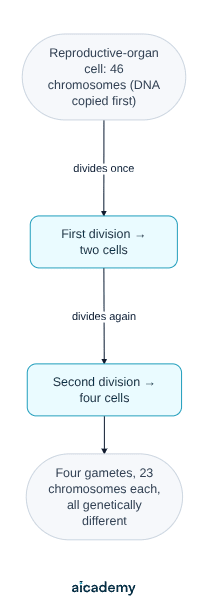
So one diploid cell of 46 chromosomes becomes four haploid gametes of 23 chromosomes each. The halving is the headline: .
Now follow fertilisation, which reverses the halving:
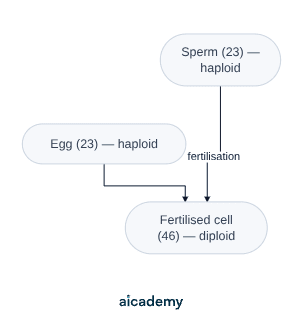
, the normal diploid number. After fertilisation, the new cell divides by mitosis to increase the number of cells, and as the embryo grows those cells differentiate into specialised types.
Watch the two divisions. Meiosis is "divide, then divide again" — that is why it makes four cells, not two. Mitosis is a single division making two identical cells.
How much of this have you taken in?
Quiz yourself on this section, free, no card needed.
Why Sexual Reproduction Produces Variation
Variation is the headline advantage of sexual reproduction, and exam questions often ask you to explain where it comes from. There are two sources.
Source 1 — meiosis makes the gametes different. When meiosis shuffles the chromosomes into gametes, every gamete ends up with a different combination of genetic information. That is why the four gametes from one cell are all genetically different rather than identical copies.
Source 2 — fertilisation is random. Any one of the male gametes could fuse with any one of the female gametes. The particular combination of genes in the offspring depends on which two gametes happen to meet.
Put the two sources together:
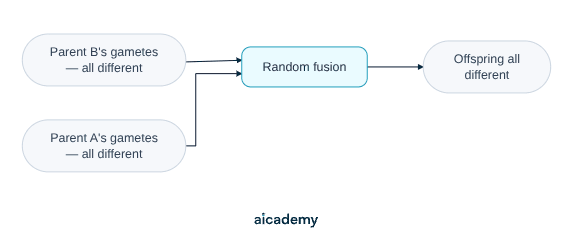
Because the genetic information comes from two parents and is mixed in this way, no two offspring (apart from identical twins) are genetically the same.
Contrast this with asexual reproduction: only mitosis is used, no gametes fuse, and no genetic information is mixed. The result is zero genetic variation — every offspring is a clone of the parent.
Key terms
- Sexual reproduction
- Reproduction involving two parents whose gametes fuse at fertilisation, mixing genetic information and producing variation.
- Asexual reproduction
- Reproduction involving one parent using mitosis only, with no gametes or fusion, producing genetically identical clones.
- Gamete
- A sex cell (sperm, egg, or pollen) that contains only one set of chromosomes and fuses with another gamete during fertilisation.
- Fertilisation
- The fusion of a male gamete with a female gamete, which restores the full chromosome number.
- Meiosis
- Cell division in the reproductive organs that halves the chromosome number and produces four genetically different gametes.
- Clone
- An organism that is genetically identical to its parent, produced by asexual reproduction.
- Variation
- Genetic difference between offspring, produced by sexual reproduction through meiosis and random fertilisation.
Frequently asked questions
Sexual reproduction involves two parents whose gametes fuse at fertilisation, mixing genetic information so offspring are genetically different (variation). Asexual reproduction involves one parent and uses mitosis only, with no gametes or fusion, so offspring are genetically identical clones of the parent.
Meiosis happens in the reproductive organs and does two jobs: it halves the number of chromosomes so each gamete carries a single set, and it produces four gametes that are all genetically different from each other. Fertilisation then restores the full chromosome number.
Variation comes from two sources. First, meiosis shuffles the chromosomes so every gamete ends up genetically different. Second, fertilisation is random, so any male gamete could fuse with any female gamete. Because the genes come from two parents and are mixed this way, no two offspring are genetically the same.
Generate revision on any topic you study
Type any topic you're studying and Aicademy generates a complete lesson, quiz, and flashcard set, personalised to your level.
Lessons on anything
Structured, level-matched lessons on any topic you study
Practice quizzes
Find out what you actually know before the exam does
Flashcard sets
Lock in key concepts with instant revision cards
Ask Aica
Stuck on something? Get a clear explanation, any time
Plant Hormones and Tropisms
DNA, the Genome and Protein Synthesis
Related lessons
9 min
12 min
11 min