Track progress, take quizzes and save notes on this lesson.

Free forever · no card needed

Start free
Intermediate

Stem Cells

4.1.2.3 Stem cells

Aligned to the AQA 8461 specification

Level
Intermediate
Reading time
10 min
Published
16 June 2026
Updated
1 July 2026
On this page
  1. 1.What Is a Stem Cell?
  2. 2.Embryonic Stem Cells
  3. 3.Adult Stem Cells
  4. 4.Meristems: Stem Cells in Plants
  5. 5.Therapeutic Cloning
  6. 6.Uses, Risks and Ethics
  7. 7.Common Exam Mistakes

Key takeaways

  • A stem cell is an undifferentiated cell that can keep dividing to make more cells of the same type and can also differentiate into specialised cell types.
  • Embryonic stem cells come from an early embryo and can differentiate into any type of cell in the body; adult stem cells, such as those in bone marrow, form only a limited range, like blood cells.
  • Plant meristem tissue at the growing tips of roots and shoots can become any plant cell type for the whole life of the plant, letting plants be cloned quickly and cheaply.
  • Therapeutic cloning makes embryonic stem cells carrying the patient's own genes, so they are not rejected by the immune system and avoid the need for anti-rejection drugs.
  • Stem cells may treat diabetes and paralysis, but risks include transferring a viral infection, and using embryonic cells raises ethical and religious objections because it destroys an embryo.

What Is a Stem Cell?

A stem cell is an undifferentiated cell that can keep dividing to make more cells of the same type, and can also differentiate into specialised cell types.

Two ideas sit inside that definition, and the exam wants both:

  • Undifferentiated — the cell has not yet become a specific type, so it has no specialised job yet.
  • Differentiate — the process by which a cell changes to become specialised for a particular function (for example, a nerve cell or a muscle cell).

Most cells in your body are already specialised and cannot change their job. Stem cells are the exception: they are the source from which new specialised cells are produced. This matters for growth, for repair of damaged tissue, and for replacing cells that wear out.

Definition to memorise: a stem cell is an undifferentiated cell capable of giving rise to many more cells of the same type, and from which other cell types can arise by differentiation.

Where a stem cell comes from controls how many different cell types it can turn into. That single idea — the source sets the range — runs through the rest of this lesson.

Embryonic Stem Cells

Embryonic stem cells come from a very early embryo, formed days after a fertilised egg starts dividing.

Their defining feature: they can differentiate into any type of cell in the body. A single early embryo has to build an entire organism — bones, blood, brain, skin, every tissue — so its stem cells must be able to become all of them.

This makes embryonic stem cells the most flexible type, and the most useful for treating a wide range of conditions. If doctors could direct embryonic stem cells to become a chosen cell type, they could in principle replace almost any damaged tissue.

FeatureEmbryonic stem cells
SourceEarly human embryo
Can becomeAny cell type in the body
FlexibilityHighest
Main useProducing many different specialised cells for treatment or research

The catch is the source. Obtaining these cells uses an embryo, and that is where the ethical debate begins — covered later in this lesson. The biology to hold onto for now: embryonic = any cell type.

Adult Stem Cells

Adult stem cells are found in some tissues of a fully grown animal, with bone marrow the key example named by the spec.

Unlike embryonic stem cells, adult stem cells can only form a limited range of cell types. Bone marrow stem cells form the different kinds of blood cells — red blood cells, white blood cells and platelets — but they do not turn into unrelated tissues such as nerve or muscle.

Their job in the body is repair and replacement: replacing cells that are constantly lost or worn out. Your blood cells, for instance, are replaced continually throughout life, and bone marrow stem cells are the source.

FeatureAdult stem cells (e.g. bone marrow)
SourceTissues of a grown adult, such as bone marrow
Can becomeA limited range of cell types (bone marrow → blood cells)
FlexibilityLower than embryonic
Main useReplacing worn-out cells; bone marrow transplants

Bone marrow transplants are an established treatment that uses adult stem cells to rebuild a patient's blood and immune system — for example after the bone marrow has been destroyed treating leukaemia.

(Extra context — not required by AQA 8461.) Bone marrow transplants to treat leukaemia are a real, decades-old use of adult stem cells; AQA names diabetes and paralysis as the example conditions, so quote those in an exam.

Meristems: Stem Cells in Plants

Plants keep stem cells too, in tissue called meristems.

Meristem tissue is found at the growing tips of roots and shoots. Its cells can differentiate into any type of plant cell, and — unlike animals — they keep this ability throughout the whole life of the plant. This is why a plant can carry on growing new roots, stems and leaves for as long as it lives.

This lifelong supply of flexible stem cells makes plants easy to clone. A small sample of meristem tissue can be grown into many identical plants quickly and cheaply. The spec names two uses:

  • Protecting rare species — a rare plant can be cloned in large numbers to guard it against extinction.
  • Producing useful crops — a crop plant with a helpful feature, such as disease resistance, can be cloned to give farmers large numbers of identical plants with that feature.
FeaturePlant meristem stem cells
SourceGrowing tips of roots and shoots (meristems)
Can becomeAny type of plant cell
FlexibilityHighest, retained for the whole life of the plant
Main useCloning plants fast and cheaply (rare species; disease-resistant crops)

Meristem cloning has no ethical objection comparable to embryonic stem cells — it does not involve an embryo. Exam questions about plant stem cells are usually about cloning crops and rare species, not ethics.

Want more lessons like this one?

Generate lessons on anything you study. Free account, no card needed.

Start generating

Therapeutic Cloning

Therapeutic cloning is a technique for making embryonic stem cells that carry the same genes as the patient.

The point of matching the patient's genes is to avoid rejection. The immune system attacks cells it recognises as foreign. Cells with the patient's own genes are not seen as foreign, so they are not rejected — meaning the patient would not need the strong anti-rejection drugs that ordinary transplants require.

The outline process, shown so the rejection point makes sense:
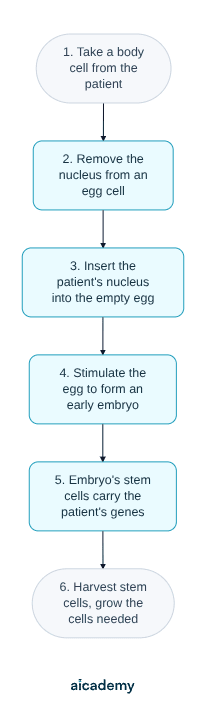
Because every cell produced in step 6 carries the patient's own genes, the patient's immune system treats them as "self".

Reasoning walk-through — why therapeutic cloning reduces rejection. The embryo is built from the patient's nucleus, so its stem cells share the patient's genes. Cells grown from them display the same surface markers as the patient's own cells. The immune system identifies foreign cells by their markers; matching markers are not flagged as foreign, so the transplanted cells are not attacked. Result: a far lower chance of rejection than a donor transplant.

The spec does not require the detailed laboratory technique — only that you can describe why patient-matched stem cells are not rejected.

Uses, Risks and Ethics

Stem cell treatment is promising because it could replace cells the body cannot repair on its own. The spec names two target conditions: diabetes and paralysis.

  • Diabetes — replacement stem cells could become insulin-producing cells in the pancreas, restoring control of blood glucose.
  • Paralysis — stem cells could replace damaged nerve cells in the spinal cord, potentially restoring movement.

Set against the potential benefits are real risks and genuine objections:

  • Transfer of viral infection — cultured stem cells could be contaminated with a virus and pass it to the patient.
  • Ethical and religious objections — many object to using embryonic stem cells because obtaining them destroys an embryo, which they regard as a potential human life.

The arguments on both sides are stated plainly below — an evaluation question wants both, then a judgement.

Argument for stem cell treatmentArgument against
Could cure currently untreatable conditions (diabetes, paralysis)Embryonic cells are obtained by destroying an embryo
Therapeutic cloning gives patient-matched cells with no rejectionRisk of transferring a viral infection to the patient
Could replace cells the body cannot repair itselfSome hold religious or ethical objections to the use of embryos

Reasoning walk-through — evaluate using embryonic stem cells to treat paralysis. One benefit: embryonic stem cells can differentiate into any cell type, so they could replace the damaged spinal nerve cells and may restore movement that is otherwise permanent. One risk: the cells are obtained from an embryo, which raises ethical objections, and cultured cells could carry a viral infection. Judgement: where paralysis is life-changing and no other cure exists, the potential to restore movement can outweigh the risks, provided cells are screened for viruses and the source is ethically regulated — so the treatment is justified under strict safeguards rather than banned outright. (A different, equally valid judgement is acceptable in an exam if it weighs the same benefit and risk.)

Common Exam Mistakes

1. Saying a stem cell "is specialised"

A stem cell is undifferentiated — it has no specialised job yet. That is the whole point. It is the cells it produces that become specialised.

2. Claiming adult stem cells can become any cell type

Only embryonic (and plant meristem) stem cells can become any cell type. Adult stem cells form a limited range — bone marrow stem cells make blood cells, not nerve or muscle.

3. Confusing why therapeutic cloning is used

Therapeutic cloning is done to make stem cells with the patient's genes so they are not rejected. It is not done to make the cells more flexible — it is about avoiding immune rejection.

4. Forgetting that meristems work for the plant's whole life

Animal adult stem cells are limited, but plant meristem cells stay able to form any plant cell type throughout the plant's life. Do not assume plants and animals behave the same way.

5. Giving only one side in an evaluation

"Evaluate" and "discuss" questions need both benefits and risks plus a judgement. Listing only benefits, or only objections, caps the marks. Name a benefit, name a risk, then reach a conclusion.

6. Naming the wrong example conditions

The spec names diabetes and paralysis as conditions stem cells may treat. Use these named examples rather than vague phrases like "lots of diseases".

Key terms

Stem cell
An undifferentiated cell that can keep dividing to make more cells of the same type and can differentiate into specialised cell types.
Undifferentiated
Describes a cell that has not yet become a specific type, so it has no specialised job yet.
Differentiate
The process by which a cell changes to become specialised for a particular function, such as a nerve cell or a muscle cell.
Embryonic stem cell
A stem cell from a very early embryo that can differentiate into any type of cell in the body.
Adult stem cell
A stem cell found in some tissues of a grown animal, such as bone marrow, that can form only a limited range of cell types.
Meristem
Plant tissue at the growing tips of roots and shoots whose cells can differentiate into any plant cell type throughout the plant's life.
Therapeutic cloning
A technique that makes embryonic stem cells carrying the same genes as the patient, so the cells are not rejected by the immune system.
Rejection
When the immune system attacks transplanted cells it recognises as foreign.

Frequently asked questions

Embryonic stem cells come from an early embryo and can differentiate into any cell type in the body, making them the most flexible. Adult stem cells are found in tissues such as bone marrow and can only form a limited range of cell types, like blood cells.

Therapeutic cloning makes embryonic stem cells using the patient's own nucleus, so the cells carry the patient's genes. The immune system does not see them as foreign, so they are not rejected and the patient avoids strong anti-rejection drugs.

The AQA specification names diabetes and paralysis. Stem cells could become insulin-producing cells in the pancreas to treat diabetes, or replace damaged nerve cells in the spinal cord to potentially restore movement in paralysis.

Generate revision on any topic you study

Type any topic you're studying and Aicademy generates a complete lesson, quiz, and flashcard set, personalised to your level.

Lessons on anything

Structured, level-matched lessons on any topic you study

Practice quizzes

Find out what you actually know before the exam does

Flashcard sets

Lock in key concepts with instant revision cards

Ask Aica

Stuck on something? Get a clear explanation, any time

Prev

Mitosis and the Cell Cycle

Next

Diffusion, Osmosis and Active Transport

Related lessons

8 min

Lesson

Mitosis and the Cell Cycle

AQA GCSE Biology · AQA 8461

1 month ago

9 min

Lesson

Cloning: Plants and Animals

AQA GCSE Biology · AQA 8461

1 month ago

Top students don’t revise more. They revise what counts.

Start revising free

Free to start. No card needed.