Stem Cells

Aligned to the AQA 8461 specification
- Topic
- Cell biology
- Level
- Intermediate
- Reading time
- 10 min
- Published
- 16 June 2026
- Updated
- 16 August 2026
On this page
Key takeaways
- A stem cell is an undifferentiated cell that can keep dividing to make more cells of the same type and can also differentiate into specialised cell types.
- Embryonic stem cells come from an early embryo and can differentiate into any type of cell in the body; adult stem cells, such as those in bone marrow, form only a limited range, like blood cells.
- Plant meristem tissue at the growing tips of roots and shoots can become any plant cell type for the whole life of the plant, letting plants be cloned quickly and cheaply.
- Therapeutic cloning makes embryonic stem cells carrying the patient's own genes, so they are not rejected by the immune system and avoid the need for anti-rejection drugs.
- Stem cells may treat diabetes and paralysis, but risks include transferring a viral infection, and using embryonic cells raises ethical and religious objections because it destroys an embryo.
Want more lessons like this one?
Generate lessons on anything you study. Free account, no card needed.
Therapeutic Cloning
Therapeutic cloning is a technique for making embryonic stem cells that carry the same genes as the patient.
The point of matching the patient's genes is to avoid rejection. The immune system attacks cells it recognises as foreign. Cells with the patient's own genes are not seen as foreign, so they are not rejected — meaning the patient would not need the strong anti-rejection drugs that ordinary transplants require.
The outline process, shown so the rejection point makes sense:
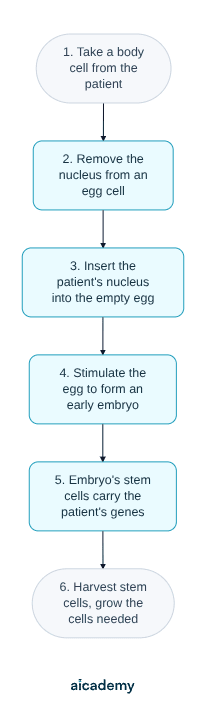
Because every cell produced in step 6 carries the patient's own genes, the patient's immune system treats them as "self".
Reasoning walk-through — why therapeutic cloning reduces rejection. The embryo is built from the patient's nucleus, so its stem cells share the patient's genes. Cells grown from them display the same surface markers as the patient's own cells. The immune system identifies foreign cells by their markers; matching markers are not flagged as foreign, so the transplanted cells are not attacked. Result: a far lower chance of rejection than a donor transplant.
The spec does not require the detailed laboratory technique — only that you can describe why patient-matched stem cells are not rejected.
Key terms
- Stem cell
- An undifferentiated cell that can keep dividing to make more cells of the same type and can differentiate into specialised cell types.
- Undifferentiated
- Describes a cell that has not yet become a specific type, so it has no specialised job yet.
- Differentiate
- The process by which a cell changes to become specialised for a particular function, such as a nerve cell or a muscle cell.
- Embryonic stem cell
- A stem cell from a very early embryo that can differentiate into any type of cell in the body.
- Adult stem cell
- A stem cell found in some tissues of a grown animal, such as bone marrow, that can form only a limited range of cell types.
- Meristem
- Plant tissue at the growing tips of roots and shoots whose cells can differentiate into any plant cell type throughout the plant's life.
- Therapeutic cloning
- A technique that makes embryonic stem cells carrying the same genes as the patient, so the cells are not rejected by the immune system.
- Rejection
- When the immune system attacks transplanted cells it recognises as foreign.
Frequently asked questions
Embryonic stem cells come from an early embryo and can differentiate into any cell type in the body, making them the most flexible. Adult stem cells are found in tissues such as bone marrow and can only form a limited range of cell types, like blood cells.
Therapeutic cloning makes embryonic stem cells using the patient's own nucleus, so the cells carry the patient's genes. The immune system does not see them as foreign, so they are not rejected and the patient avoids strong anti-rejection drugs.
The AQA specification names diabetes and paralysis. Stem cells could become insulin-producing cells in the pancreas to treat diabetes, or replace damaged nerve cells in the spinal cord to potentially restore movement in paralysis.
Generate revision on any topic you study
Type any topic you're studying and Aicademy generates a complete lesson, quiz, and flashcard set, personalised to your level.
Lessons on anything
Structured, level-matched lessons on any topic you study
Practice quizzes
Find out what you actually know before the exam does
Flashcard sets
Lock in key concepts with instant revision cards
Ask Aica
Stuck on something? Get a clear explanation, any time
Mitosis and the Cell Cycle
Diffusion, Osmosis and Active Transport
Related lessons
9 min
9 min
10 min