The Digestive System and Food Tests

Aligned to the AQA 8461 specification
- Topic
- Organisation
- Level
- Intermediate
- Reading time
- 9 min
- Published
- 16 June 2026
- Updated
- 16 August 2026
On this page
Key takeaways
- The digestive system is an organ system in which organs work together to break large insoluble food molecules into small soluble ones that can be absorbed into the blood.
- Amylase breaks starch into sugars, protease breaks protein into amino acids, and lipase breaks lipids into fatty acids and glycerol; each is made in specific organs such as the pancreas and small intestine.
- Bile is not an enzyme; made in the liver and stored in the gall bladder, it neutralises stomach acid to give the optimum pH and emulsifies fats to increase the surface area for lipase.
- Food tests: iodine turns blue-black with starch, Benedict's turns brick-red with reducing sugar on heating, Biuret turns purple with protein, and the ethanol emulsion test turns cloudy white with lipid.
- Products of digestion are absorbed in the small intestine, while the large intestine absorbs water from the remaining material.
The Digestive System as an Organ System
The digestive system is an organ system: a group of organs working together to break food down and absorb the useful molecules into the blood.
The food you eat is made of large insoluble molecules — starch, proteins and lipids — that are too big to pass through the wall of the gut into your bloodstream. Digestion breaks these into small soluble molecules that can be absorbed.
Food travels along the alimentary canal (the gut) in a fixed order. Each part has a job:
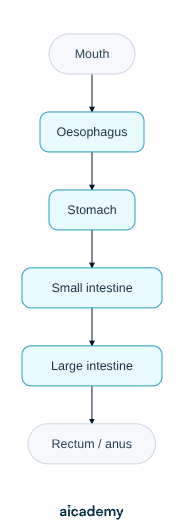
Three organs sit alongside the canal and release substances into it rather than passing food through:
- Salivary glands — release amylase into the mouth.
- Pancreas — releases amylase, protease and lipase into the small intestine.
- Liver — makes bile (stored in the gall bladder), which flows into the small intestine.
The digestive system is the spec's named example of an organ system: several organs cooperating to carry out one function — digesting and absorbing food.
Worth saving these ideas?
Turn what you've read into instant revision cards. Free to get started.
Key terms
- Organ system
- A group of organs working together to carry out one function, such as the digestive system breaking down and absorbing food.
- Digestion
- The breakdown of large insoluble food molecules into small soluble molecules that can be absorbed into the blood.
- Amylase
- A carbohydrase enzyme, made in the salivary glands and pancreas, that breaks down starch into simple sugars.
- Protease
- An enzyme, made in the stomach, pancreas and small intestine, that breaks down proteins into amino acids.
- Lipase
- An enzyme, made in the pancreas and small intestine, that breaks down lipids into fatty acids and glycerol.
- Bile
- An alkaline fluid made in the liver and stored in the gall bladder that neutralises stomach acid and emulsifies fats.
- Emulsify
- To break large fat droplets into many tiny droplets, increasing the surface area exposed to lipase.
- Qualitative test
- A food test whose result is a colour change showing whether a nutrient is present, not a measured amount.
Frequently asked questions
Bile is an alkaline fluid made in the liver and stored in the gall bladder. It neutralises stomach acid to give the optimum pH for small-intestine enzymes, and it emulsifies fats into tiny droplets to increase the surface area for lipase. Bile is not an enzyme and does not digest fat itself.
Iodine goes orange-brown to blue-black with starch. Benedict's goes blue to brick-red with reducing sugar when heated. Biuret goes blue to purple/lilac with protein. The ethanol emulsion test goes clear to cloudy white with lipid.
The small soluble products of digestion, such as glucose, amino acids, fatty acids and glycerol, are absorbed into the blood in the small intestine. The large intestine absorbs water from the remaining material, forming faeces.
Generate revision on any topic you study
Type any topic you're studying and Aicademy generates a complete lesson, quiz, and flashcard set, personalised to your level.
Lessons on anything
Structured, level-matched lessons on any topic you study
Practice quizzes
Find out what you actually know before the exam does
Flashcard sets
Lock in key concepts with instant revision cards
Ask Aica
Stuck on something? Get a clear explanation, any time
Enzymes and the Lock-and-Key Model
The Heart and Blood Vessels
Related lessons
11 min
14 min
8 min