Diffusion, Osmosis and Active Transport

Aligned to the AQA 8461 specification
- Topic
- Cell biology
- Level
- Intermediate
- Reading time
- 14 min
- Published
- 16 June 2026
- Updated
- 25 August 2026
On this page
- 1.Diffusion Moves Particles Down a Concentration Gradient
- 2.Three Factors Change the Rate of Diffusion
- 3.Surface Area : Volume Ratio Limits Cell Size
- 4.Big Organisms Need Exchange Surfaces
- 5.Osmosis: Water Across a Partially Permeable Membrane
- 6.Required Practical 3 and Percentage Change in Mass
- 7.Reading the Osmosis Graph
- 8.Active Transport: Moving Against the Gradient
- 9.Common Exam Mistakes
Key takeaways
- Diffusion is the net movement of particles of a substance in solution, or of a gas, from an area of higher concentration to an area of lower concentration; it is passive and needs no energy.
- The rate of diffusion increases with a steeper concentration gradient, a higher temperature and a larger surface area of the membrane.
- As an organism gets bigger its surface area : volume ratio falls, so large organisms need specialised exchange surfaces and a transport system rather than relying on diffusion across the outer surface.
- Osmosis is the diffusion of water from a dilute solution to a more concentrated solution through a partially permeable membrane; like diffusion it is passive.
- Active transport moves substances from a more dilute to a more concentrated solution, against the concentration gradient, and requires energy from respiration; examples are root hairs absorbing mineral ions and the gut absorbing sugar.
Three Factors Change the Rate of Diffusion
The rate of diffusion is how quickly the net movement happens. Three factors control it, and the exam expects you to explain the effect of each.
| Factor | Effect on rate | Why |
|---|---|---|
| Concentration gradient | Steeper gradient → faster | A bigger difference in concentration means a larger net flow toward the low side |
| Temperature | Higher temperature → faster | Particles gain kinetic energy and move more quickly, so they spread out sooner |
| Surface area of the membrane | Larger area → faster | More space for particles to cross at the same time |
A useful way to picture the gradient is two regions either side of a membrane:
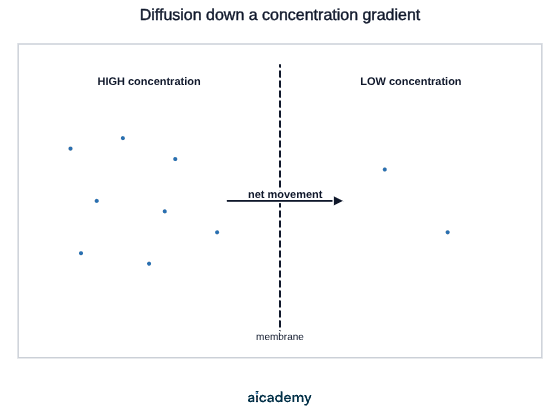
A steeper gradient and a larger surface area both speed diffusion up. A gradient that has evened out gives no net movement, even though particles still move.
Something not quite clicking?
Ask Aica to explain any part of this differently. Free, takes 30 seconds.
Osmosis: Water Across a Partially Permeable Membrane
Osmosis is the diffusion of water from a dilute solution (lots of water, little dissolved solute) to a more concentrated solution (less water, more solute), through a partially permeable membrane — a membrane that lets water molecules through but not the larger solute particles.
The net movement of water is toward the more concentrated solution because that side has the lower water concentration. Like diffusion, osmosis is passive and needs no energy.
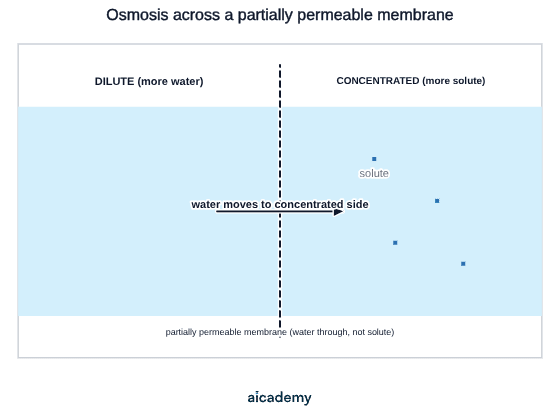
A plant cell placed in pure water gains water by osmosis and becomes firm (turgid); in a concentrated solution it loses water and becomes flaccid. This water movement is what Required practical 3 measures.
Osmosis moves only water, and only across a partially permeable membrane, from a dilute to a more concentrated solution. Naming all three parts is what earns the marks.
Key terms
- Diffusion
- The net movement of particles of a substance in solution, or of a gas, from a higher to a lower concentration.
- Concentration gradient
- The difference in concentration between two areas; a steeper gradient gives a faster net movement of particles.
- Surface area : volume ratio
- A comparison of a body's surface area to its volume, which falls as an object gets bigger.
- Exchange surface
- A specialised surface, with a large area and thin membrane, where substances are transferred in a large organism.
- Osmosis
- The diffusion of water from a dilute to a more concentrated solution through a partially permeable membrane.
- Partially permeable membrane
- A membrane that lets water molecules through but not the larger dissolved solute particles.
- Active transport
- The movement of substances against the concentration gradient, from dilute to concentrated, using energy from respiration.
- Passive
- A process, such as diffusion or osmosis, that needs no energy from the cell.
Frequently asked questions
Diffusion is the passive net movement of any dissolved substance or gas down a concentration gradient. Osmosis is the passive movement of water only, across a partially permeable membrane, to the more concentrated solution. Active transport moves dissolved substances against the gradient and needs energy from respiration.
Percentage change in mass is the final mass minus the initial mass, divided by the initial mass, multiplied by 100. Always divide by the initial mass and keep the sign: a positive answer is a gain of water and a negative answer is a loss of water.
As an object gets bigger its volume grows faster than its surface area, so its surface area : volume ratio falls. The inside cells become too far from the outside for diffusion alone, so large multicellular organisms need specialised exchange surfaces and a transport system such as blood.
Generate revision on any topic you study
Type any topic you're studying and Aicademy generates a complete lesson, quiz, and flashcard set, personalised to your level.
Lessons on anything
Structured, level-matched lessons on any topic you study
Practice quizzes
Find out what you actually know before the exam does
Flashcard sets
Lock in key concepts with instant revision cards
Ask Aica
Stuck on something? Get a clear explanation, any time
Stem Cells
Enzymes and the Lock-and-Key Model
Related lessons
10 min
14 min
9 min