Enzymes and the Lock-and-Key Model

Aligned to the AQA 8461 specification
- Topic
- Organisation
- Level
- Intermediate
- Reading time
- 11 min
- Published
- 16 June 2026
- Updated
- 25 August 2026
On this page
Key takeaways
- An enzyme is a biological catalyst, a protein that speeds up a reaction without being changed or used up, and each enzyme is specific to one substrate.
- In the lock-and-key model the substrate fits into the enzyme's active site, which has a complementary shape to only one specific substrate.
- Above the optimum temperature or at the wrong pH, the active site changes shape so the substrate no longer fits; this permanent change is called denaturation, not the enzyme being killed.
- A shorter reaction time means a faster rate, calculated as rate = 1 / time, so in Required practical 5 the shortest time marks the optimum pH for amylase.
- Carbohydrase (amylase) breaks starch into sugars, protease breaks proteins into amino acids, and lipase breaks lipids into fatty acids and glycerol.
The Lock-and-Key Model
Enzymes are specific because the shape of the active site matches the shape of only one substrate. The lock-and-key model is a simplified way to picture this: the substrate (the key) fits exactly into the active site (the lock). A key of the wrong shape will not fit a particular lock.
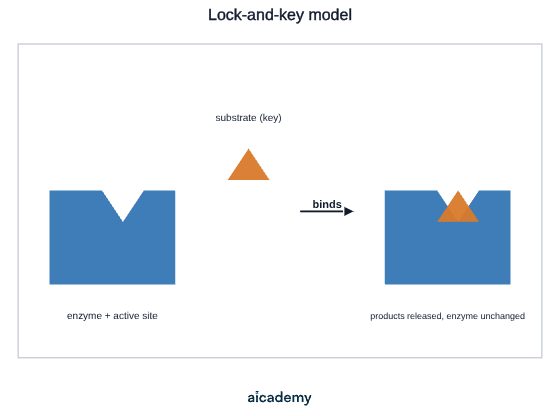
The substrate binds in the active site, the reaction takes place, and the products are released. The enzyme is then free to bind another substrate molecule.
A substrate with the wrong shape cannot fit the active site, so no reaction happens. This is why one enzyme cannot do another enzyme's job — amylase breaks down starch but has no effect on protein.
(Extra context — not required by AQA 8461: scientists now prefer the "induced fit" model, where the active site changes shape slightly to grip the substrate. The lock-and-key model is the version AQA assesses at GCSE.)
Something not quite clicking?
Ask Aica to explain any part of this differently. Free, takes 30 seconds.
Key terms
- Enzyme
- A biological catalyst: a protein that speeds up a chemical reaction without being changed or used up itself.
- Active site
- The small pocket on an enzyme where the substrate binds and the reaction happens.
- Substrate
- The molecule that an enzyme acts on.
- Lock-and-key model
- A simplified model in which the substrate (the key) fits exactly into the enzyme's active site (the lock).
- Denaturation
- The permanent change in shape of an enzyme's active site, caused by high temperature or the wrong pH, so the substrate no longer fits.
- Optimum temperature
- The temperature at which an enzyme works fastest, around 37 degrees C in the human body.
- Optimum pH
- The pH at which a particular enzyme works fastest.
- Metabolism
- All the reactions happening inside cells and the body, such as breaking down food, building large molecules and respiration.
- Carbohydrase
- An enzyme, such as amylase, that breaks down starch and carbohydrates into simple sugars (glucose).
- Protease
- An enzyme that breaks down proteins into amino acids.
- Lipase
- An enzyme that breaks down lipids (fats) into fatty acids and glycerol.
Frequently asked questions
Above the optimum temperature or at the wrong pH, the bonds holding the protein in shape break and the active site changes shape, so the substrate no longer fits and no reaction happens. This permanent change is called denaturation; the enzyme is not killed because it was never alive.
A simple measure of rate is 1 divided by the time taken, giving units of per second. A reaction that finishes in a shorter time is faster and has a larger rate, so in Required practical 5 the pH with the shortest time is the optimum pH.
Carbohydrase such as amylase breaks starch into simple sugars (glucose), protease breaks proteins into amino acids, and lipase breaks lipids into fatty acids and glycerol. Lipase gives two products, so naming only one loses the mark.
Generate revision on any topic you study
Type any topic you're studying and Aicademy generates a complete lesson, quiz, and flashcard set, personalised to your level.
Lessons on anything
Structured, level-matched lessons on any topic you study
Practice quizzes
Find out what you actually know before the exam does
Flashcard sets
Lock in key concepts with instant revision cards
Ask Aica
Stuck on something? Get a clear explanation, any time
Diffusion, Osmosis and Active Transport
The Digestive System and Food Tests
Related lessons
9 min
10 min
9 min