Track progress, take quizzes and save notes on this lesson.

Free forever · no card needed

Start free
Intermediate

Enzymes and the Lock-and-Key Model

4.2.1 Principles of organisation·4.2.2.1 The human digestive system (enzyme action·Required practical 5)

Aligned to the AQA 8461 specification

Level
Intermediate
Reading time
10 min
Published
16 June 2026
Updated
1 July 2026
On this page
  1. 1.Cells, Tissues, Organs and Organ Systems
  2. 2.What Enzymes Are
  3. 3.The Lock-and-Key Model
  4. 4.Temperature, pH and Denaturation
  5. 5.Calculating Rate of Reaction
  6. 6.Required Practical 5: Effect of pH on Amylase
  7. 7.Carbohydrases, Proteases and Lipases
  8. 8.Common Exam Mistakes

Key takeaways

  • An enzyme is a biological catalyst, a protein that speeds up a reaction without being changed or used up, and each enzyme is specific to one substrate.
  • In the lock-and-key model the substrate fits into the enzyme's active site, which has a complementary shape to only one specific substrate.
  • Above the optimum temperature or at the wrong pH, the active site changes shape so the substrate no longer fits; this permanent change is called denaturation, not the enzyme being killed.
  • A shorter reaction time means a faster rate, calculated as rate = 1 / time, so in Required practical 5 the shortest time marks the optimum pH for amylase.
  • Carbohydrase (amylase) breaks starch into sugars, protease breaks proteins into amino acids, and lipase breaks lipids into fatty acids and glycerol.

Cells, Tissues, Organs and Organ Systems

Every living organism is built up in levels of organisation, from the smallest unit to the whole body. Each level is a group of the level below working together.

  • Cells are the basic building blocks of all living organisms.
  • A tissue is a group of cells with a similar structure and function working together — for example, muscle tissue contracts, glandular tissue makes and releases substances.
  • An organ is a group of different tissues that work together to perform a specific function — the stomach is an organ containing muscular tissue (to churn food), glandular tissue (to make digestive juices) and epithelial tissue (to line and protect it).
  • An organ system is a group of organs that work together to carry out a major job for the organism.

Learn the order in one line: cells → tissues → organs → organ systems → organism. Each level is made of groups of the level before it.

The digestive system is a clear example of an organ system: the mouth, stomach, pancreas and small intestine are separate organs that work together to digest and absorb food. The chemical "tools" that actually break the food down are enzymes — the focus of the rest of this lesson.

What Enzymes Are

An enzyme is a biological catalyst: a protein that speeds up a chemical reaction without being changed or used up itself. Because they are not used up, a tiny amount of enzyme can process a large amount of substance.

Enzymes control metabolism — all the reactions happening inside cells and the body, such as breaking down food, building large molecules and respiration.

Each enzyme is a large protein molecule folded into a precise 3D shape. Somewhere on that shape is a small pocket called the active site, where the reaction happens. The molecule the enzyme acts on is called the substrate.

Key facts to be precise about:

  • Enzymes are not alive — they are molecules, so they cannot be "killed".
  • Enzymes are not used up in the reaction, so they can be reused.
  • Each enzyme is specific: it only works on one substrate (or one type of reaction).

The reactions enzymes catalyse can either break a large molecule into smaller ones (as in digestion) or join small molecules into larger ones (as in building new tissue). Word equations are enough at GCSE — no chemical symbol equations are required.

The Lock-and-Key Model

Enzymes are specific because the shape of the active site matches the shape of only one substrate. The lock-and-key model is a simplified way to picture this: the substrate (the key) fits exactly into the active site (the lock). A key of the wrong shape will not fit a particular lock.
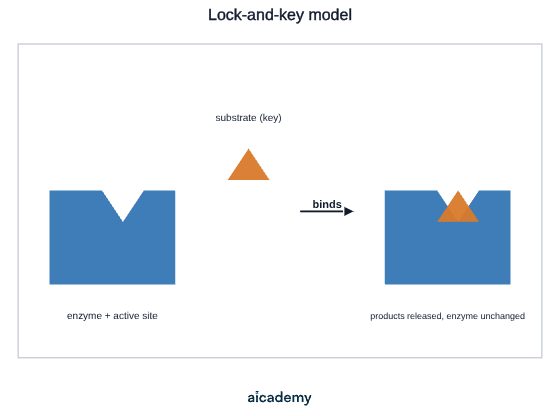
The substrate binds in the active site, the reaction takes place, and the products are released. The enzyme is then free to bind another substrate molecule.

A substrate with the wrong shape cannot fit the active site, so no reaction happens. This is why one enzyme cannot do another enzyme's job — amylase breaks down starch but has no effect on protein.

(Extra context — not required by AQA 8461: scientists now prefer the "induced fit" model, where the active site changes shape slightly to grip the substrate. The lock-and-key model is the version AQA assesses at GCSE.)

Temperature, pH and Denaturation

The rate of an enzyme reaction depends on temperature and pH. Both work because they affect the shape of the active site.

Temperature. As temperature rises, molecules move faster and collide more often, so the rate increases — up to the optimum temperature (around 37 °C in the human body). Above the optimum, the rise in temperature breaks the bonds holding the protein in shape. The active site changes shape, the substrate no longer fits, and the enzyme stops working. This permanent change is called denaturation.

pH. Each enzyme also has an optimum pH at which it works fastest. Moving away from the optimum in either direction (too acidic or too alkaline) changes the active site's shape and slows the reaction; far enough from the optimum, the enzyme denatures.

ConditionEffect on rateReason
Below optimum temperatureSlowerFewer, lower-energy collisions
At optimum (about 37 °C)FastestMost successful collisions, active site intact
Above optimum temperatureDrops sharplyActive site changes shape — denatured
Wrong pHSlower, then stopsActive site changes shape — denatured

Denaturation changes the shape of the active site so the substrate no longer fits. Do not write that the enzyme is "killed" — it was never alive. Once denatured, the change is permanent: cooling back down does not restore activity.

Something not quite clicking?

Ask Aica to explain any part of this differently. Free, takes 30 seconds.

Ask Aica

Calculating Rate of Reaction

In Required practical 5 you measure how long an enzyme takes to break down a substrate, then turn that time into a rate. The faster the reaction, the shorter the time.

A simple measure of rate is:

Worked example 1 — rate from a time. A starch solution is completely digested by amylase in 40 s at the optimum pH.

At a less suitable pH the same reaction takes 100 s:

The first reaction is faster, so it has the larger rate (0.025 is greater than 0.010), even though "40" looks smaller than "100". A short time means a fast rate.

Worked example 2 — rate from an amount. If g of starch is broken down in s, then using :

Always state the units: when using , or g/s (or g per second) when dividing an amount by a time.

Required Practical 5: Effect of pH on Amylase

Required practical 5 investigates how pH affects the rate at which amylase breaks down starch. The breakdown is followed using iodine solution, which turns blue-black when starch is present and stays orange-brown once the starch has gone.

Method (continuous sampling):

  1. Add a drop of iodine solution to each well of a spotting tile.
  2. Mix amylase, starch solution and a pH buffer solution (the buffer fixes the pH for that run) in a test tube.
  3. Stand the tube in a water bath so the temperature is kept constant (the control variable).
  4. Every 30 seconds, take a sample with a pipette and add it to a fresh drop of iodine.
  5. Record the time at which the iodine first stays orange-brown — the point where all the starch has been digested.
  6. Repeat at a range of pH values (e.g. pH 4 to pH 9), changing only the buffer.

Reading the results. Calculate the rate for each pH as . The pH with the shortest time / fastest rate is the optimum pH.

pHTime for starch to disappear (s)Rate (s⁻¹)
41000.010
5670.015
6500.020
7400.025
8710.014
91250.008

Worked example — reading the optimum. The rate rises from pH 4 to a peak at pH 7 (shortest time, 40 s; highest rate, 0.025 s⁻¹), then falls again. The graph of rate against pH is therefore a hump shape: it climbs to the optimum as the active site shape becomes more suitable, then drops as the wrong pH changes the active site shape and denatures the amylase.

Carbohydrases, Proteases and Lipases

Digestive enzymes convert large, insoluble food molecules into small, soluble molecules that can be absorbed into the bloodstream. There are three classes you must know — including where each is made and the products it forms.

Enzyme classSubstrate (breaks down)ProductsWhere it is made
Carbohydrase (e.g. amylase)Starch / carbohydratesSimple sugars (glucose)Salivary glands, pancreas
ProteaseProteinsAmino acidsStomach, pancreas, small intestine
LipaseLipids (fats)Fatty acids + glycerolPancreas, small intestine

Word equations summarise the three reactions:

SubstrateEnzymeProducts
Starchamylasesugars (glucose)
Proteinproteaseamino acids
Lipidlipasefatty acids + glycerol

The products are reused by the body: amino acids build new proteins, sugars and glycerol/fatty acids build new carbohydrates and lipids, and some glucose is used in respiration to release energy.

Memory aid: carbohydrase → carbs; protease → proteins; lipase → lipids. Match each enzyme to its food, then recall the products: sugars; amino acids; fatty acids + glycerol.

Common Exam Mistakes

1. Saying an enzyme is "killed" by heat or pH

Enzymes are not alive, so they cannot be killed. The correct term is denatured: high temperature or the wrong pH changes the shape of the active site so the substrate no longer fits.

2. Forgetting that enzymes are not used up

An enzyme catalyses the reaction and is released unchanged, ready to work again. Do not write that enzymes are "consumed" or "broken down" in the reaction they speed up.

3. Confusing a short time with a slow rate

A reaction that finishes in a short time is fast, so it has a large rate. In RP5, the shortest time marks the optimum pH, not the slowest reaction.

4. Mixing up the products of each enzyme

EnzymeProducts
Carbohydrase / amylaseSimple sugars (glucose)
ProteaseAmino acids
LipaseFatty acids and glycerol

Lipase gives two products — drop either fatty acids or glycerol and you lose the mark.

5. Saying the enzyme "fits the substrate" the wrong way round

In the lock-and-key model the substrate fits into the active site of the enzyme, not the other way around. The active site has a complementary shape to one specific substrate, which is why enzymes are specific.

Key terms

Enzyme
A biological catalyst: a protein that speeds up a chemical reaction without being changed or used up itself.
Active site
The small pocket on an enzyme where the substrate binds and the reaction happens.
Substrate
The molecule that an enzyme acts on.
Lock-and-key model
A simplified model in which the substrate (the key) fits exactly into the enzyme's active site (the lock).
Denaturation
The permanent change in shape of an enzyme's active site, caused by high temperature or the wrong pH, so the substrate no longer fits.
Optimum temperature
The temperature at which an enzyme works fastest, around 37 degrees C in the human body.
Optimum pH
The pH at which a particular enzyme works fastest.
Metabolism
All the reactions happening inside cells and the body, such as breaking down food, building large molecules and respiration.
Carbohydrase
An enzyme, such as amylase, that breaks down starch and carbohydrates into simple sugars (glucose).
Protease
An enzyme that breaks down proteins into amino acids.
Lipase
An enzyme that breaks down lipids (fats) into fatty acids and glycerol.

Frequently asked questions

Above the optimum temperature or at the wrong pH, the bonds holding the protein in shape break and the active site changes shape, so the substrate no longer fits and no reaction happens. This permanent change is called denaturation; the enzyme is not killed because it was never alive.

A simple measure of rate is 1 divided by the time taken, giving units of per second. A reaction that finishes in a shorter time is faster and has a larger rate, so in Required practical 5 the pH with the shortest time is the optimum pH.

Carbohydrase such as amylase breaks starch into simple sugars (glucose), protease breaks proteins into amino acids, and lipase breaks lipids into fatty acids and glycerol. Lipase gives two products, so naming only one loses the mark.

Generate revision on any topic you study

Type any topic you're studying and Aicademy generates a complete lesson, quiz, and flashcard set, personalised to your level.

Lessons on anything

Structured, level-matched lessons on any topic you study

Practice quizzes

Find out what you actually know before the exam does

Flashcard sets

Lock in key concepts with instant revision cards

Ask Aica

Stuck on something? Get a clear explanation, any time

Prev

Diffusion, Osmosis and Active Transport

Next

The Digestive System and Food Tests

Related lessons

9 min

9 min

Top students don’t revise more. They revise what counts.

Start revising free

Free to start. No card needed.