Track progress, take quizzes and save notes on this lesson.

Free forever · no card needed

Start free
Intermediate

Antibiotics, Painkillers and Drug Development

4.3.1.8 Antibiotics and painkillers·4.3.1.9 Discovery and development of drugs

Aligned to the AQA 8461 specification

Level
Intermediate
Reading time
12 min
Published
16 June 2026
Updated
1 July 2026
On this page
  1. 1.What Antibiotics Do
  2. 2.Antibiotics Do Not Kill Viruses
  3. 3.Painkillers Treat Symptoms, Not the Pathogen
  4. 4.Antibiotic Resistance
  5. 5.Where Drugs Originally Came From
  6. 6.Testing a New Drug: Toxicity, Efficacy and Dose
  7. 7.Preclinical Testing, Clinical Trials and Peer Review
  8. 8.Common Exam Mistakes

Key takeaways

  • An antibiotic, such as penicillin, cures bacterial disease by killing the infective bacteria inside the body; specific bacteria should be treated by specific antibiotics, as there is no universal antibiotic.
  • Antibiotics have no effect on viruses, because viruses are not cells and reproduce inside the body's own cells, making it hard to develop antiviral drugs without damaging body tissues.
  • Painkillers treat the symptoms of disease but do not kill the pathogen; only antibiotics kill the pathogen, and only when it is a bacterium.
  • Drugs were originally extracted from plants and microorganisms: digitalis from foxgloves, aspirin from willow, and penicillin from Penicillium mould (discovered by Alexander Fleming).
  • New drugs are tested for toxicity, efficacy and dose, in order from preclinical testing (cells, tissues, live animals) to clinical trials (healthy volunteers then patients), with results published only after peer review.

What Antibiotics Do

An antibiotic is a medicine that cures bacterial disease by killing the infective bacteria inside the body. Penicillin is the classic example. Because antibiotics kill the pathogen itself, they tackle the cause of the illness, not just how it makes you feel.

A key point in the specification is about matching: specific bacteria should be treated by specific antibiotics. There is no single drug that deals with every bacterial infection. A doctor identifies which bacterium is causing the disease, then chooses an antibiotic known to kill that type. Using the wrong antibiotic may have little effect on the infection.

Antibiotic: a medicine (such as penicillin) that kills infective bacteria inside the body, curing the bacterial disease.

The arrival of antibiotics changed medicine dramatically. Before them, infections we now treat easily could be fatal.

Claim about antibioticsTrue or false?
They kill bacteria inside the bodyTrue
One antibiotic treats every bacterial infectionFalse
They kill virusesFalse
They have greatly reduced deaths from bacterial diseaseTrue

The use of antibiotics has greatly reduced deaths from infectious bacterial diseases — a major reason average life expectancy rose through the twentieth century.

Antibiotics Do Not Kill Viruses

Antibiotics work on bacteria only. They have no effect on viral pathogens — so they cannot cure a cold, flu, or any other viral illness. This is one of the most heavily tested ideas in the topic, and the reason follows from what a virus is.

A virus is not a living cell. It reproduces inside the body's own cells, hijacking them to make copies of itself. Antibiotics target structures and processes that bacterial cells have; a virus has none of these, and it hides inside your cells. That is why it is difficult to develop drugs that kill viruses without also damaging the body's tissues — a drug reaching the virus would have to act inside your own cells and risk harming them too.

FeatureBacteriaViruses
Living cell?YesNo
Where it reproducesInside the body, on its ownInside the body's own cells
Killed by antibiotics?YesNo
Easy to target with a drug?YesHard — would risk harming body cells

Exam tip: antibiotics kill bacteria, not viruses. Viruses reproduce inside body cells, so a drug that destroys them tends to damage those cells as well.

Worked walk-through 1 — why the doctor won't prescribe antibiotics for a cold. A patient asks for antibiotics for a heavy cold. A cold is caused by a virus. Antibiotics kill bacteria, not viruses, so they would do nothing for the cold. The doctor declines because the medicine cannot treat the cause — and needless use drives antibiotic resistance (next slide). They advise rest and a painkiller for the symptoms instead.

Painkillers Treat Symptoms, Not the Pathogen

This slide draws the single most important distinction in the whole topic: some medicines kill the pathogen, and others only relieve how you feel.

Painkillers and other medicines treat the symptoms of disease but do not kill pathogens. A painkiller such as paracetamol can ease a headache or lower a fever, making you more comfortable while your immune system fights the infection — but it does nothing to the bacterium or virus causing the illness. Antibiotics are different: they attack the bacterial pathogen directly.

Type of medicineWhat it acts onDoes it kill the pathogen?Example use
AntibioticBacteriaYes (bacteria only)Curing a bacterial chest infection
PainkillerSymptoms (e.g. pain, fever)NoEasing aches during flu

Key idea: painkillers relieve symptoms; they do not kill the pathogen. Only antibiotics kill the pathogen — and only when that pathogen is a bacterium.

So during a viral illness like flu, a painkiller is genuinely useful — it makes the symptoms bearable — even though no medicine on the shelf will kill the virus for you. Your own immune system does that work.

Antibiotic Resistance

Antibiotics have saved countless lives, but their success is now under threat. The emergence of strains of bacteria resistant to antibiotics is of great concern, and the problem is increasing.

Resistant bacteria are strains that the antibiotic can no longer kill. When a population of bacteria is treated, a few may by chance carry a mutation that lets them survive the drug. The antibiotic kills the non-resistant majority, but the resistant survivors reproduce and pass on their resistance. Over time the resistant strain spreads. The more often antibiotics are used — especially when they are not needed — the faster this happens.
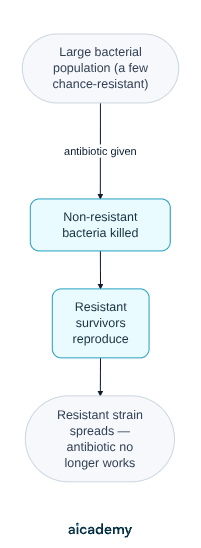
Of great concern: if resistant strains spread faster than new antibiotics are developed, common infections could once again become difficult to treat.

This is exactly why the doctor in Slide 2 refused antibiotics for a viral cold: every unnecessary course of antibiotics gives bacteria another chance to evolve resistance. Doctors now prescribe antibiotics only when they are genuinely needed, and patients are told to finish the full course.

(Extra context — not required by AQA 8461.) The detail of how resistance evolves by natural selection, and named examples such as MRSA, belong to the evolution and inheritance topics. Here you only need that resistant strains are emerging and that this is a serious concern.

Worth saving these ideas?

Turn what you've read into instant revision cards. Free to get started.

Make flashcards

Where Drugs Originally Came From

Before chemists could build medicines, drugs were extracted from plants and microorganisms. AQA names three you must know.

DrugOriginal natural sourceWhat it does
DigitalisFoxgloves (a plant)A heart drug
AspirinWillow (a plant)A painkiller
PenicillinPenicillium mould (a microorganism)The first antibiotic

Penicillin has a famous discovery story: it was discovered by Alexander Fleming from the Penicillium mould. Fleming noticed that a mould contaminating one of his bacterial culture plates had killed the bacteria around it — the mould was producing a substance that destroyed them. That substance was penicillin, the first antibiotic.

Remember the three sources: digitalis from foxgloves, aspirin from willow, penicillin from Penicillium mould (Fleming).

Today, most new drugs are synthesised by chemists in the pharmaceutical industry. However, the starting point may still be a chemical extracted from a plant — nature gives chemists a useful molecule, which they then refine, copy, or improve in the laboratory.

Testing a New Drug: Toxicity, Efficacy and Dose

A promising new substance is not a medicine yet. New drugs must be tested and trialled before use to check that they are safe and effective. Every new drug is extensively tested for three things:

  • Toxicity — is it harmful? Does it have dangerous side effects?
  • Efficacy — does it actually work? Does it treat the disease?
  • Dose — how much should be given? What is the right amount to be both safe and effective?

Testing happens in a fixed order, moving from the lab to people only once earlier stages look safe. The pipeline below is the sequence the specification asks you to know.
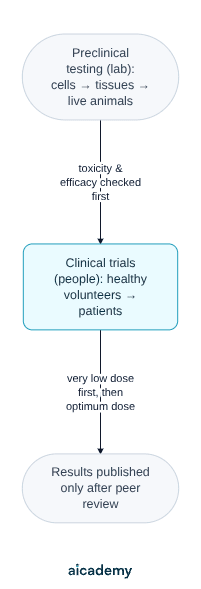
Three things every drug is tested for: toxicity (is it safe?), efficacy (does it work?) and dose (how much to give?).

This ordering matters: testing on cells and animals first means a dangerous drug is caught before it is ever given to a person.

Preclinical Testing, Clinical Trials and Peer Review

Here is the pipeline in detail, with the reason each stage exists — exactly the kind of "explain why" answer examiners reward.

StageTested onWhy this stage is needed
Preclinical testingCells, tissues, then live animalsChecks toxicity and efficacy safely, before any human is exposed
Clinical trial — startHealthy volunteers, very low dosesChecks the drug is safe in people before testing higher amounts
Clinical trial — laterPatients with the diseaseChecks it works on the illness, and finds the optimum dose

Preclinical testing is done in a laboratory using cells, tissues and live animals. Clinical trials then use people: first healthy volunteers given very low doses, and — if the drug is found to be safe — further trials on patients to find the optimum dose (the dose that is most effective with the fewest side effects).

To judge whether a drug truly works, trials use a placebo — a dummy treatment with no active drug. Some patients receive the real drug, others the placebo; comparing the groups shows whether improvements are due to the drug itself. In a double-blind trial, neither the doctor nor the patient knows who has the real drug and who has the placebo until the trial ends. This stops expectations from either side biasing the results.

Double-blind: neither the patient nor the doctor knows who received the placebo. This removes bias from both directions.

Finally, results are published only after peer review — other independent scientists scrutinise the work before it is accepted. Peer review helps detect false claims and errors, so doctors can trust the published findings.

Worked walk-through 2 — putting the stages in order and justifying each. A new bacterial-infection drug is ready to test.

  1. Cells and tissues in the lab — cheap and safe; catches obvious toxicity before any living thing is harmed.
  2. Live animals — checks effects on a whole body before any human is exposed.
  3. Healthy volunteers, very low dose — confirms the drug is safe in people without risking a large dose.
  4. Patients, building to the optimum dose, with a double-blind placebo comparison — proves it actually treats the disease and finds the best amount.
  5. Peer review, then publish — independent scientists check the results before anyone relies on them.

Each step gates the next: people are not moved to higher doses, or to patients, until the earlier, safer stage has passed.

Common Exam Mistakes

1. Saying antibiotics kill viruses

Antibiotics kill bacteria only. They have no effect on viruses, because viruses are not cells and reproduce inside the body's own cells. A cold or flu cannot be cured with antibiotics.

2. Confusing painkillers with antibiotics

Painkillers treat symptoms (pain, fever) and do not kill the pathogen. Only antibiotics kill the pathogen — and only when it is a bacterium. Writing "a painkiller cures the infection" is wrong and is unlikely to gain credit.

3. Forgetting that specific bacteria need specific antibiotics

There is no universal antibiotic. The right drug must be matched to the bacterium causing the disease; the wrong one may not work.

4. Mixing up the natural sources of drugs

Keep them straight: digitalis → foxgloves, aspirin → willow, penicillin → Penicillium mould (Fleming). Swapping these around is a common slip.

5. Getting the testing order wrong

The sequence is cells and tissues → live animals → healthy volunteers (very low dose) → patients (optimum dose) → peer review and publish. Testing on patients before preclinical work, or skipping the low-dose start, is incorrect.

6. Misdefining a double-blind trial

In a double-blind trial neither the doctor nor the patient knows who has the placebo — not just the patient. Saying "only the patient doesn't know" describes a single-blind trial, which is unlikely to gain credit if the question asks about a double-blind trial.

Key terms

Antibiotic
A medicine, such as penicillin, that kills infective bacteria inside the body and cures bacterial disease.
Painkiller
A medicine that treats the symptoms of disease, such as pain or fever, but does not kill the pathogen.
Antibiotic resistance
When strains of bacteria are no longer killed by an antibiotic, an emergence that is of great concern and is increasing.
Toxicity
Whether a drug is harmful or has dangerous side effects, one of three things every new drug is tested for.
Efficacy
Whether a drug actually works and treats the disease, one of three things every new drug is tested for.
Preclinical testing
Testing a new drug in the laboratory on cells, tissues and then live animals before any human is exposed.
Clinical trial
Testing a drug on people: first healthy volunteers at very low doses, then patients to find the optimum dose.
Placebo
A dummy treatment with no active drug, given to some patients so results can be compared with the real drug.
Double-blind trial
A trial in which neither the doctor nor the patient knows who received the real drug or the placebo until it ends.
Peer review
Scrutiny of results by other independent scientists before publication, helping detect false claims and errors.

Frequently asked questions

Colds and flu are caused by viruses, and antibiotics kill bacteria, not viruses, so they have no effect. Viruses reproduce inside the body's own cells, which is why a drug that destroys them tends to damage those cells too. A painkiller can ease the symptoms while the immune system fights the virus.

An antibiotic kills the pathogen, but only when that pathogen is a bacterium. A painkiller, such as paracetamol, only treats the symptoms of disease, like pain or fever, and does not kill the pathogen at all.

In a double-blind trial neither the doctor nor the patient knows who is receiving the real drug and who is receiving the placebo until the trial ends. This stops expectations from either side biasing the results. If only the patient does not know, that is a single-blind trial.

Generate revision on any topic you study

Type any topic you're studying and Aicademy generates a complete lesson, quiz, and flashcard set, personalised to your level.

Lessons on anything

Structured, level-matched lessons on any topic you study

Practice quizzes

Find out what you actually know before the exam does

Flashcard sets

Lock in key concepts with instant revision cards

Ask Aica

Stuck on something? Get a clear explanation, any time

Prev

Vaccination and Herd Immunity

Next

Photosynthesis and Uses of Glucose

Related lessons

10 min

10 min

11 min

Lesson

Monoclonal Antibodies

AQA GCSE Biology · AQA 8461

1 month ago

Top students don’t revise more. They revise what counts.

Start revising free

Free to start. No card needed.