Track progress, take quizzes and save notes on this lesson.

Free forever · no card needed

Start free
Intermediate

Vaccination and Herd Immunity

4.3.1.7 Vaccination

Aligned to the AQA 8461 specification

Level
Intermediate
Reading time
10 min
Published
16 June 2026
Updated
1 July 2026
On this page
  1. 1.What a Vaccine Contains
  2. 2.How a Vaccine Produces Immunity
  3. 3.The Primary and Secondary Response
  4. 4.Walk-Through: Reading an Antibody Response Graph
  5. 5.Herd Immunity: Protecting the Whole Population
  6. 6.Advantages and Disadvantages of Vaccination
  7. 7.Common Exam Mistakes

Key takeaways

  • A vaccine works by introducing small quantities of a dead or inactive form of a pathogen that carries the same antigens as the live version, stimulating white blood cells to produce antibodies.
  • A vaccine does not give you the disease, because it contains no live pathogen multiplying inside you, only the antigens needed to train the immune system.
  • After vaccination the immune system retains memory of the antigen, so on re-infection the secondary response produces antibodies faster and in greater quantity, destroying the pathogen before illness develops.
  • Herd immunity occurs when a large proportion of a population is immune, reducing the spread of a pathogen and protecting even those who cannot be vaccinated.
  • Vaccination has controlled many deadly communicable diseases and eradicated smallpox, but it does not protect everyone, can rarely cause a bad reaction, and low uptake can let outbreaks return.

What a Vaccine Contains

A vaccine works by introducing small quantities of a dead or inactive form of a pathogen into the body. The pathogen is harmless in this form — it has been killed or weakened so it cannot cause the disease — but it still carries the same antigens as the live pathogen.

An antigen is a marker molecule on the surface of a pathogen. The immune system recognises antigens as foreign. Because the dead or inactive pathogen in a vaccine carries the same antigens as the live version, the body's white blood cells respond to it exactly as they would to a real infection — without you ever becoming ill.

Vaccine: a preparation containing dead or inactive forms of a pathogen (or its antigens) that stimulates the immune system to produce antibodies, giving protection against future infection.

This is the single most important idea in the topic, and the most misunderstood:

A vaccine does not give you the disease. It contains a dead or inactive pathogen, so there is no live pathogen multiplying inside you — only the antigens needed to train the immune system.

This lesson builds on the immune response covered in the separate human defence systems lesson. As a quick recap: when a pathogen enters the body, white blood cells defend you by engulfing pathogens (phagocytosis), producing antibodies that lock onto specific antigens, and producing antitoxins that neutralise toxins. Vaccination puts that antibody-producing machinery to work in advance.

How a Vaccine Produces Immunity

A vaccine triggers the same white blood cell response as a real infection, but safely. The dead or inactive pathogen carries antigens, so the white blood cells treat it as a genuine threat and learn to fight it.

Here is the sequence, step by step:
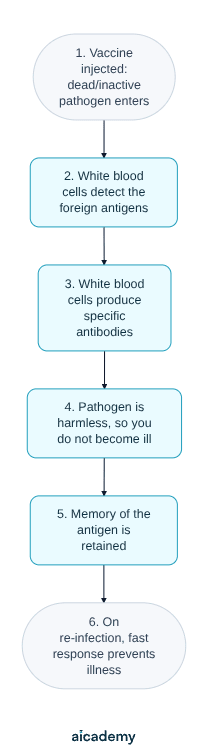
The key product of this process is memory. After vaccination, the body keeps a record of that specific antigen. This is what makes the response to a real infection so much faster the second time around.

Remember the chain: antigen recognised → antibodies produced → memory retained → rapid response on re-infection. Every mark in a "how does vaccination work" question maps onto one of these stages.

The antibodies a white blood cell makes are specific — each type locks onto only one antigen, the way a key fits one lock. That is why memory of a particular antigen only protects against that particular pathogen.

The Primary and Secondary Response

The reason vaccination prevents illness lies in the difference between the body's first and second encounters with an antigen.

FeaturePrimary response (first exposure)Secondary response (re-exposure)
SpeedSlow — takes days to build upFast — antibodies made quickly
Quantity of antibodiesLowerMuch higher
ResultYou may feel ill while it buildsPathogen destroyed before illness develops
WhyWhite blood cells meet the antigen for the first timeMemory of the antigen already exists

The first time the body meets an antigen — whether from a vaccine or a live infection — the right white blood cells are rare. It takes several days for them to find the antigen, multiply, and produce enough antibodies. During that delay a live pathogen can multiply and make you ill.

The second time the same antigen appears, memory means the correct white blood cells are already primed. They respond faster and produce a larger quantity of the correct antibodies. The pathogen is destroyed before it can multiply enough to cause symptoms — so you do not become ill.

Exam tip: "faster and in greater quantity" is the phrase examiners look for when describing the secondary response. State both — speed and amount.

Walk-Through: Reading an Antibody Response Graph

A common exam question gives a graph of antibody concentration in the blood over time, with two exposures to the same antigen. You must interpret it and explain why no illness occurs the second time.
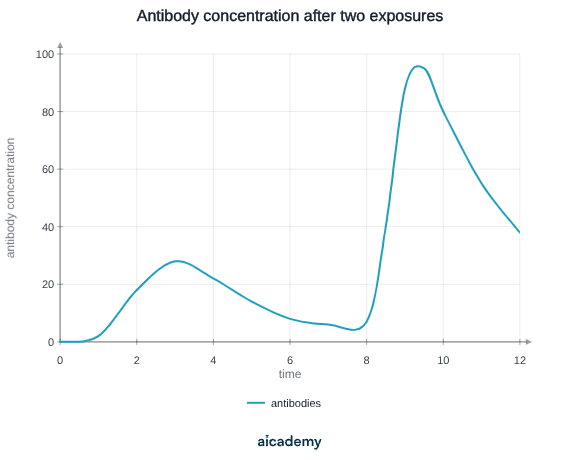
The first exposure gives a slow, low peak; the second exposure to the same antigen gives a fast, much higher peak.

Reading the graph, step by step:

  1. After the first exposure, antibody concentration rises slowly and reaches a low peak. This is the primary response — white blood cells are meeting the antigen for the first time, so there is a delay before antibodies appear. The level then falls.
  2. After the second exposure to the same antigen, antibody concentration rises much faster and reaches a much higher peak. This is the secondary response.

Why no illness occurs the second time: the memory created by the first exposure means the correct antibodies are produced so quickly and in such a large quantity that the pathogen is destroyed before it can reproduce enough to cause symptoms. The person is immune.

Exam tip: if asked to compare the two responses, mention both axes — the second response is faster (time axis) and higher (concentration axis).

Worth saving these ideas?

Turn what you've read into instant revision cards. Free to get started.

Make flashcards

Herd Immunity: Protecting the Whole Population

Vaccination protects more than the individual. If a large proportion of the population is immune, the spread of a pathogen through that population is much reduced. This is called herd immunity.

The logic is about transmission. A pathogen spreads by passing from an infected person to a susceptible one. If most people are immune, an infected person is surrounded mainly by people who cannot catch and pass on the pathogen. The chain of transmission keeps breaking, so outbreaks fizzle out.

Herd immunity: when a large enough proportion of a population is immune (usually through vaccination) that a pathogen can no longer spread easily, protecting even those who are not immune.

Walk-through — how herd immunity protects unvaccinated people:

  1. Some people cannot be vaccinated — for example, newborn babies or people with weakened immune systems.
  2. If most of the people around them are vaccinated and immune, the pathogen has very few susceptible hosts to infect.
  3. With so few people able to catch and pass it on, the pathogen struggles to reach the unvaccinated person at all.
  4. The unvaccinated person is therefore protected indirectly — not because they are immune, but because the pathogen cannot travel through the immune population to reach them.

This is why high vaccination rates matter for a community, not just for each person who is vaccinated. As more people are immunised, the protection extends to vulnerable people who cannot be vaccinated themselves.

Advantages and Disadvantages of Vaccination

AQA asks you to evaluate the global use of vaccination in preventing disease, which means weighing benefits against drawbacks factually.

AdvantagesDisadvantages
Vaccines control communicable diseases that were once common and deadlyVaccines do not give protection in every person who is vaccinated
Widespread vaccination produces herd immunity, protecting those who cannot be vaccinatedA person can have a bad reaction to a vaccine (such reactions are rare)
Smallpox has been eradicated worldwide through vaccinationIf too few people are vaccinated, herd immunity is lost and outbreaks return
Preventing disease is often cheaper than treating itSome people choose not to vaccinate, which can lower overall coverage

The benefits are substantial: vaccination has dramatically reduced — and in the case of smallpox, eliminated — diseases that previously killed huge numbers of people. Herd immunity extends that protection to the most vulnerable.

The drawbacks are real but should be stated proportionately. Vaccines are not effective in absolutely everyone, and bad reactions can occur, though they are rare. The biggest population-level risk is low uptake: if too few people are vaccinated, herd immunity breaks down and a disease that was under control can spread again.

Exam tip: an "evaluate" answer needs both sides and a supported judgement. State advantages, state disadvantages, then conclude — for example, that the large reduction in disease generally outweighs the rare risks.

(Extra context — not required by AQA 8461.) AQA states you do not need to know details of specific vaccination schedules or the side effects of named vaccines. Keep evaluation answers to the general points above.

Common Exam Mistakes

1. Saying the vaccine gives you the disease

A vaccine contains a dead or inactive pathogen. There is no live pathogen multiplying inside you, so it cannot give you the disease — it only carries the antigens needed to train the immune system.

2. Describing antibodies as something the vaccine contains

The vaccine does not contain antibodies. It contains the antigen (on a dead or inactive pathogen). Your own white blood cells then produce the antibodies in response.

3. Leaving "memory" out of the explanation

The reason the second response is so fast is that the immune system retains memory of the antigen after the first exposure. Without mentioning memory, an answer cannot explain why the secondary response is quicker and larger.

4. Describing the secondary response with only one feature

The secondary response is both faster and larger — antibodies are produced more quickly and in greater quantity. State both to gain full credit.

5. Confusing herd immunity with individual immunity

Vaccination makes the individual immune. Herd immunity is the population-level effect: when enough people are immune, the pathogen cannot spread, protecting even those who are not vaccinated.

6. Giving a one-sided answer to "evaluate"

"Evaluate" requires both advantages and disadvantages plus a judgement. Listing only the benefits, or only the risks, does not meet the command word.

Key terms

Vaccine
A preparation containing dead or inactive forms of a pathogen, or its antigens, that stimulates the immune system to produce antibodies and give protection against future infection.
Antigen
A marker molecule on the surface of a pathogen that the immune system recognises as foreign.
Antibody
A protein produced by white blood cells that locks onto a specific antigen; each type is specific to one antigen.
Primary response
The body's slow, low-level production of antibodies the first time it meets an antigen.
Secondary response
The body's fast, high-level production of antibodies on re-exposure to an antigen, made possible by retained memory.
Herd immunity
When a large enough proportion of a population is immune that a pathogen can no longer spread easily, protecting even those who are not immune.

Frequently asked questions

No. A vaccine contains a dead or inactive form of the pathogen, so there is no live pathogen multiplying inside you. It only carries the antigens needed to train your immune system to produce antibodies, so it cannot give you the disease.

After the first exposure the immune system retains memory of the antigen, so the correct white blood cells are already primed. On re-infection they respond faster and produce a larger quantity of antibodies, destroying the pathogen before it causes symptoms.

Herd immunity is when a large enough proportion of a population is immune, usually through vaccination, that a pathogen can no longer spread easily. This protects vulnerable people who cannot be vaccinated, such as newborn babies or those with weakened immune systems.

Generate revision on any topic you study

Type any topic you're studying and Aicademy generates a complete lesson, quiz, and flashcard set, personalised to your level.

Lessons on anything

Structured, level-matched lessons on any topic you study

Practice quizzes

Find out what you actually know before the exam does

Flashcard sets

Lock in key concepts with instant revision cards

Ask Aica

Stuck on something? Get a clear explanation, any time

Prev

Human Defence Systems and the Immune System

Next

Antibiotics, Painkillers and Drug Development

Related lessons

11 min

Lesson

Monoclonal Antibodies

AQA GCSE Biology · AQA 8461

1 month ago

Top students don’t revise more. They revise what counts.

Start revising free

Free to start. No card needed.