Photosynthesis and Uses of Glucose

Aligned to the AQA 8461 specification
- Topic
- Bioenergetics
- Level
- Intermediate
- Reading time
- 9 min
- Published
- 16 June 2026
- Updated
- 25 August 2026
On this page
Key takeaways
- Photosynthesis converts carbon dioxide and water into glucose using light energy, releasing oxygen as a by-product: carbon dioxide + water → glucose + oxygen.
- Photosynthesis is endothermic: energy is transferred from the environment to the chloroplasts by light, which is why plants do not photosynthesise in the dark.
- Photosynthesis happens in the chloroplasts, where the green pigment chlorophyll absorbs the light energy that drives the reaction.
- Glucose is used in respiration and converted to insoluble starch (storage), fats or oils, cellulose for cell walls, and amino acids; storing insoluble starch avoids drawing in water by osmosis.
- To make amino acids and therefore proteins, the plant combines glucose with nitrate ions absorbed from the soil, which supply the nitrogen glucose lacks.
Where Photosynthesis Happens
Photosynthesis takes place in the chloroplasts — small structures found mainly in the cells of the leaf.
Chloroplasts contain a green pigment called chlorophyll. Chlorophyll absorbs light energy and makes that energy available to drive the reaction. The green colour of leaves comes directly from chlorophyll.
Most photosynthesis happens in the palisade mesophyll cells near the top of the leaf, because they are packed with chloroplasts and sit where light reaches first.
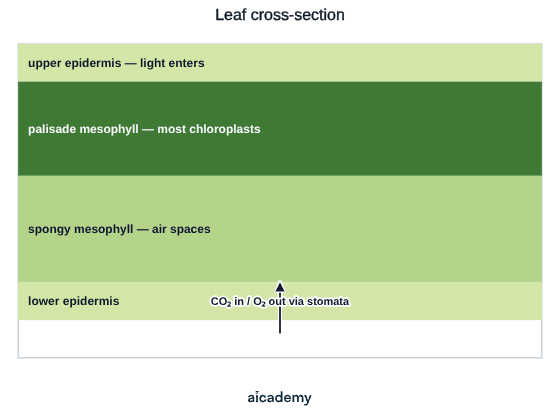
Because the reaction depends on light reaching chlorophyll, leaves are broad and thin — a large surface area to capture as much light as possible.
Studying this for an exam?
Generate a personalised learning path for this subject. Free to get started.
Making Proteins Needs Nitrate Ions
Glucose contains only carbon, hydrogen and oxygen — but proteins also contain nitrogen. So glucose alone is not enough to build proteins.
To make amino acids (which join together to form proteins), the plant combines glucose with nitrate ions absorbed from the soil. The nitrate ions supply the nitrogen that glucose cannot.
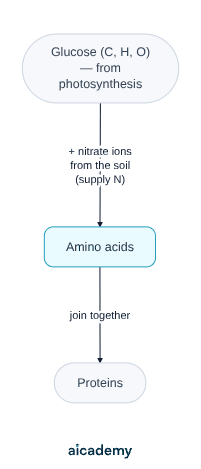
Worked example — why a plant short of nitrate grows poorly. Proteins are needed for growth, for enzymes, and for repairing tissues. If the soil is low in nitrate ions, the plant cannot make enough amino acids, so it cannot make enough protein. The result is stunted growth and often yellowing older leaves — which is why farmers add nitrate-containing fertilisers to crops.
Glucose → amino acids needs nitrate ions from the soil. If an exam question asks what extra substance a plant needs to make protein, the answer is nitrate ions (a source of nitrogen).
(Extra context — not required by AQA 8461.) The nitrogen in nitrate ions originally enters the soil through the nitrogen cycle, including nitrogen-fixing bacteria, but you are not assessed on that mechanism here.
Key terms
- Photosynthesis
- The process by which plants use light energy to convert carbon dioxide and water into glucose, releasing oxygen as a by-product.
- Chloroplast
- The structure, found mainly in leaf cells, where photosynthesis takes place; it contains chlorophyll.
- Chlorophyll
- The green pigment in chloroplasts that absorbs light energy and makes it available to drive photosynthesis.
- Endothermic
- A reaction that transfers energy in from the surroundings; photosynthesis is endothermic because energy is transferred from the environment to the chloroplasts by light.
- Starch
- An insoluble store of glucose made by the plant; being insoluble, it can be stored in large amounts without drawing water into the cell by osmosis.
- Cellulose
- A substance made from glucose that strengthens plant cell walls, giving the plant structure.
- Amino acids
- Building blocks for proteins, made by the plant from glucose combined with nitrate ions from the soil.
- Nitrate ions
- Ions absorbed from the soil that supply the nitrogen a plant needs to turn glucose into amino acids and proteins.
Frequently asked questions
Photosynthesis is endothermic: it takes energy in from the surroundings, transferred from the environment to the chloroplasts by light. Although it stores energy in glucose, it must first take energy in, so it is endothermic, not exothermic. Respiration is the exothermic process.
Glucose is used in respiration to release energy, and converted into insoluble starch for storage, fats or oils as an energy store, cellulose to strengthen cell walls, and amino acids to make proteins (which also needs nitrate ions from the soil).
Plants need nitrate ions from the soil to make amino acids and therefore proteins. Glucose contains only carbon, hydrogen and oxygen, but proteins also contain nitrogen, so the nitrate ions supply the nitrogen that glucose cannot.
Generate revision on any topic you study
Type any topic you're studying and Aicademy generates a complete lesson, quiz, and flashcard set, personalised to your level.
Lessons on anything
Structured, level-matched lessons on any topic you study
Practice quizzes
Find out what you actually know before the exam does
Flashcard sets
Lock in key concepts with instant revision cards
Ask Aica
Stuck on something? Get a clear explanation, any time
Antibiotics, Painkillers and Drug Development
Rate of Photosynthesis and Limiting Factors
Related lessons
12 min
9 min
14 min