Vaccination and Herd Immunity

Aligned to the AQA 8461 specification
- Level
- Intermediate
- Reading time
- 11 min
- Published
- 16 June 2026
- Updated
- 16 August 2026
On this page
Key takeaways
- A vaccine works by introducing small quantities of a dead or inactive form of a pathogen that carries the same antigens as the live version, stimulating white blood cells to produce antibodies.
- A vaccine does not give you the disease, because it contains no live pathogen multiplying inside you, only the antigens needed to train the immune system.
- After vaccination the immune system retains memory of the antigen, so on re-infection the secondary response produces antibodies faster and in greater quantity, destroying the pathogen before illness develops.
- Herd immunity occurs when a large proportion of a population is immune, reducing the spread of a pathogen and protecting even those who cannot be vaccinated.
- Vaccination has controlled many deadly communicable diseases and eradicated smallpox, but it does not protect everyone, can rarely cause a bad reaction, and low uptake can let outbreaks return.
How a Vaccine Produces Immunity
A vaccine triggers the same white blood cell response as a real infection, but safely. The dead or inactive pathogen carries antigens, so the white blood cells treat it as a genuine threat and learn to fight it.
Here is the sequence, step by step:
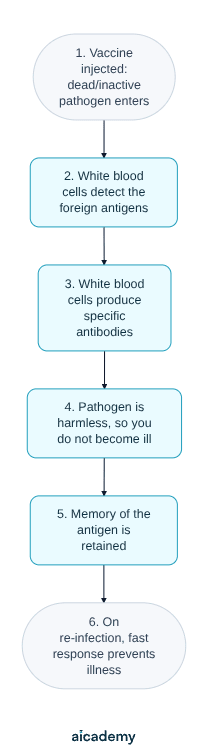
The key product of this process is memory. After vaccination, the body keeps a record of that specific antigen. This is what makes the response to a real infection so much faster the second time around.
Remember the chain: antigen recognised → antibodies produced → memory retained → rapid response on re-infection. Every mark in a "how does vaccination work" question maps onto one of these stages.
The antibodies a white blood cell makes are specific — each type locks onto only one antigen, the way a key fits one lock. That is why memory of a particular antigen only protects against that particular pathogen.
Walk-Through: Reading an Antibody Response Graph
A common exam question gives a graph of antibody concentration in the blood over time, with two exposures to the same antigen. You must interpret it and explain why no illness occurs the second time.
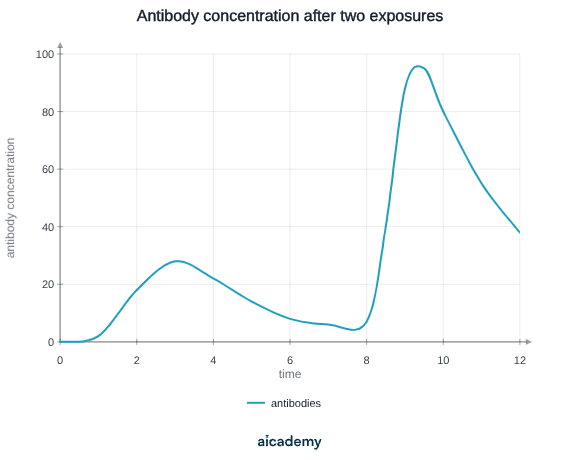
The first exposure gives a slow, low peak; the second exposure to the same antigen gives a fast, much higher peak.
Reading the graph, step by step:
- After the first exposure, antibody concentration rises slowly and reaches a low peak. This is the primary response — white blood cells are meeting the antigen for the first time, so there is a delay before antibodies appear. The level then falls.
- After the second exposure to the same antigen, antibody concentration rises much faster and reaches a much higher peak. This is the secondary response.
Why no illness occurs the second time: the memory created by the first exposure means the correct antibodies are produced so quickly and in such a large quantity that the pathogen is destroyed before it can reproduce enough to cause symptoms. The person is immune.
Exam tip: if asked to compare the two responses, mention both axes — the second response is faster (time axis) and higher (concentration axis).
Worth saving these ideas?
Turn what you've read into instant revision cards. Free to get started.
Key terms
- Vaccine
- A preparation containing dead or inactive forms of a pathogen, or its antigens, that stimulates the immune system to produce antibodies and give protection against future infection.
- Antigen
- A marker molecule on the surface of a pathogen that the immune system recognises as foreign.
- Antibody
- A protein produced by white blood cells that locks onto a specific antigen; each type is specific to one antigen.
- Primary response
- The body's slow, low-level production of antibodies the first time it meets an antigen.
- Secondary response
- The body's fast, high-level production of antibodies on re-exposure to an antigen, made possible by retained memory.
- Herd immunity
- When a large enough proportion of a population is immune that a pathogen can no longer spread easily, protecting even those who are not immune.
Frequently asked questions
No. A vaccine contains a dead or inactive form of the pathogen, so there is no live pathogen multiplying inside you. It only carries the antigens needed to train your immune system to produce antibodies, so it cannot give you the disease.
After the first exposure the immune system retains memory of the antigen, so the correct white blood cells are already primed. On re-infection they respond faster and produce a larger quantity of antibodies, destroying the pathogen before it causes symptoms.
Herd immunity is when a large enough proportion of a population is immune, usually through vaccination, that a pathogen can no longer spread easily. This protects vulnerable people who cannot be vaccinated, such as newborn babies or those with weakened immune systems.
Generate revision on any topic you study
Type any topic you're studying and Aicademy generates a complete lesson, quiz, and flashcard set, personalised to your level.
Lessons on anything
Structured, level-matched lessons on any topic you study
Practice quizzes
Find out what you actually know before the exam does
Flashcard sets
Lock in key concepts with instant revision cards
Ask Aica
Stuck on something? Get a clear explanation, any time
Human Defence Systems and the Immune System
Antibiotics, Painkillers and Drug Development
Related lessons
12 min
12 min
12 min