Track progress, take quizzes and save notes on this lesson.

Free forever · no card needed

Start free
Intermediate

Antibiotic-Resistant Bacteria

4.6.3.7 Resistant bacteria

Aligned to the AQA 8461 specification

Level
Intermediate
Reading time
10 min
Published
16 June 2026
Updated
1 July 2026
On this page
  1. 1.Why Bacteria Evolve So Fast
  2. 2.How a Resistant Strain Arises by Mutation
  3. 3.Natural Selection: How the Resistant Strain Takes Over
  4. 4.Why a Resistant Strain Spreads Through a Population
  5. 5.How to Reduce the Rate of Resistance
  6. 6.The Race Against New Antibiotics
  7. 7.Common Exam Mistakes

Key takeaways

  • Bacteria evolve resistance rapidly because they reproduce very fast, dividing roughly every 20 minutes, which produces huge numbers of cells and many chances for mutations to occur.
  • The resistance mutation arises by chance before the antibiotic is used; the antibiotic does not create resistance, it only selects the resistant bacteria already present by killing the non-resistant ones.
  • A resistant strain takes over by natural selection: variation, then selection pressure (antibiotic given), then survival, reproduction and a new resistant population.
  • MRSA (Methicillin-Resistant Staphylococcus aureus) is the named example: a resistant strain of an existing species produced by mutation, not a new species.
  • Resistance can be slowed by not prescribing antibiotics inappropriately, completing the full course so no bacteria survive to mutate, and restricting agricultural use; new antibiotics are slow and costly to develop and unlikely to keep pace.

Why Bacteria Evolve So Fast

Antibiotics are drugs that kill bacteria inside the body. But some bacteria are no longer killed by the antibiotics that used to work — they are antibiotic-resistant. Understanding how this happens is one of the clearest real-world examples of natural selection on the AQA spec.

Bacteria can evolve rapidly, and the reason is simple: they reproduce at a very fast rate. A single bacterium divides in two by binary fission, and under good conditions that can happen roughly every 20 minutes.

TimeNumber of bacteria
Start1
20 min2
40 min4
60 min8
2 hours64
4 hours~4,000
8 hours~16 million

Each time a bacterium copies its DNA to divide, there is a chance of a copying error — a mutation. Because the population doubles so often, billions of new bacteria are produced quickly, and that means a huge number of chances for mutations to appear.

Key idea: fast reproduction means fast evolution. Each cell division is a fresh opportunity for a useful mutation to arise by chance.

How a Resistant Strain Arises by Mutation

A mutation is a random change in a bacterium's DNA. Most mutations have no useful effect, but occasionally a mutation changes a bacterium so that an antibiotic can no longer kill it. This produces a new strain — a variety of the same species with a slightly different set of genes.

The single most important point in this whole topic is when the mutation happens:

The resistance mutation arises by chance BEFORE the antibiotic is used. The antibiotic does not create resistance — it only reveals and selects the resistant bacteria that were already there.

This is the classic trap. Antibiotics do not teach or force bacteria to become resistant. The mutation is random and would have happened anyway. What the antibiotic does is act as the selection pressure: it kills the non-resistant bacteria and leaves the resistant ones behind to reproduce.

Worked walk-through — where the mutation comes from:

  1. A population of bacteria is reproducing. By chance, one bacterium's DNA mutates so it is resistant to antibiotic X.
  2. At this point the antibiotic has not been used. The resistant bacterium is just one cell among millions — it has no special advantage yet.
  3. The mutation happened randomly during DNA copying. It was not caused by, and did not need, the antibiotic to exist.

Get this order right and the rest of the topic follows logically.

Natural Selection: How the Resistant Strain Takes Over

Once a resistant bacterium exists, natural selection does the rest. Natural selection is the process where organisms best suited to their environment survive, reproduce, and pass on their genes.

Here is the full sequence as it would be marked in an exam — keep it in this exact order:
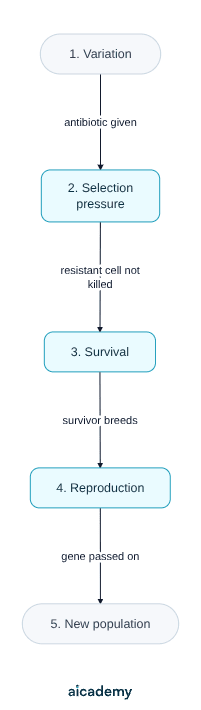
The detail behind each stage, in the exact order an examiner expects:

  1. Variation. A population of bacteria contains genetic variation. By chance, a mutation makes one bacterium resistant to the antibiotic. This happens before the drug is used.
  2. Selection pressure. The antibiotic is used. It kills the non-resistant bacteria. The resistant bacterium is not killed.
  3. Survival. The resistant bacterium survives while its competitors die off.
  4. Reproduction. The survivor reproduces rapidly, passing the resistance gene to its offspring.
  5. New population. Over time the whole population becomes resistant. The resistant strain has risen by natural selection.

Worked walk-through — MRSA as the spec example:

MRSA (Methicillin-Resistant Staphylococcus aureus) is the named example you must know. Staphylococcus aureus is a common bacterium; MRSA is a strain of it that is resistant to antibiotics, including methicillin.

  1. In a population of S. aureus, a chance mutation produces a cell resistant to the antibiotic.
  2. A patient is treated with that antibiotic. The non-resistant S. aureus are killed; the resistant ones survive.
  3. The surviving resistant bacteria reproduce, so the proportion of resistant cells rises.
  4. Eventually the antibiotic no longer works against the infection — the resistant MRSA strain has spread.

Exam tip: describe it as survive → reproduce → pass on the gene → population becomes resistant. Do not write that bacteria "want to" or "try to" become resistant — that is the Lamarckian error and loses marks.

Why a Resistant Strain Spreads Through a Population

Once a resistant strain exists, it can spread between people, and this is hard to stop for two specific reasons stated by the spec.

Reason it spreadsWhy this matters
People are not immune to the new strainA new strain is different enough that the population has no existing immunity, so people catch it easily.
There is no effective treatmentThe antibiotics that would normally cure the infection no longer kill the resistant bacteria, so the infection is not stopped.

This combination is what makes resistant strains such as MRSA dangerous, especially in hospitals where many vulnerable patients are close together and antibiotics are used heavily.

(Extra context — not required by AQA 8461.) Resistance genes can also be passed directly between living bacteria on small rings of DNA, not only from parent to offspring. AQA only expects the natural-selection mechanism, so for the exam stick to survive-and-reproduce.

The key exam point: a resistant strain spreads because the population is not immune to it and there is no effective treatment to stop it.

Studying this for an exam?

Generate a personalised learning path for this subject. Free to get started.

Create a learning path

How to Reduce the Rate of Resistance

We cannot stop mutations happening, but we can slow down how fast resistant strains develop. The spec lists three measures. Learn each one with the reason it works — exam questions usually ask you to explain, not just list.

MeasureWhy it slows resistance
Doctors should not prescribe antibiotics inappropriately (e.g. for viral or non-serious infections)Antibiotics do not kill viruses, so prescribing them for a cold is pointless. Every unnecessary use is another chance to select for resistant bacteria, so reducing use reduces that selection pressure.
Patients should complete the full course of antibioticsThis ensures all the target bacteria are killed and none survive to mutate and form resistant strains.
The agricultural use of antibiotics should be restrictedGiving antibiotics to farm animals routinely selects for resistant bacteria in the animals, which can then reach humans. Limiting this reduces the overall selection pressure.

Worked walk-through — why finishing the course matters:

  1. You start a 7-day course of antibiotics. By day 3 you feel better because most of the bacteria are dead.
  2. But the bacteria still alive on day 3 are the toughest ones — the slowest to be killed.
  3. If you stop now, those tougher survivors are left to reproduce. They are the most likely to mutate or carry partial resistance.
  4. If you finish the course, the antibiotic stays at a high enough level long enough to kill all the bacteria — so none survive to mutate into a resistant strain.

Memorise: complete the course → all bacteria killed → none survive to mutate → no resistant strain forms.

The Race Against New Antibiotics

You might think the answer is just to keep inventing new antibiotics. The problem is that developing new antibiotics is costly and slow.

A new drug must be discovered, tested for safety, trialled on patients, and approved — a process that can take well over a decade and cost a very large amount of money. Meanwhile, bacteria reproduce every 20 minutes and produce new mutations constantly.

ProcessTimescaleSpeed
Bacteria evolving resistanceminutes to daysvery fast
Developing a new antibiotic10+ yearsvery slow

Because of this mismatch in speed, the development of new antibiotics is unlikely to keep up with the emergence of new resistant strains. This is exactly why prevention — using existing antibiotics responsibly — matters so much. We are trying to slow resistance down because we cannot rely on replacing antibiotics fast enough.

Key takeaway: new antibiotics are slow and expensive to develop, so they are unlikely to keep pace with fast-evolving bacteria. Reducing resistance is more reliable than out-inventing it.

Common Exam Mistakes

1. Saying the antibiotic causes or creates the resistance

The mutation that makes a bacterium resistant happens by chance, before the antibiotic is used. The antibiotic only selects the bacteria that are already resistant — it does not create resistance. Writing that bacteria "become resistant because of the antibiotic" describes a Lamarckian process and loses marks.

2. Using "want to", "try to" or "need to"

Bacteria do not choose to become resistant or adapt on purpose. Always describe it as a passive process: a random mutation occurs, and those that happen to be resistant survive and reproduce.

3. Forgetting that bacteria evolve fast because they reproduce fast

The starting point of the whole explanation is the fast reproduction rate. This produces large numbers of bacteria quickly, giving many chances for mutations. Marks are often available for this point alone.

4. Confusing "strain" with "species"

A resistant strain (like MRSA) is a variety of an existing species (Staphylococcus aureus) produced by mutation — not a brand-new species.

5. Listing the prevention measures without explaining them

"Finish your antibiotics" on its own is weak. The reason — so all bacteria are killed and none survive to mutate — is usually where the mark is.

6. Saying we should just make more antibiotics

Developing new antibiotics is slow and costly, so it is unlikely to keep up with new resistant strains. This is why responsible use, not constant replacement, is the main strategy.

Key terms

Antibiotic
A drug that kills bacteria inside the body.
Antibiotic-resistant bacteria
Bacteria that are no longer killed by an antibiotic that used to work against them.
Mutation
A random change in a bacterium's DNA, which can occur as a copying error when the cell divides.
Strain
A variety of an existing species with a slightly different set of genes, produced by mutation.
Natural selection
The process where organisms best suited to their environment survive, reproduce and pass on their genes.
Selection pressure
A factor, such as an antibiotic, that kills the non-resistant individuals and leaves the resistant ones to reproduce.
MRSA
Methicillin-Resistant Staphylococcus aureus, a strain of S. aureus that is resistant to antibiotics including methicillin.

Frequently asked questions

A random mutation in a bacterium's DNA happens by chance before the antibiotic is used and makes that bacterium resistant. When the antibiotic is given it kills the non-resistant bacteria but not the resistant one, which survives, reproduces and passes on the resistance gene until the whole population is resistant.

Completing the full course ensures all the target bacteria are killed and none survive to mutate into a resistant strain. The bacteria still alive partway through are the toughest ones, so stopping early leaves those survivors to reproduce.

Developing a new antibiotic is costly and slow, taking well over a decade, while bacteria reproduce every 20 minutes and mutate constantly. Because of this mismatch, new antibiotics are unlikely to keep up with new resistant strains, so using existing ones responsibly matters more.

Generate revision on any topic you study

Type any topic you're studying and Aicademy generates a complete lesson, quiz, and flashcard set, personalised to your level.

Lessons on anything

Structured, level-matched lessons on any topic you study

Practice quizzes

Find out what you actually know before the exam does

Flashcard sets

Lock in key concepts with instant revision cards

Ask Aica

Stuck on something? Get a clear explanation, any time

Prev

Evidence for Evolution: Fossils and Extinction

Next

Classification of Living Organisms

Related lessons

Top students don’t revise more. They revise what counts.

Start revising free

Free to start. No card needed.