Monoclonal Antibodies

Aligned to the AQA 8461 specification
- Level
- Advanced
- Reading time
- 12 min
- Published
- 16 June 2026
- Updated
- 16 August 2026
On this page
- 1.What Makes an Antibody "Monoclonal"
- 2.The Problem: Why You Cannot Just Grow Antibodies
- 3.How Monoclonal Antibodies Are Produced
- 4.Why a Tumour Cell? The Key Reasoning
- 5.Uses of Monoclonal Antibodies
- 6.Worked Example: How a Pregnancy Test Works
- 7.Treating Cancer, and Why Hopes Were Not Met
- 8.Common Exam Mistakes
Key takeaways
- A monoclonal antibody is produced from a single clone of identical cells, so every molecule is identical and binds to one specific antigen.
- A hybridoma is a lymphocyte fused with a tumour cell; the lymphocyte makes the antibody while the tumour cell divides indefinitely, giving a cell that does both.
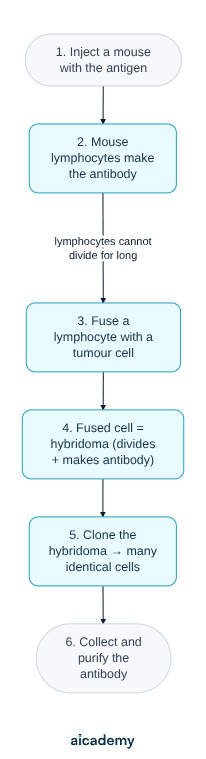
- Production: inject a mouse with the antigen, take its lymphocytes, fuse them with tumour cells to form hybridomas, clone the hybridomas, then collect and purify the antibody.
- Monoclonal antibodies are used in diagnosis (pregnancy tests), measuring and detecting chemicals and pathogens, research using fluorescent dyes, and targeted cancer treatment.
- In cancer treatment the antibody delivers a radioactive substance, toxic drug or growth-stopping chemical to cancer cells, but they cause more side effects than expected so are less widely used than hoped.
How Monoclonal Antibodies Are Produced
The production process turns one antibody-making lymphocyte into a factory that produces a single antibody in bulk. Follow the flow from the mouse to the purified antibody:
Each step has a job. Walk through the logic rather than memorising words:
- Stimulate the mouse. The mouse is injected with the antigen so its lymphocytes are stimulated to make the specific antibody against it.
- Take the lymphocytes. These are the only cells that make the exact antibody required — but on their own they will not keep dividing.
- Fuse with a tumour cell. A lymphocyte is combined with a particular kind of tumour cell.
- The hybridoma forms. The hybridoma cell both divides quickly and makes the antibody — it has inherited one useful property from each parent cell.
- Clone the hybridoma. Single hybridoma cells are cloned to produce many identical cells that all make the same antibody.
- Collect and purify. Because the cloned cells divide so fast, a large amount of the antibody can be collected and purified.
Exam phrasing: lymphocytes are stimulated to make the antibody, they are combined with a tumour cell to form a hybridoma, the hybridoma is cloned, and the antibody is collected and purified. Use those verbs in order.
How much of this have you taken in?
Quiz yourself on this section, free, no card needed.
Worked Example: How a Pregnancy Test Works
A home pregnancy test is the classic application — and a favourite exam context. It detects the hormone hCG (human chorionic gonadotropin), which is present in the urine of a pregnant person.
(Extra context — the hormone's name, hCG, is not required by AQA 8461. The spec only needs you to explain how the test uses monoclonal antibodies, given that a pregnancy hormone is present.)
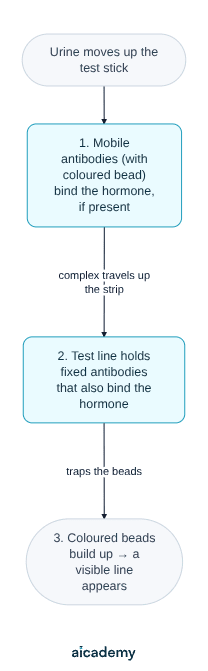
Walk through what happens, applying the binding rule at each step:
Reasoning through the two outcomes:
- Pregnant: the urine contains the hormone. The hormone binds the mobile antibodies, the complex is then caught by the fixed antibodies at the test line, the colour concentrates there, and a line appears — a positive result.
- Not pregnant: no hormone is present, so nothing is trapped at the test line and no line appears.
The exam point is the specificity: the test works only because the monoclonal antibodies bind to that one specific hormone and ignore everything else in the urine. If asked to explain a result, name the antibody–hormone binding as the cause of the colour change.
Key terms
- Monoclonal antibody
- An antibody produced from a single clone of identical cells, so every molecule is identical and binds to one specific antigen.
- Antibody
- A protein made by white blood cells that binds to one specific antigen.
- Antigen
- A molecule, usually a protein, on the surface of a cell or pathogen that the immune system recognises.
- Lymphocyte
- The white blood cell that makes a chosen antibody but does not divide well outside the body.
- Tumour cell
- A cell that divides rapidly and indefinitely but does not make the required antibody.
- Hybridoma
- A cell formed by fusing a lymphocyte with a tumour cell, which both divides quickly and makes the specific antibody.
- Clone
- A group of genetically identical cells.
Frequently asked questions
A hybridoma is a lymphocyte fused with a tumour cell. The lymphocyte makes the required antibody but cannot divide many times in culture, while the tumour cell divides rapidly and indefinitely, so the hybridoma both divides quickly and makes the antibody, allowing large amounts to be produced.
If the pregnancy hormone is present in the urine it binds mobile antibodies carrying a coloured bead, the complex travels up the strip, and fixed antibodies at the test line also bind the hormone, concentrating the colour into a visible line. The test works only because the antibodies bind that one specific hormone.
Although they can target one specific cell or chemical while sparing healthy tissue, monoclonal antibodies create more side effects than expected. For that reason they are not yet as widely used as everyone had hoped when they were first developed.
Generate revision on any topic you study
Type any topic you're studying and Aicademy generates a complete lesson, quiz, and flashcard set, personalised to your level.
Lessons on anything
Structured, level-matched lessons on any topic you study
Practice quizzes
Find out what you actually know before the exam does
Flashcard sets
Lock in key concepts with instant revision cards
Ask Aica
Stuck on something? Get a clear explanation, any time
Antibiotics, Painkillers and Drug Development
Plant Diseases and Defences
Related lessons
12 min
12 min
10 min